

Why The US Navy Never Flew The F-15 Eagle
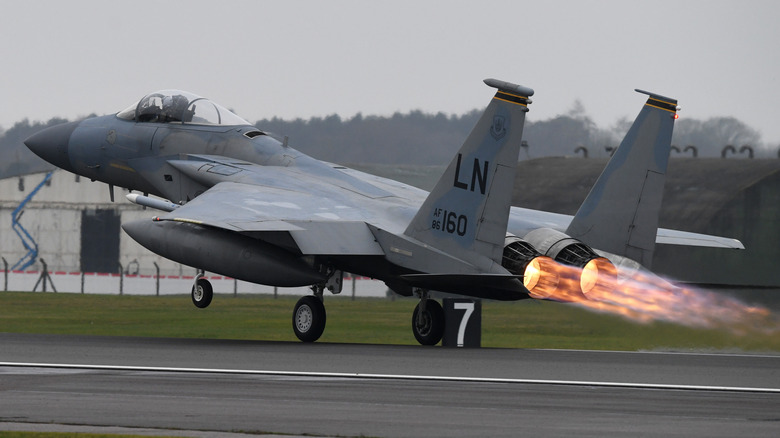
Since the F-15 Eagle first flew in the early '70s, the jet has been at the center of the USAF's plans, even with the introduction of fifth-generation upstarts like the ultra-advanced F-35 Lightning II. Now aged over fifty years, the F-15 should probably be looking forward to retirement, but no. Instead, the jet's importance to the USAF is such that it's likely to remain in service until the 2040s at least.
This raises an interesting point. If the F-15 Eagle has been such a successful fighter for the USAF, why didn't the Navy get in on the act and use the fighter on its aircraft carriers? This is not as unlikely a scenario as it might sound; there was a time when the prospect of a naval F-15N Sea Eagle flying the flag from American carriers was a very real one.
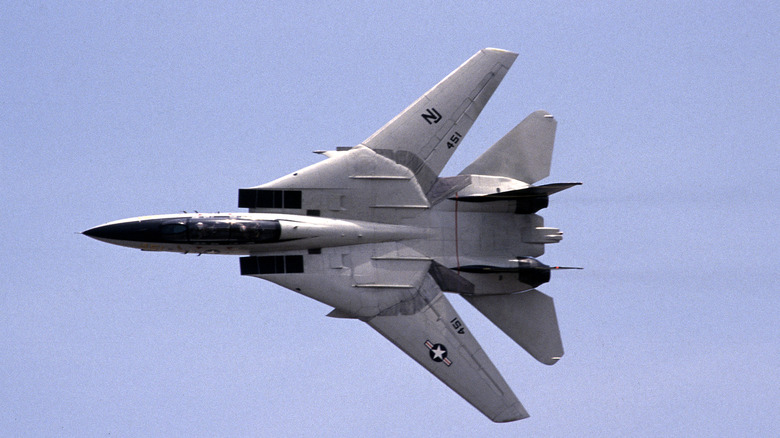
Ultimately, the Navy opted for another '70s fighter, the F-14 Tomcat, which became a mainstay of Naval aviation before it was retired in 2006. On the face of it, the Navy's decision to opt for the Tomcat instead of the F-15 Eagle seems strange, especially as the Eagle was a substantially cheaper option than the Grumman-built F-14 Tomcat. However, adapting the F-15 for sea operations wasn't as simple as attaching an arrestor hook. Instead, the required modifications to the airframe would have resulted in a much heavier aircraft that was not as compelling as the Tomcat.
Why the F-15N Sea Eagle experiment never took off
In the early '70s, McDonnell Douglas actively pitched a carrier-capable version of the F-15. Known as the F-15N Sea Eagle, it was proposed as the replacement for the Navy's F-4 Phantom, which was being retired due to design flaws.
The project had potential, at least on paper, and for a while, it looked like the F-15 might indeed join the Navy. The Eagle's impressive thrust-to-weight ratio and design attributes suggested it could be faster and more agile than the F-14 Tomcat. The F-15 also came in at $28 million (in 1998 dollars), $10 million less than the F-14's price tag. But it wasn't to be.
Put simply, naval aviation places far greater strain on airframes than land-based use, and adapting the F-15 would have required major structural changes. Such changes included reinforcing the landing gear, adding the arrestor hook mechanism, and kitting the jet out with folding wings. This is the crux of the matter: the additional weight of these components made the F-15 a less appealing option, adding an estimated 3,000 pounds to the aircraft's weight.
If this were the only issue, then we may still have seen the F-15N Sea Eagle soar from the decks of U.S. carriers. But, unfortunately, it wasn't the only stumbling block preventing the F-15 from getting its sea legs.
It wasn't the wrong fighter; it was the wrong mission
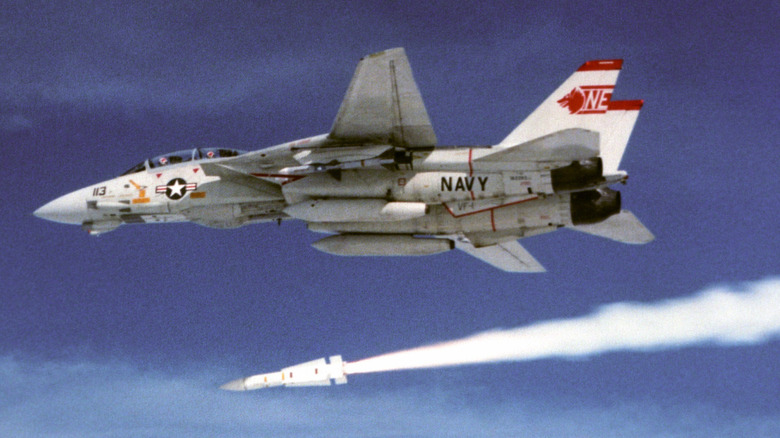
Even if the F-15 could have been easily adapted for carrier operations, other issues proved harder to overcome. The Army and Navy also had differing requirements, with the latter needing an aircraft capable of defending against Soviet bombers and anti-ship missiles. This meant that it needed to be able to launch large air-to-air missiles.
To address this, the design team looked at adapting the F-15 to carry and fire the long-range AIM-54 Phoenix missile. However, the missile and its associated hardware would have added about 10,000 pounds to the aircraft compared to a standard F-15A. All this weight would have meant that the jet would have been more like a waddling duck than a streamlined sea eagle.
Ultimately, there were too many hurdles — both technical and political – for the project to move ahead. However, one offshoot of the discussions was the formation of a new study group to help steer the direction of Naval aviation. This group was eventually responsible for the next generation of Naval fighter jets, namely the F/A-18 Super Hornet, one of the best fighters ever built by Boeing. So, while a flight deck full of F-15s would have been a sight to see, history had other ideas. In the end, though, both services received planes that went on to have long, successful careers.