

China Has A Way To Keep Drones Flying Longer, And The Method May Surprise You
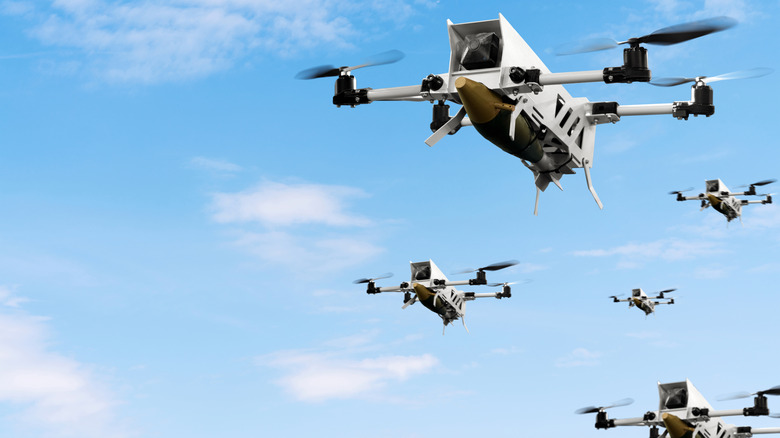
Sending power through the air is one of those unicorn projects that feels like it would be magical, if only someone could get it to work. It's such a unicorn that multiple groups are pursuing that very thing, and of course, more than a few of them are devoted to making weapons of war work better. All cynicism aside, that's where we find ourselves today.
A team of Chinese researchers built a drone and a ground vehicle that can keep it aloft for just over three hours at an altitude of around 15 meters. The ground vehicle uses microwave transmitters to wirelessly beam power to the drone, even when both of them are moving. That's ironic, since China has also used similar tech to knock drones out of the air. The idea is that the armored ground vehicle can deploy the drone and feed it power to keep it aloft for longer missions related to surveillance and strike missions. Drones, like those in Ukraine, are becoming more commonplace on the battlefield.
As you may have guessed, the hardest part is coordinating the position of the microwave transmission while both vehicles are moving. The team relied primarily on GPS signals, real-time position tracking, and on-board controls to keep the antenna aligned.
While the microwaves lose most of the energy it's sending to the drone — only about three to five percent of the energy made it — one key advantage is the microwaves may be able to manage a whole fleet of drones at once. Other initiatives tried by organizations like the Defense Advanced Research Projects Agency (DARPA) include lasers, which have a much longer range and better efficiency, but can be affected by line-of-sight issues like obstructions and even poor weather conditions.
Advantages of wireless power transmission
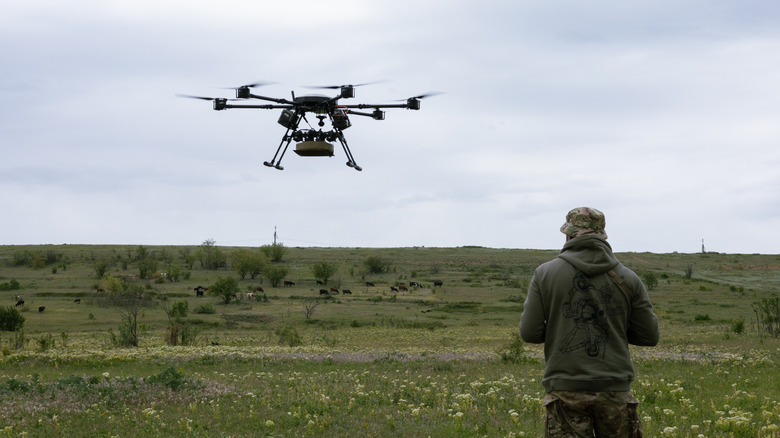
Of course, some of the advantages of wireless power transmission are obvious. You can get a drone to fly longer than most other drones with fewer breaks and less downtime. This can be a key advantage, especially when using a drone for surveillance and real-time enemy tracking. Keeping drones aloft is a big part of the challenge when deploying them into combat situations.
Another big advantage involves the batteries, which are heavy. Wireless power transmission could enable drone designs with significantly smaller batteries. Weight on board a flying vehicle is an important consideration, so any weight cost you gain from a smaller battery can be reassigned to other sensors, weapons packages, or anything else the drone might need to accomplish its mission.
Of course, this technology is still in its infancy, so there's more work to be done before you see this in the skies over a battlefield—and hopefully, if you see them, you're watching on CNN and not out your living room window. But this is still an exciting development in the world of drones who have long been hampered by limited flight times.