

These Norwegian Soldiers Still Use An Old-School Tactic To Hide From Drones
Poets, songwriters, and Hallmark cards have long referred to newly fallen snow as winter's blanket, with the fluffy white stuff coating the landscape as far as the eye can see. Militarily speaking, though, winter conditions are a nightmare. Not only is it difficult for ground forces to wade through, but the pervasive stark whiteness makes it difficult to hide soldiers and equipment — especially in this day and age of prolific drone use, where more than 90 countries and non-state actors are now using them.
Since Russia launched its full-scale invasion of Ukraine in February 2022, that particular war zone has become known as the world's most advanced drone theater of operations. In 2024, drones surpassed artillery as the go-to method of attack, inflicting 70% of all battlefield injuries or deaths. Drone warfare has created a paradigm shift on the battlefield, and the pace of military drone use is certain to increase, especially as they've become cheaper and easier to build when compared to conventional artillery or air assets.
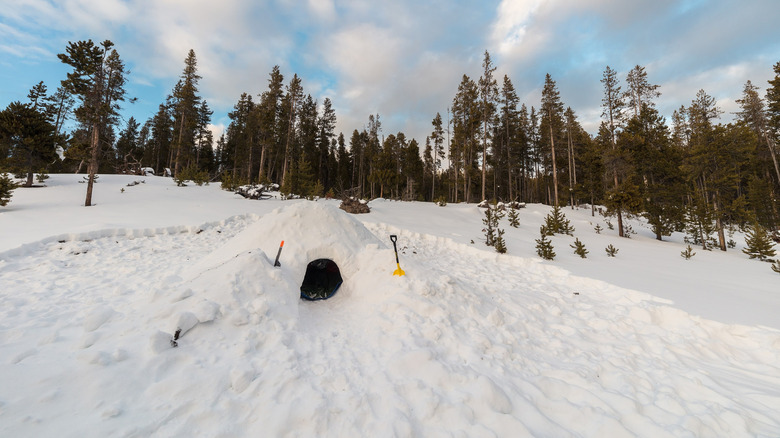
Drones are packed with an array of technological wizardry, including high-definition and thermal imaging capabilities, something that's far more effective in winter environments due to the massive temperature difference between the bitterly cold surroundings and, in the case of human soldiers, their body heat. Interestingly, Norway's Long Range Reconnaissance Squadron uses an old-school method to hide from this highly advanced technology. Soldiers with the elite Arctic warfare unit dig into the snow to build caves (referred to as quinzhees, or quinzees), something kids around the world have basically been doing for centuries.
A deadly game of hide-and-seek
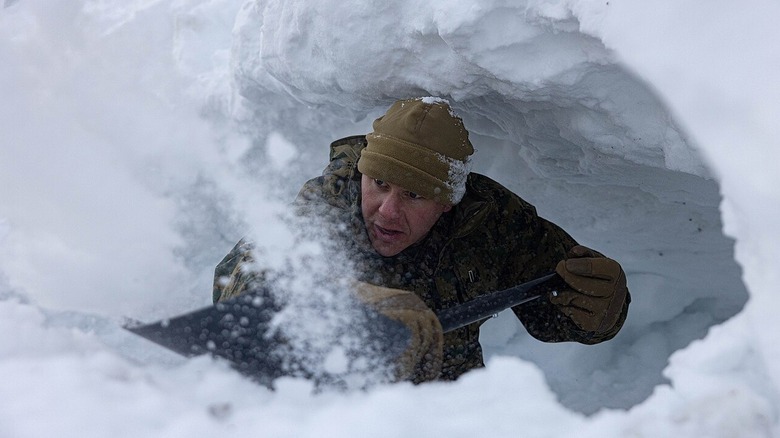
The deceptively simple quinzhee is built from loose snow (which has a lower density) piled into a cone roughly 5 feet high and 6.5 feet wide. It's then allowed to sit until the outer shell hardens (a process known as sintering) and increases density. Once firm, an interior can be hollowed out. This isn't an igloo, which uses hard snow to form blocks that are then stacked together. When testing the thermal properties of an igloo, a snow cave, and a quinzhee, the walls of the quinzhee had the highest thermal conductivity, while the igloo was the best insulator.
While speaking with Defense News, one member of Norway's Long Range Reconnaissance Squadron, using the codename "Poster Boy," says countermeasures and evasive tactics, such as tents and camouflage, are no longer feasible due to the constant evolution of technology. Modern warfare is a deadly game of hide-and-seek, forcing units like theirs to sometimes move every 15 minutes to stay undetected. He added that "snow is our absolute best concealment," especially as it's falling, because it quickly fills their tracks.
Mother Nature's blanket is only part of the equation, though. Over the last few years, the Norwegian Defense Materiel Agency has been testing a camouflage system that will help keep them hidden. Created by Saab (which has a long history of first making cars and now military equipment), the Mobile Camouflage System (MCS) can also be mounted on vehicles as panels. This not only hides thermal signatures from infrared cameras and heat-seeking sensors, but also reduces radar visibility while also disrupting shapes, making things harder to see even with the naked eye.