

Those Gaps You Drive Over On Highway Bridges Serve A Purpose

For something designed to connect two sides, a bridge sure is made up of a lot of divisions. These manifest as gaps that produce that little thunk-thunk as you drive over them, and it can almost feel like bad construction. The thing is that these gaps are there out of necessity. They've got a name, too: expansion joints.
The issue is that bridges aren't static, monolithic structures. Depending on the weather, they tend to expand and shrink. Engineers account for that change by using something called the coefficient of thermal expansion. Concrete, the primary material in bridges, has a coefficient ranging from 7 to 12 millionths per degree Celsius, which is how much its original length expands or shrinks with each degree of temperature change. That may sound tiny, but it adds up fast once you begin to scale up. In fact, a 100 degrees Fahrenheit shift in temperature — which tends to happen between seasons — and a 100-foot slab will shuffle itself around by roughly ¾ of an inch. That's why you may have noticed that bridge gaps feel larger and bumpier in the winter when the concrete in the bridges shrinks.
Beyond this, the bridges also have to deal with things like heavy trucks rolling through, the settling of the ground underneath, and the occasional earthquake. The only solution to all these factors is building in gaps, specifically between sections of the bridge deck or where a bridge meets the normal road. They are typically filled with flexible bits like rubber or interlocking steel that can compress, stretch, or slide as needed. This applies to building bridges over water as well as highway overpasses.
Not all bridge gaps are the same
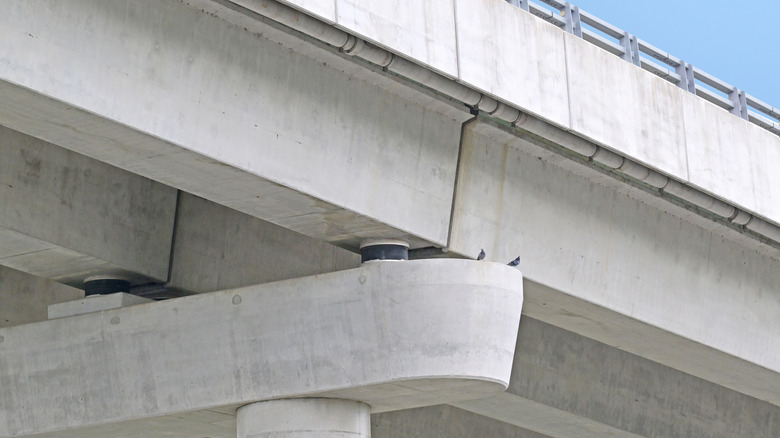
We've established that bridge gaps are good. But you may have also noticed that not every gap you drive over feels the same. There's a reason for that. Engineers actually use different types of joints in those gaps depending on how much the bridge is going to move. Shorter bridges expand and contract less dramatically, so engineers are able to get away with simpler compression seal joints. These are essentially blocks of neoprene rubber stuffed between the concrete sections. They're designed to handle movement of under 2 inches, and they're quiet enough not to even be noticed.
Long-span bridges are another story, though. Since they flex way more, sometimes over a foot in either direction, engineers have to build in more complex connectors called modular joints. These are systems of beams and flexible seals working together to soak up movement from any angle at once. You'll find them on some of the biggest bridges ever built.
Another option for long-span bridges is the finger plate joint. These are essentially two combs with metal teeth pointing at each other, meshing together and sliding as the bridge shifts. The advantage with these is that they are simpler and cheaper to install upfront compared to modular joints. But they also have a downside. Since their "teeth" have gaps, water and road grime fall straight through them. They're also noticeably noisier than the other two sealed types to drive on.