

Is Having A GoPro On Your Helmet Illegal In California? Here's What You Should Know
From the 1,650-mile stretch of the Pacific Coast Highway that runs all along California's coast up into Seattle, to more intimate swaths of road like the Redwood Highway that wind lazily through towering, old-growth redwood forests, and shorter, more technical bits like the 2.4-mile "Snake" of Los Angeles County's Mulholland Highway, California is an expansive playground for motorcycle riders. It's also a state with an all-inclusive helmet law (California Vehicle Code §27803) that requires both operators and riders to wear a properly secured U.S. Department of Transportation-compliant motorcycle safety helmet, regardless of age, gender, or bike size.
As of 2023 (per the Insurance Institute for Highway Safety), the U.S. had almost 9 million registered motorcycles, doubling since 2002 (at 4.3 million). California's steady climate and diverse landscapes made it #1 with 936,809. The Sunshine State of Florida was second at 668,046. And if you're curious, third place went to Ohio, with 407,952, less than half that in California.
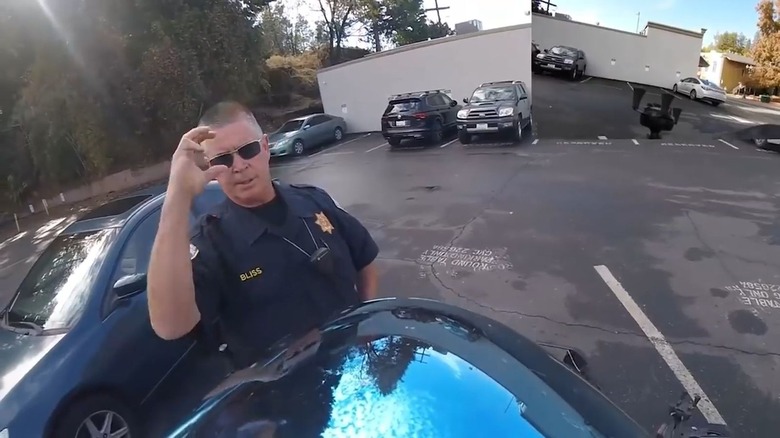
Streaming video is now a way of life for everyone, not just those seeking 15 minutes of fame. For instance, according to Global Media Insight, YouTube has over 113 million active channels and 122 million daily active users. GoPro cameras are a great way to show off what you're doing, whenever and wherever you're doing it, on whatever vehicle you're on. And while DOT standards apply nationwide, not every state enforces them the same way, creating a hodgepodge of GoPro camera rules and enforcement practices. Technically, attaching a GoPro to your helmet isn't illegal in California, but it sits in a very gray area that could result in unpleasant encounters with law enforcement.
A GoPro isn't essential, but does it matter?
Federal law (49 CFR § 571.218, subsection S5.5) states that helmets can't have any "rigid projections" longer than 0.20 inches unless they're an "essential accessory." Whether you're an influencer with a streaming channel or just a cautious rider logging rides for safety, GoPro cameras — even with special mounts — aren't considered an "essential accessory." Some may argue that it isn't explicitly illegal either, as there is no specific California law on this issue. Still, helmets must meet federal safety standards.
And here's where the laws become obfuscated and move into a "gray area." Subsection 1 (of § 571.218) refers to the 0.20-inch reference as a minimum performance requirement, which appears solely directed at motorcycle helmet manufacturers. Subsection 3 doubles down on that by stating that it applies to all helmets "designed for use by motorcyclists." This has led to the widespread interpretation that it applies only to the manufacturer as it pertains to safety and testing standards used during the helmet's design phase, not to what someone does with it after purchase.
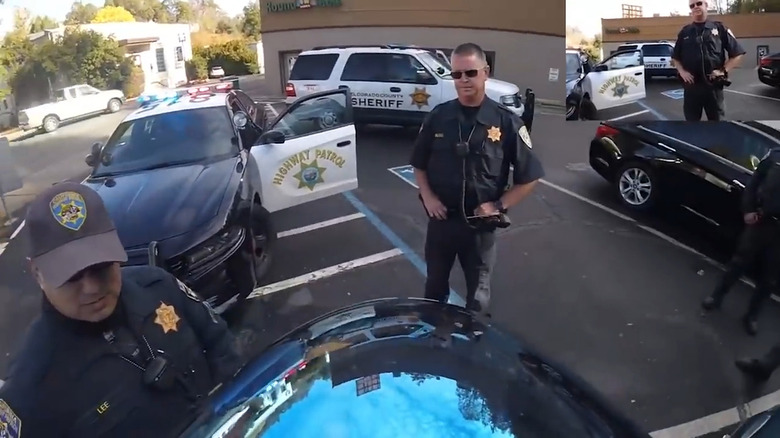
A GoPro does exceed the 0.20-inch federal rule, but because the wording is ambiguous, it's easy to see why officers might think it includes the end user, and not just the manufacturer. And since technically, riding without a DOT-compliant helmet — think "novelty" helmets that don't have the necessary thickness, weight, or proper DOT labeling – can result in a fine of $197 to $250 (for a first offense), there is a large margin for interpretive error. So, if you are stopped, it's probably best to save your arguments for court rather than stand your ground during the actual traffic stop.