

The Only Shelby Built From The Ground-Up Ditched Ford For An Oldsmobile V8
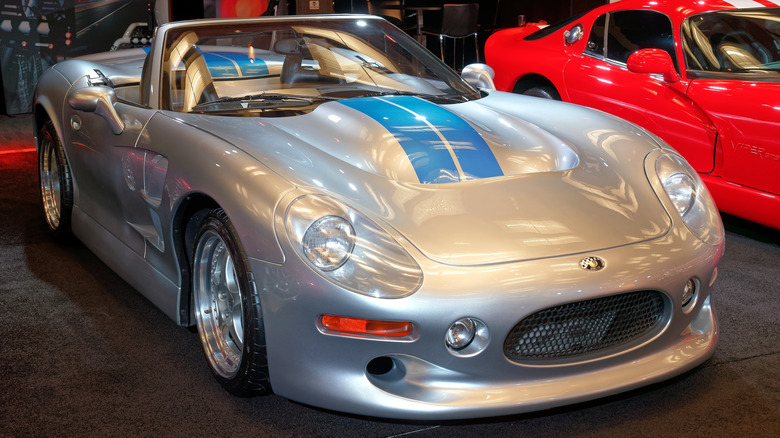
There was a car created by Carroll Shelby that didn't have a Ford engine under its hood. In fact, it wasn't even based on a Ford. We are talking about the Shelby Series 1 Roadster, the only car ever built by Shelby from a clean-sheet design. Instead of a big engine from the Blue Oval providing the motive power for this Shelby, there was an Oldsmobile V8 under the hood generating the necessary horsepower. Overall, it was an underappreciated Shelby car.
The Shelby Series 1 Roadster was Carroll Shelby's final attempt to create a modern version of the automotive icon that was the Shelby Cobra. Just 249 examples of the Series 1 were produced, all 1999 models, conforming to that year's Federal Motor Vehicle Safety Standards. The Shelby's chassis was state-of-the-art, featuring 6061 T4 aluminum elements that were formed and extruded before being welded together and heat treated. Honeycomb aluminum panels formed the floor and rocker panels for extra rigidity, producing a chassis that weighed only 265 pounds. The body that was draped over this chassis was made of fiberglass composite and carbon fiber, keeping the curb weight down to just 2,650 pounds. This was much less than that of the car seen as the Shelby's main competitor at the time, the Chevrolet Corvette C5.
The Shelby Series 1 Roadster's suspension used a double wishbone setup connected to cantilevered coil-overs in the center of the vehicle. The brakes were discs all around, with forged aluminum 18-inch Speedline wheels measuring 10 inches wide in the front and 12 inches wide in the rear, mounted with Goodyear Eagle F1 tires.
The Shelby Series 1 Roadster had its share of problems
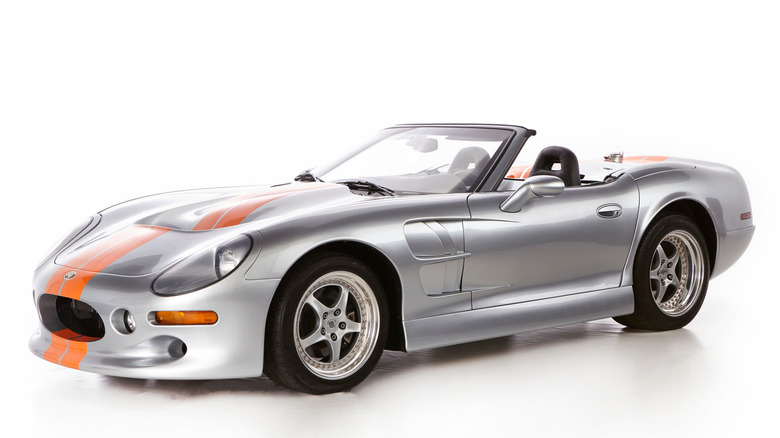
The Shelby Series 1 Roadster experienced a large number of problems during its gestation, primarily due to both production-related issues and roadblocks stemming from corporate politics. Production problems included chassis jigs that permitted warping during cooling, plus delays due to an overworked team at Shelby that pushed production out to 1999. This further led to cost overruns when a new set of safety standards had to then be met. Then there were handling issues, the lack of ABS (which led to braking problems), whining gears from the ZF manual transmission, and repeatedly cracking aluminum castings in the rear suspension. Moreover, the side windows and convertible tops did not fit correctly and some of the transaxles needed replacement, all issues that increased costs further. Also, the car's carbon fiber body panels turned out to be not properly sealed, requiring body filler that added hundreds of pounds of weight to the Series 1 Roadster.
Political problems were largely the result of the forced 1996 departure of John Rock, the Oldsmobile general manager who had championed GM's hookup with Shelby to produce the Series 1 Roadster. Once Rock was gone, Oldsmobile would not supply the computer tuning codes for the L47 engine Shelby was using, ultimately reducing the stock engine's output from 350 horses to 320. Making things worse, GM refused to share any current Corvette parts with the Shelby Series 1 Roadster, so Shelby was unable to use the 'Vette's transaxle or any C5 suspension pieces. The price also increased, starting at a sub-$100k target when it was first announced up to $181,824 in 2000.
How well did the Shelby Series 1 Roadster perform?
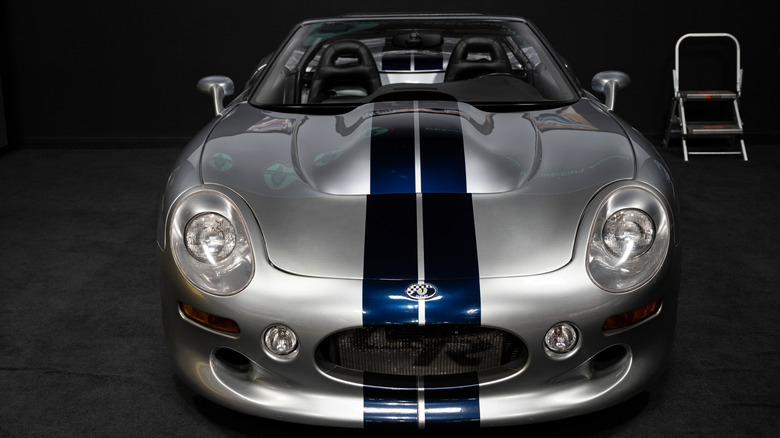
For motive power, the Shelby Series 1 Roadster was supposed to use an Oldsmobile racing engine, but emissions-compliance issues resulted in the car using the civilian version, the 4.0-liter DOHC V8 from the Oldsmobile Aurora, mounted behind the front axle in a front mid-engine position. The engine was mated to a six-speed manual ZF transmission driving the rear wheels. Weight distribution was an ideal 51:49. The engine made 250 horsepower in the Aurora, but the Shelby ended up with 320, while an optional supercharger, which works differently than a turbocharger, would literally boost that to 450 horsepower.
According to the Museum of American Speed, the stock Shelby Series 1 Roadster can do 0-60 mph in 4.4 seconds, with a quarter-mile time of 12.8 seconds at 112 mph and a top speed of 170 mph. Car and Driver managed, after many difficulties related to the car's reliability, to get a 0-60 mph time of 4.1 seconds and a quarter-mile time of 13.0 seconds at 112 mph. The publication famously called the Series 1 "a work in progress."
The Shelby Series 1 Roadster should have been a modern reincarnation of the Shelby Cobra, with all the performance and charisma of the original version. Instead, it is seen as a project that came up against all of the typical obstacles that befall low-volume vehicle producers. From the eternal struggle to make money on a few hundred cars and corporate infighting with formerly helpful partners to the realities of making a vehicle that conforms to the Federal Motor Vehicle Safety Standards, the Series 1 had the deck stacked against it; regardless, it remains Carrol Shelby's flawed but striking swansong.