

What Happens To All The Items Left Behind At TSA Checkpoints?
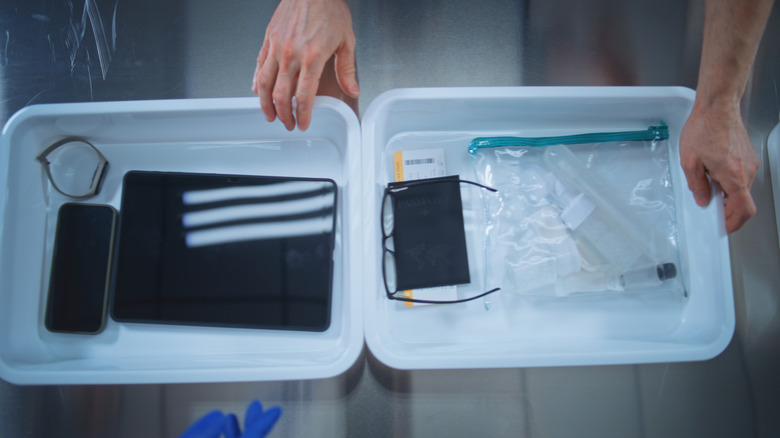
So far in 2026, on average, more than two million people fly the friendly skies each and every day. According to the Transportation Security Administration (TSA), travelers leave behind anywhere between 90,000 and 100,000 items at airport checkpoints every single month, and much of it's actually cold, hard cash. In 2025, the TSA scooped up $967,897.97 in unclaimed checkpoint money, mostly coins people removed from their pockets during security screening. So, what exactly happens to all those items that get left behind?
Although TSA tries to return money to the owner whenever possible, when they can't, they have to follow strict protocols. First, they must track the amounts received from each airport and then report the totals not only to Congress but also to several different committees. When foreign currency goes unclaimed, it is exchanged into U.S. dollars to reduce conversion costs. Any unclaimed funds must be spent on carrying out the TSA's mission of providing civil aviation security.
Physical items like laptops, cellphones, wallets, belts, and passports follow very different pathways through the system. The TSA does have a "Lost and Found" where passengers can collect any items they may have left behind or that escaped from checked baggage. If there's no easy, identifiable way to return an item to the owner, TSA will hold it for at least 30 days. That's why it's always important to plaster your contact information on everything you're traveling with, because you never know what might happen while frantically scurrying through the airport.
Finders keepers, losers weepers
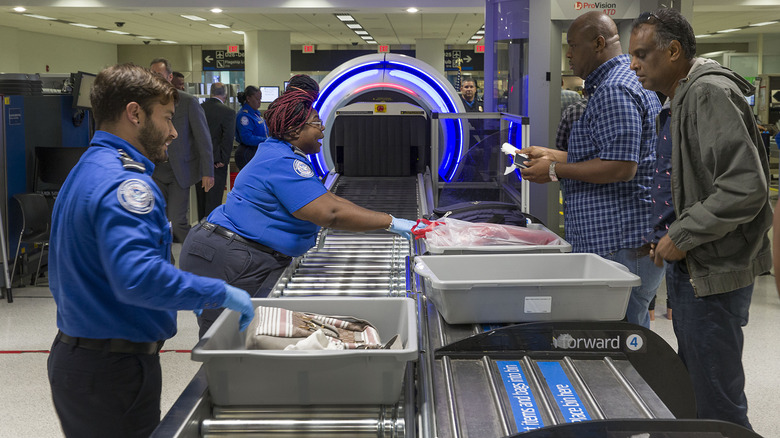
After 30 days, any electronics that go unclaimed will have their memory wiped and hard drive destroyed. If a drive can't be removed, the entire item gets tossed into the shredder to protect personal data. Documents like passports and driver's licenses are also destroyed after the 30-day waiting period. If any weapons are confiscated or found inside carry-on bags, they're turned over to local police. It might be surprising to know that in 2024, the TSA snatched 6,678 firearms at airport security checkpoints.
Any unclaimed items that remain are then shipped to individual state surplus property agencies, where they might be recycled, donated, destroyed, or sold at auction like the government surplus marketplace GovDeals. Once an item is sold, the proceeds are turned over to the U.S. Department of the Treasury and used to pay off the national debt. It should be noted that if you voluntarily leave an item behind (as opposed to losing it), that 30-day grace period goes out the proverbial window and will be dealt with far more swiftly. Interestingly, one way items are sold is through lost luggage auctions, sometimes referred to as "suitcase gambling," which is pretty much the same as people blindly bidding on abandoned and repossessed storage units, hoping to strike gold.
To avoid mistakenly leaving something behind, it's best to follow the age-old adage of keeping calm. Secondly, label everything of value, and if you do lose something, remember you have a limited amount of time to try and get it back.