

How Much Does An MC-130J Cost The US Air Force & Who Builds Them?
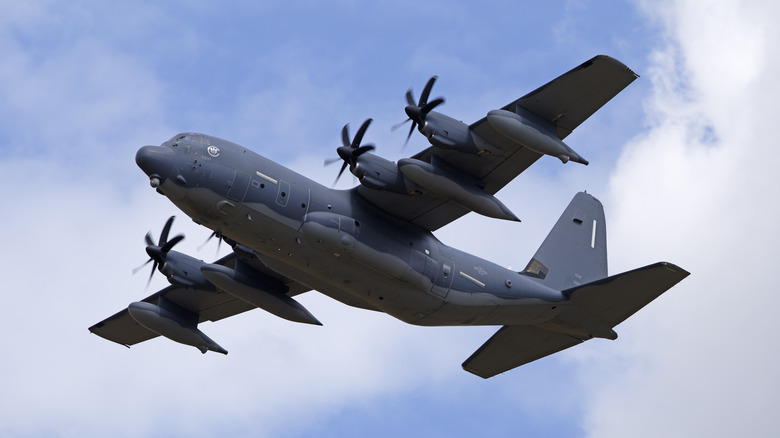
While the iconic Boeing B-52 Stratofortress bomber is widely known as one of the longest-serving military aircraft of all time, the legendary C-130 Hercules is a similarly old design that isn't just still in service, but is still being produced – albeit as a heavily evolved variant of the original. The first C-130 Hercules first entered service nearly 70 years ago, and the airframe has spawned a multitude of modernized and specialized variants, including the MC-130J Commando II, which takes its name from the historic Commando air transport of World War II.
Built by Lockheed Martin, the MC-130J Commando II is designed to perform covert air support operations in contested and enemy-held territory, including combat search and rescue (CSAR) . At the end of fiscal year 2025, when production for these planes wrapped up, the United States Air Force had 57 MC-130Js in active service, with each of the planes costing of over $100 million.
During Operation Epic Fury in Iran, American military forces launched a dangerous mission to rescue a downed American airman behind enemy lines, which included two MC-130Js, among other vehicles. It sounds like the plot of an over-the-top 1980s action movie, but it's all real. While no American lives were lost during this CSAR mission, and the airman was recovered safely, the two MC-130Js were destroyed – not at the hands of enemy fire, but intentionally, by the U.S. military's own weaponry.
A versatile support aircraft
Perhaps because it's a prop-driven aircraft designed primarily for air transport rather than a sleek, jet-powered fighter or bomber, the venerable C-130 Hercules sometimes doesn't get the appreciation it deserves compared to other military aircraft. A workhorse of the skies, the C-130 has been produced in more than 70 different variants, which operate in 70 different countries around the world. Among the notable variants are the modern C-130J Super Hercules and the formidable AC-130 gunship, which is sometimes called the Angel of Death.
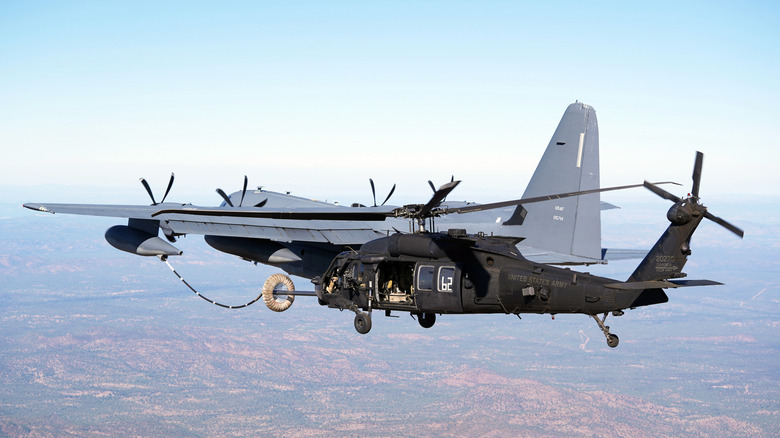
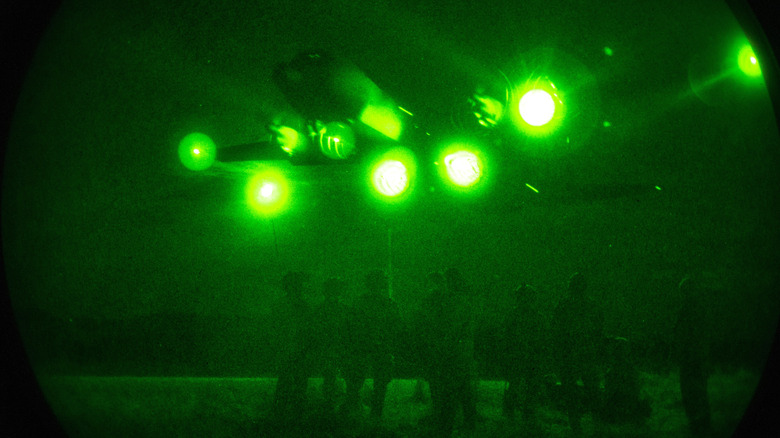
The MC-130J Commando II is one of the most advanced and capable variants of the C-130, having been introduced in 2011. The Commando II was built for low-level infiltration and exfiltration, operating in direct support of special operations forces — usually under the cover of night. This includes not just transporting and supplying soldiers in combat zones, but also mid-air refueling of special operations helicopters and tilt-rotor aircraft.
With more powerful and more efficient engines than earlier C-130 variants, the MC-130J can fly faster and longer, and is also capable of taking off from short runways and makeshift airfields. Thanks to increased computerization, it can operate with a crew as small as five. Per the United States Air Force, each MC-130J in the fleet had a unit cost of $114.2 million in the 2022 fiscal year.
More than just a transport
While most of the MC-130J's missions are done at low altitudes, the plane can fly as high as 28,000 feet, and its four six-bladed Rolls-Royce turboprop engines give it a top speed of 362 knots. Among the reasons for both the MC-130J's high cost and its strategic importance are its high-tech avionics, cargo, refueling, and countermeasure systems. While the plane itself is based on a classic design, it's packed with modern equipment far more advanced than anything the original C-130s had back in the 1950s.
Likewise, while the C-130 may have been designed as a heavy cargo aircraft, it is far from the lumbering freighter that some might think it is. Air show demonstrations have shown that modern variants of the C-130 are capable of jaw-dropping aerobatic maneuvers with a skilled pilot at the controls.
The MC-130J Commando II made international headlines after the U.S. military was forced to destroy two of its own planes after they got stuck in the sand during the successful CSAR mission in Iran. Though costly from a monetary standpoint, there was likely zero hesitation to destroy the costly aircraft if it meant preventing them from enemy capture, to say nothing of upholding the unofficial U.S. military creed of "no man left behind."