

137 Years After Being Swallowed By Fog, This Long-Lost Ship Was Finally Found
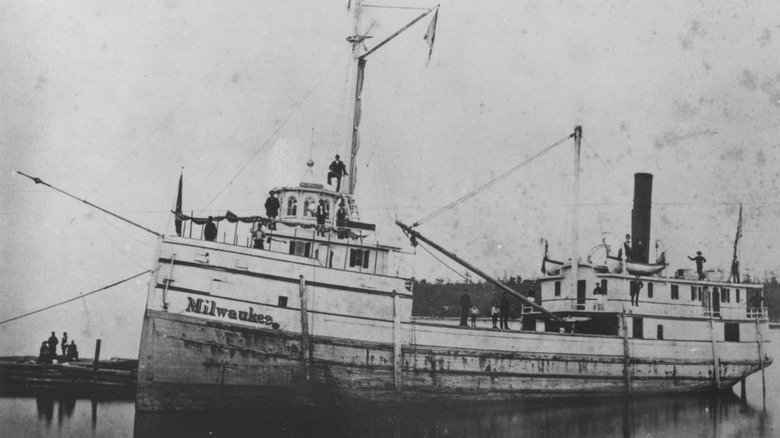
On July 9, 1886, Lake Michigan was calm. Recent wildfires in Wisconsin caused smoke to hang precariously across the region. The steamship Milwaukee was headed back to Muskegon, Michigan, after delivering a load of lumber to Chicago, Illinois. Meanwhile, the steamship C. Hickox was hauling lumber from Muskegon back to Chicago. It was also towing a fully loaded schooner barge. Both ships were on the exact same heading.
At around midnight, the two ships approached each other about 40 miles off the coast of Holland, Michigan. Dennis Harrington, the lookout aboard the Milwaukee, actually saw the Hickox's lights and promptly informed Captain Armstrong. According to records, Captain O'Day aboard the Hickox saw the approaching Milwaukee as well. Per standard operating procedures, both ships should have slowed, turned to starboard, and blown their whistles. None of that happened. Suddenly, a thick bank of fog appeared out of nowhere. What's more, when O'Day tried sounding the whistle to signal for a turn, the chain broke, and the ship plowed headfirst into the side of the Milwaukee.
Despite efforts to keep the Milwaukee afloat, the 135-foot steamer with its three decks sank in 360 feet of water within two hours. It remained in solitude until 2023, when the Michigan Shipwreck Research Association (MSRA) found it using side-scan sonar. It was the 19th wreck the MSRA had found sitting beneath the waters off the shores of Western Michigan. And while the Milwaukee isn't one of our dozen most fascinating shipwrecks from around the world, it still has an incredible story to tell.
Side-scan sonar and ROVs uncovered the Milwaukee
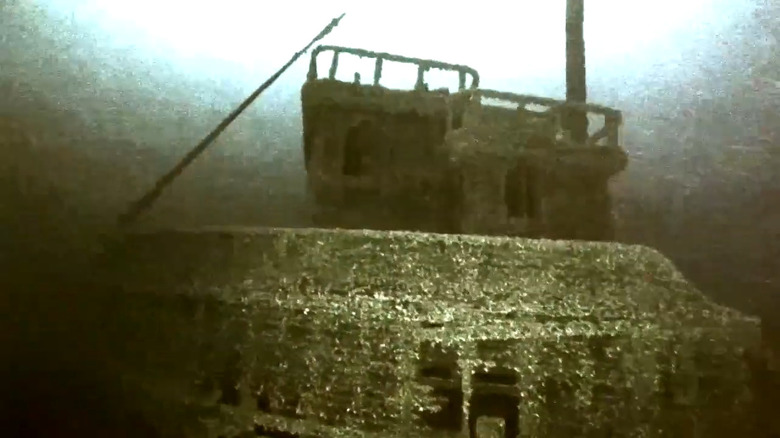
The Michigan Shipwreck Research Association, whose mission is to find wrecks in and around the region, knew about the Milwaukee, but didn't know its exact resting place. After digging through newspaper accounts and studying water currents, they located what they believed was the wreckage in just two days in June 2023 (with the help of side-scan sonar). Amazingly, the ship was sitting upright on the ocean floor, facing northeast in the very same direction it had been heading when the Hickox rammed her in 1886.
After the initial discovery, the team returned with a remotely operated vehicle (ROV) — which doesn't require a license to operate. After a few months, they were able to positively identify it as the Milwaukee, which had undergone extensive retrofits before its tragic fate. The Northern Transportation Company (NTC) of Ohio originally commissioned it back in 1868. The NTC wanted to use it to haul cargo and passengers from the Northern Railroad line in Ogdensburg, New York, across the Great Lakes, making it one of the first steamships to do so.
Then, the financial panic that swept across the globe in September 1873 led to the failure of over 100 banks in the U.S. alone. By 1880, both the railroad and the Welland Canal locks had expanded, making the ship's configuration obsolete. The NTC was forced to sell the Milwaukee to W. W. Ellsworth, who, in 1881, turned the passenger sleeping cabins into additional cargo space. Ellsworth sold the ship to Lyman Gates Mason in 1883, who then began using it to transport lumber from Michigan to Chicago.
Once lost, now found

When the crash first happened, the crew from the Milwaukee was able to safely climb aboard the Hickox, in part thanks to the efforts of a third steamer – the City of New York — which had been in the vicinity and heard the distress signals. It actually helped the Hickox keep the Milwaukee afloat by sandwiching it between them and tying it off with ropes. Although it didn't keep the Milwaukee from sinking, no additional lives were lost. Sadly, Dennis Harrington (Milwaukee's lookout) was tossed into the water and lost, and both captains subsequently had their licenses suspended for failing to follow proper navigational protocols.
After sending the ROV down, it did take some time for the Michigan Shipwreck Research Association to positively ID the wreck. Not because the water was cloudy, since the lake is known to have incredibly clear water once it shifts from being covered with ice. The ship's retrofit just before it sank downsized the pilothouse and aft cabin to increase how much lumber it could haul, and in doing so changed its appearance. MSRA was only sure it was the Milwaukee after it inspected the impact spot and matched it to the damage reportedly caused by the Hickox.
Interestingly, it was one of 13 new wrecks uncovered in the area, a rate three times the norm. By comparison, none were discovered the year before; previously, the most found during a single year was four in 2016. The Wisconsin Historical Society believes the increase can be attributed to "fluctuating water levels and greater public awareness of how to report discoveries."