

What's The Difference Between Motorcycle And Car Engines?
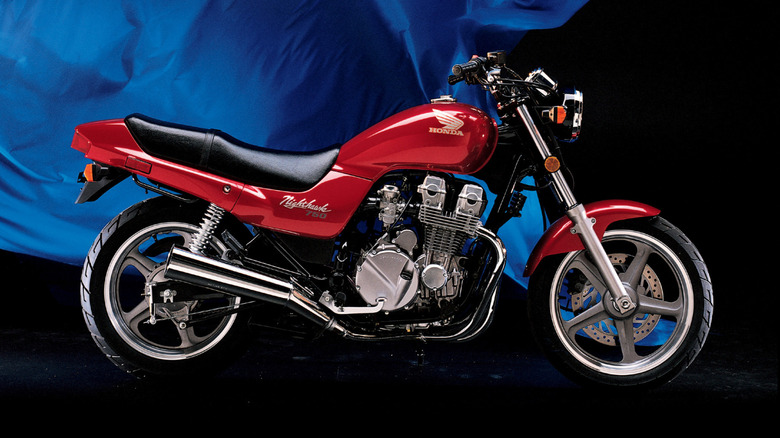
The two most common motorized vehicles you are likely to see on the road today are cars and motorcycles. That's not exactly a controversial statement, nor is it breaking news. All the same, you've probably caught yourself staring at an interesting bike or car at a stop light and thinking, "what's the difference between these engines?"
After all, both a motorcycle and car engine do the same thing, which is to convert internal combustion to vehicle motion via a bunch of controlled explosions held together by some screaming metal parts. The short answer to the question of differences? "Not a lot." The more in-depth answer? "It depends."
The chief difference is size, although that's not a hard and fast rule. Motorcycle engines are generally smaller in the overall displacement category. You'd be hard-pressed to find a car on the road with a 250cc motor, but it's a common size for a motorcycle. Similarly, a 3.0-liter V6 is a common car engine size, but nothing aside from monstrous custom-built bikes would have an engine that big.
Bike versus car engine differences are often about oil
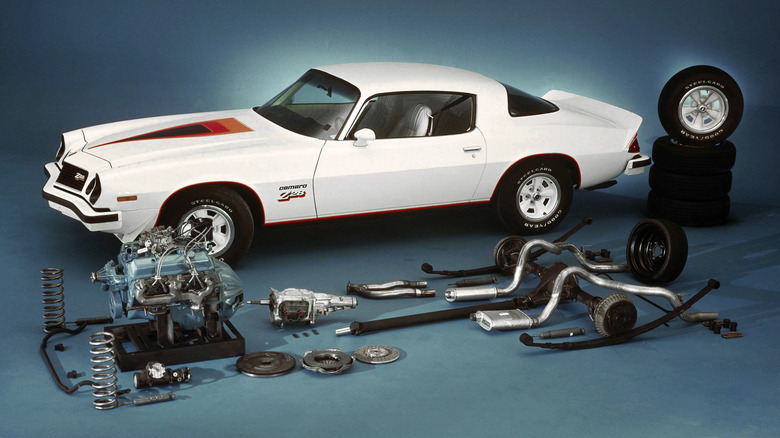
Another difference between bike and car engines is that motorcycle motors generally run at higher temperatures (many are air-cooled) and at higher RPMs. Major oil manufacturer Castrol explains that you can't use the same automotive oil in a motorcycle engine: "In a car engine, the oil protects only the engine. Different fluids (such as transmission fluids) protect other key areas of the car engine. Motorcycles have a common sump and motorcycle oil is required to protect not only the engine but also cool and lubricate the clutch and gearbox."
This means the biggest functional difference between these two engine types is cooling. The ratio of parts that are cooled by air, oil, and coolant differ between motorcycles and four-wheeled vehicles. But once again, given the century-plus of history behind internal combustion engines, it's not a rule that's necessarily set in stone. While those differences in size, general operation, and cooling cover the vast majority of bikes and cars you see on the road, given the wide swathe of motorized history, there's always been a bit of crossover; some motorcycles have used car engines and some cars have used motorcycle engines.
Motorcycles and cars that used interchangeable engines
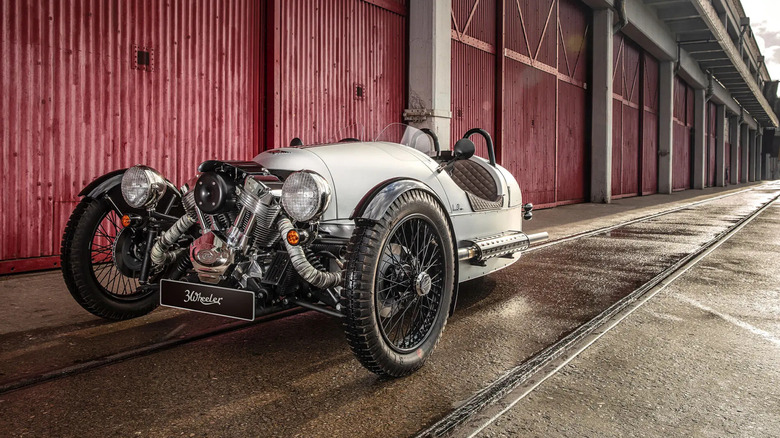
The Morgan 3-Wheeler is a prime example of a vehicle that blurs the line between motorcycle and car. The vehicle looks like a roadster from the 1920s, but it was actually made in 2011. The first generation of the 3-Wheeler used a huge 1,998cc V-twin as its engine. The new 3-Wheeler, launched in 2022, uses a more conventional Ford engine. Morgan notes that the V-twin was made by S&S, which, funnily enough, also makes performance parts for Harley-Davidson engines. The V-twin in the Morgan was connected to a five-speed sourced from Mazda; the whole funny little "car", if you can even call it that, made 82 horsepower.
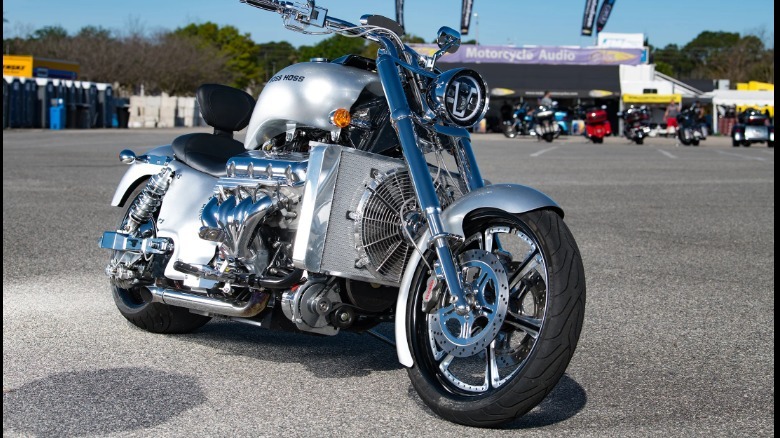
One the other side, motorcycles have used car engines, and not necessarily small ones, either. Boss Hoss motorcycles use small block and big block Chevy V8s as their engine of choice. Those bikes look like something out of a dystopian sci-fi fever dream, with performance and specs to match; its Cruiser model weighs 1,100 pounds and has up to 600 horsepower, if you opt for the big block 454 cubic inch V8.
These are both extreme examples, of course. Regardless, the lines are blurred enough between motorcycle and car engines to the point where there isn't a lot of differences, but the real take home bullet points to remember are that engine use generally differs in both size and how oil is used for coolant.