

How Many Marines And Sailors Can A US Aircraft Carrier Hold?
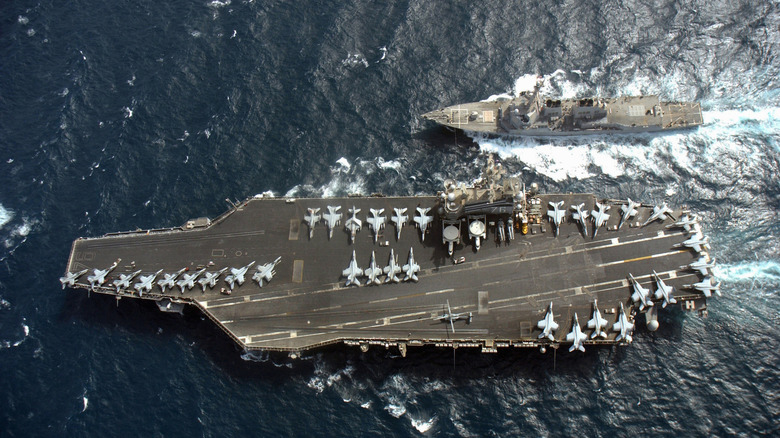
Aircraft carriers sailing with the United States Navy are floating cities meant for projecting military force wherever there's an ocean. Each carrier is considered a literal piece of sovereign US territory, allowing it more freedom of navigation than some other surface ships.
The current Gerald R. Ford class of aircraft carrier has a massive crew of 4,660 sailors, officers, staff, and aviators split between the people running the ship and the air wing to operate and maintain the ship's air capabilities. The earlier, yet still in service, Nimitz-class carrier has a crew of 3,200 sailors and officers and an additional crew of 2,480 for the air wing. Both classes of ships are 1,092 feet long and, thanks to nuclear power, can remain at sea nearly indefinitely.
However, despite all the staff and sailors onboard, there are very few, if any, Marines onboard aircraft carriers. Marine detachments on most naval vessels in general, dates back to the founding of the country, but the practice was discontinued in 1998.
Amphibious assaults
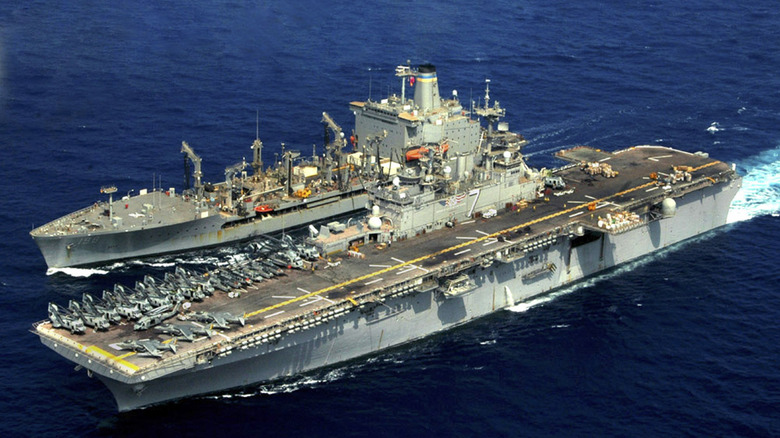
However, that doesn't mean the U.S. Navy isn't in the practice of moving Marines. It's just that a more conventional aircraft carrier isn't doing the heavy lifting. That task goes to a ship like the Wasp-class amphibious assault ship. The Wasp-class is a bit of an oddball when it comes to classification. It looks like an aircraft carrier, and it can, in fact, carry a number of different helicopters and fighter jets like the F-35 variants that are capable of taking off vertically. It's a much "smaller" vessel at a length of 844 feet.
When it comes to carrying Marines, a Wasp-class can carry a detachment of 1,687 personnel, the majority of Marines that comprise a Marine Expeditionary Unit. Altogether, a Marine Expeditionary Unit is around 2,200 Marines and sailors spread out over several vessels.
Aircraft carriers, are huge, imposing, and powerful, but everyone onboard usually has a job dedicated to running the ship or aircraft onboard.