

What Company Developed The A-10 Warthog, And How Many Are Still Flying?
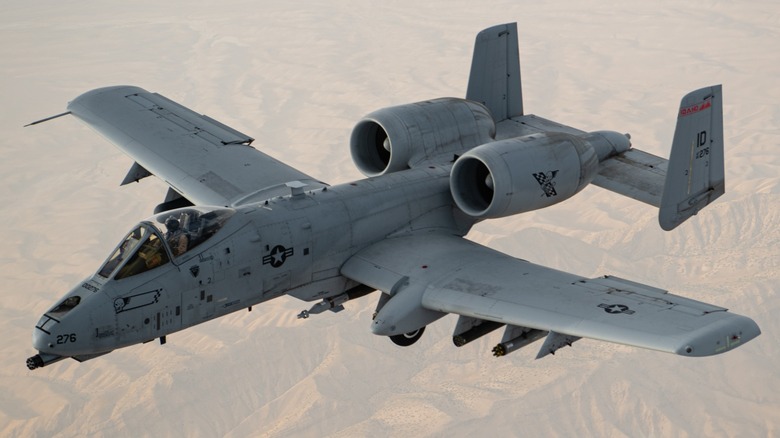
One type of aircraft used by the U.S. in its 2026 war with Iran is the A-10 Thunderbolt II, which is impressive given that the plane first deployed in March 1976, half a century earlier. Affectionately nicknamed the Warthog, the roots of the A-10 actually go further back another decade, when the U.S. Air Force considered building a dedicated Close Air Support (CAS) plane to support the war in Vietnam, particularly one that was all-weather-capable and which had enough firepower to take out Soviet tanks.
Four years later, the U.S.A.F. put a call out for proposals for the new A-X (Attack Experimental) plane, and six defense contractors responded. In early 1973, Fairchild's prototype won the contract. The company, which Sherman Mills Fairchild founded in 1920 to make and sell aerial photographic equipment, had previously produced the C-119 Flying Boxcar, a cargo and troop transport plane that played a big role in the Korean War. To win the contract, Fairchild's CAS prototype faced off against another from Northrop and even needed to prove its worth in a fly-off with the A-7D Corsair II before full production could begin.
That production ran for eight years, with the last Warthog being constructed in 1984. All told, 713 units were built. Not adjusting for inflation, the original cost of each A-10 is estimated to be around $18 million, which is closer to $70 million in 2026 dollars. On top of that, millions more have been spent upgrading each of the surviving planes with newer wings, weapons, and defensive capabilities, which is a big reason why between 260 and 280 planes are still flying over 40 years later.
A different company built the A-10's cannon
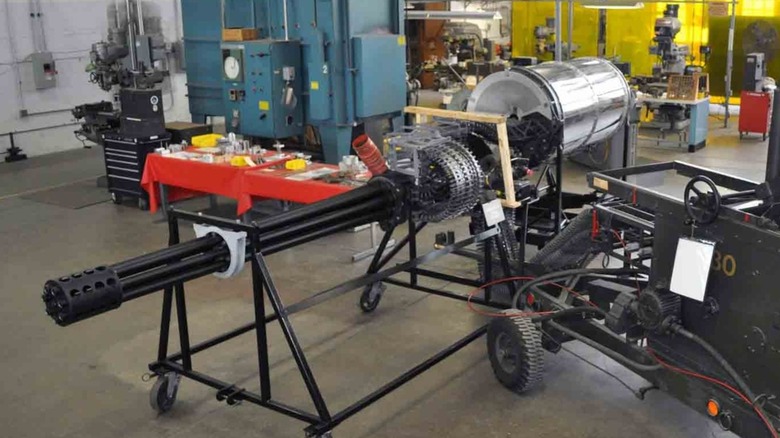
A design aspect that was very important to the Air Force during the A-10's development was that it needed to effectively carry a very big gun. After all, the aircraft was specifically designed for CAS, and serious firepower was needed to take on Soviet tanks on the ground. The Department of Defense issued a separate request for proposal (RFP) for a 30-mm rotary cannon in 1970, which meant that different companies could (and would) be selected to build the cannon and the plane that would carry it.
General Electric ended up winning the contract and building the GAU-8/A Avenger Gatling gun. That means the monster gun, which can fire a whopping 65 rounds per second, had the same GE branding as many Americans' microwaves. The Air Force specifically required that the Avenger be versatile enough to attack light, medium, and heavy tanks, as well as armored personnel carriers, bunkers, and fixed or mobile artillery.
As part of the contract, four types of ammunition were also developed for the 7-barrel Avenger: armor-piercing incendiary, high-explosive incendiary, semi-armor-piercing high explosive, and target practice rounds. On average, the cannon could carry 1,150 rounds in its drum. In the 1990s, GE divested its aerospace armaments division, and General Dynamics — which has no relation to the similarly-named General Electric — is now the manufacturer of the GAU-8/A Avenger.
How long will the A-10 Warthog remain in service?
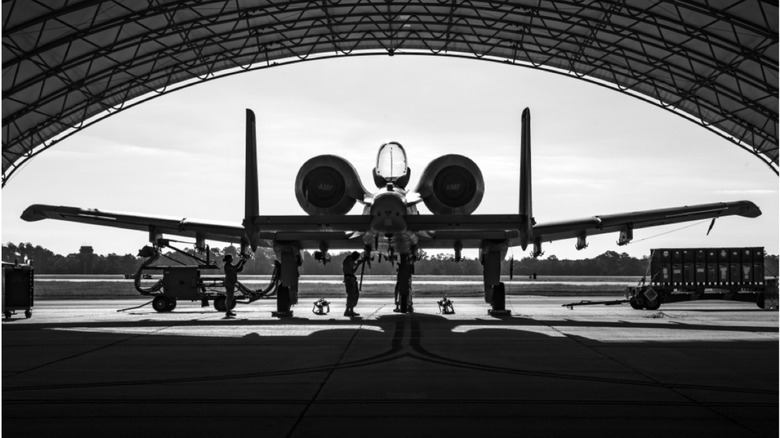
Reports vary about how many Warthogs are still in service today, but the range is somewhere between 260 and 280. That's not bad for an aircraft that's been in service for 50 years. The A-10 played a crucial role in the first Gulf War, flying 8,100 sorties and launching 90% of the AGM-65 Maverick missiles fired during the conflict. When Operation Desert Storm concluded, the Warthog boasted a mission-capable rate of nearly 96%. A few years later, it was heavily used during NATO's bombing of Yugoslavia at the height of the Kosovo War.
Since then, the U.S. Air Force has repeatedly requested to phase out the aging plane, but Congress has not deemed it cost-effective, given how useful the Warthog continues to be. As the military modernizes for 21st-century combat, it seemed the retirement of the A-10 was still inevitable, at least until the U.S. started a war with Iran. The Warthog suddenly found itself back in action, being used to target small, fast-moving boats and other coastal threats in the Middle East.
The aircraft briefly made headlines when one was shot down near the Strait of Hormuz — fortunately, the pilot was quickly rescued. There won't be a replacement for the downed plane, though, as no new Warthogs will ever be made. As for what aircraft could succeed the A-10 Warthog, there may not be a definitive answer, especially as there's nothing in the works and the military has focused its resources more on multirole aircraft, such as the F-35 Lightning II and F-15EX Eagle II. These planes, as well as a fleet of uncrewed combat aerial vehicles (UCAVs), may collectively fill the hole the A-10 leaves when the final Warthog is eventually retired.