

How Long After A Tire Rotation Should You Re-Torque Your Wheels?

A good set of quality tires can typically withstand everything from rough roads to bad weather, and a lot more. Of course, getting the most out of your tires means doing preventative maintenance as well, and that's where regular tire rotations come into play. But it's also a good idea to re-torque your wheels about 30 miles after your rotation. It's a practice that can potentially save you from some problems later on.
"Re-torque" simply means to re-tighten, as your lug nuts can loosen over time. This can sometimes be caused by heat, but motion can be a big contributor as well. Even the weight of your vehicle can add to the problem. Despite how well the wheel was secured during your rotation, exterior forces can impact your tires. Because of this, you may end up with uneven tread wear, or possibly a loose wheel, which could make for a dangerous situation.
It's important to note that your lug nuts may not move that much, if at all, when you re-torque them. After all, wheel and tire assemblies can vary, and if you don't drive that often, you might be just fine. In fact, you may be able to go from one tire rotation to the next without an issue. But it's better to be safe than sorry. When in doubt, stop by your local garage and have a technician take a look. It might cost you a little time, but it could save you some grief in the long run.
The proper technique for re-torquing your wheels
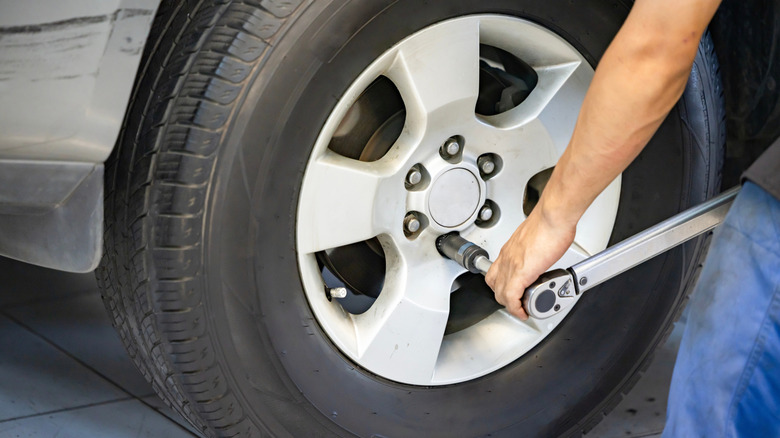
You might not rotate your own tires at home, but you can re-torque your own wheels. Before you begin, consult your vehicle's owner's manual. You should be able to find some useful information about the correct torque specifications for your make and model. This is important, because every vehicle is different in terms of how much force it takes to properly secure your wheels. Too little torque and your wheels could come loose. Too much, and you're risking possible damage to the wheel.
If you're re-tightening the lug nuts while your vehicle is on the ground, the weight of your car should keep the tires stationary. Be sure to park on a flat surface and put on your parking brake. Next, use a torque wrench to tighten each lug nut in a crisscross/star pattern to the proper specification according to your owner's manual. But beware that if you use a tire iron, you won't be able to achieve the exact torque as specified in your manual.
If you do have access to a lift and want to tighten your lug nuts that way, the biggest difference is that your vehicle will be off the ground. This is where an actual torque wrench will come in handy, as the wheel would be less likely to move as much during the tightening process. Just follow the same crisscross pattern, tighten the bolts to the proper specifications via your owner's manual, and you're all set.