

The US Navy Wants This Autonomous Sub For Deploying Heavy Payloads Under The Sea
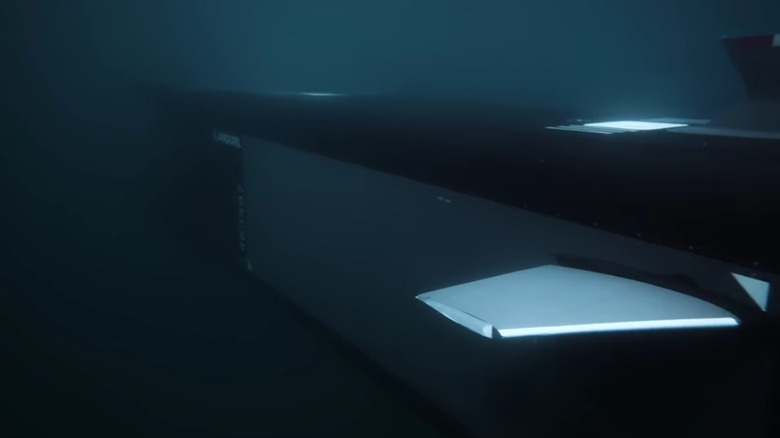
The use of drones and autonomous vehicles is continuing to rise. In a military capacity, this has allowed people in the service to access areas that would otherwise be incredibly difficult and dangerous to reach. While the public may be more familiar with how the U.S. military is developing new ways to deal with drones on the battlefield, this idea pertains to the depths of the ocean, too. This is why the U.S. Navy is so interested in the capacities of the Dive-XL, an autonomous submarine developed by Anduril.
In April 2025, the U.S. Navy announced the beginning of its Combat Autonomous Maritime Platform program. Its aim is to find partners that can deliver an unmanned and autonomous vessel capable of diving as far as over 650 feet below the surface. The vessel should be sizeable-enough to have the ability to dispatch payloads at these considerable depths, and boast a range of around 1,000 nautical miles. It was specified, too, that this autonomous submarine should be capable of handling equipment of varying sizes. This is particularly important because the possible scope of such a vessel's mission notably varies from reconnaissance to something considerably more offensive.
Anduril's Dive-XL has been selected to fulfill this role. Stretching 27 feet long with a 7-foot beam, it's far from the tiny, stealthy drone some militaries are so used to wielding in the air. Let's see exactly why this sub might be so important to the future of naval warfare.
Why the Dive-XL sub could be right for the U.S. Navy
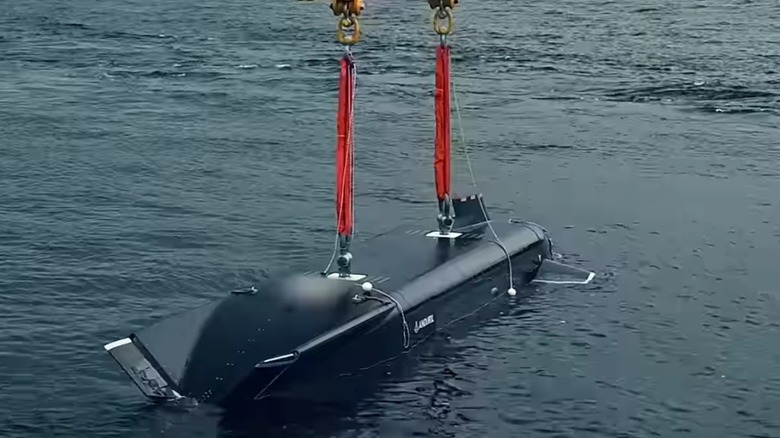
With a range of about 2,000 nautical miles and the capacity to reach depths of about 20,000 feet, the Dive-XL definitely meets the requirements established by the Combat Maritime Autonomous Platform. It's also designed to support single, double, triple, and extended payload configurations with a modular body. Powered with an all-electric power train that allows for long missions without surfacing, the Dive-XL can serve a variety of missions. An overly-specialized machine can only suit a niche role, while something like the Dive-XL is more versatile.
It's also designed to accommodate and deploy tech such as Anduril's Seabed Sentry, which is essentially individual Lattice AI-enabled cogs in an underwater communication and surveillance network. It also works with the Copperhead drone, an autonomous weapon that can be equipped with an explosive and is available in different capacities. The latter was specifically built to be deployed by a system like Dive-XL.
Anduril boasts that the capacity to stay underwater for long periods using pure electric power dramatically boosts the model's ability to "operate undetected, extend its range, and deliver payloads in contested maritime environments." This, according to the manufacturer, will be key to performing its role in an environment, and in a future, where it is unlikely to be the only autonomous vessel of its type.
The practicality of deploying the Anduril Dive-XL
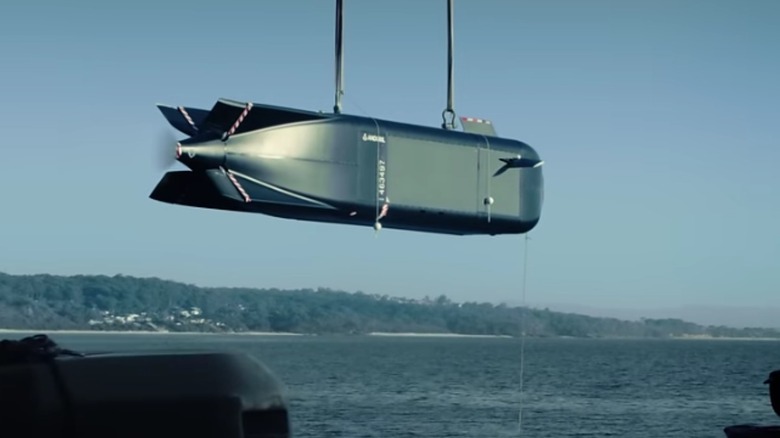
The U.S. Navy has wielded many deadly attack submarines, and this Anduril model will be a formidable, though far from conventional, addition to the ranks. The variable hull design will make it less costly as well as more versatile, all of which will help to accomplish the main goal of quickly accumulating an autonomous force that can dispense numerous drones. This can in turn ease the pressure on already-strained sailors of crewed vessels.
Anduril also claims that the system "enables warfighters to launch, employ, and recover the system flexibly at sea or ashore with minimal infrastructure and heavy equipment." To help with that, it's first got to be easy to get it to where it needs to be. That is why Anduril designed it to be launched and collected by ship or pier and transported via aircraft or truck. It can also be carried across water in a shipping crate.
There's no doubt that drones and autonomous vehicles will be an increasingly prominent part of warfare and defense in the future. The U.S. Navy clearly considers Anduril's Dive-XL to be a significant part of that equation, but how it will continue to evolve and which different functions it will be able to fulfill beneath the surface remain to be seen.