

Why Are Cars Called 'Cars' And Not Something Else?
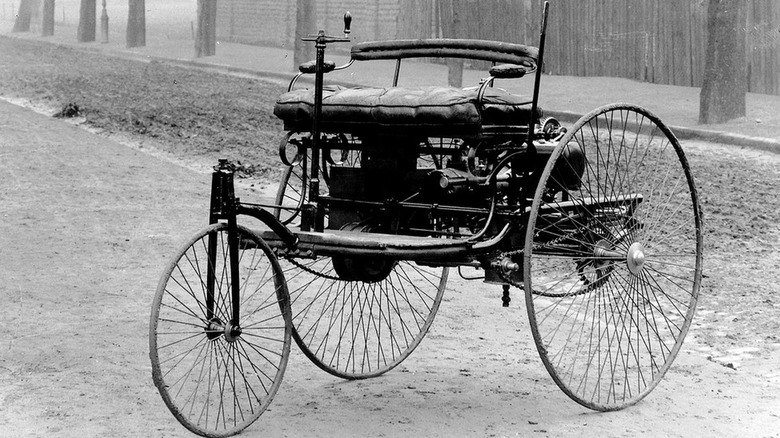
Automobile, jalopy, clunker, hooptie, wheels, rustbucket, ride, and land yacht are just some of the many different ways we refer to what started out as the horseless carriage. But why and when did we come up with the simple three-letter term of "car"? Well, it's convoluted, but first, we need to jump back to a time long before the first vehicles powered by internal combustion engines were ever a thought in the minds of inventors like Carl Benz or Gottlieb Daimler in 1886. The word goes even further back than the steam-powered tricycle built by French military engineer Nicolas-Joseph Cugnot in 1769, which was used to haul artillery.
Around 1200 BCE, a group of disparate tribes in central Europe began to band together, forming the Celtic culture. Their word "karros" was used to define a two-wheeled war chariot. It was eventually absorbed into Latin, which became one of the earliest languages in the Indo-European family ... thanks to the Etruscan people, whose original language most directly influenced what became Archaic Latin (circa 1000 BCE). Somewhere around the 7th century BCE, the Romans developed a written system and by 100 BCE had formalized it as Classical Latin.
With more than 60% of all English words having Greek or Latin roots, and with roughly 80% of all the entries found in an English dictionary based on a Latin precedent, it shouldn't come as a surprise that the word "car" is also derived from a Latin word. In this case, that word is "carrus" (or "carrum"), meaning a wheeled vehicle; more precisely, a cart (or wagon) pulled by some manner of draft animal like horses, oxen, or mules.
Car versus automobile
As Latin spread, so too did the word "carrus." By 1300, the Anglo-French speakers were using words like "carre" and "carretta" for a "wheeled vehicle," and the Old Irish and Welsh word for a cart or wagon was "carr." Even the Greeks eventually adopted the Celtic-Latin word, morphing it into "karron" for a "wagon with four wheels."
The Renaissance was a movement that began in the mid-1300s in Florence, Italy, and swept across Europe through the 17th century. Culture, art, and science all underwent a "fervent rebirth" as humanity emerged from the bleak Middle Ages, where the term "car" had generally come to mean something that carries. During this period, very complex mechanical systems capable of autonomous movement were first conceived by the likes of Leonardo da Vinci, Roberto Valturio, and Francesco di Giorgio Martini, whose designs were considered precursors to what would eventually become the automobile, another word that inexorably became intertwined with "car."
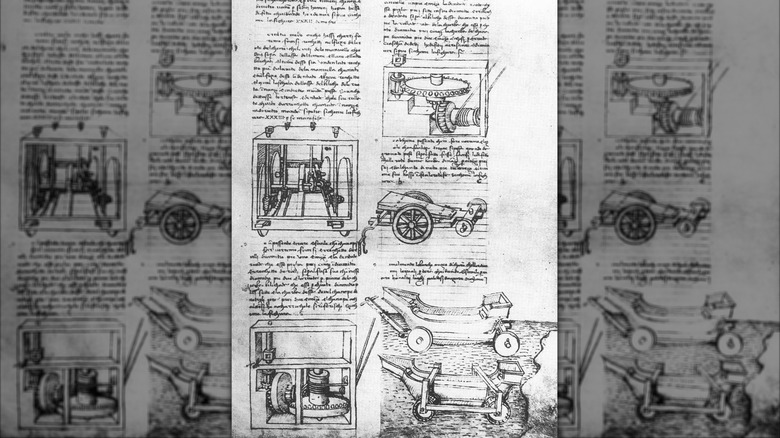
In 1465, Italian engineer and writer Roberto Valturio drew up a design for a cart powered by a pair of four-bladed propellers (not unlike the odd French contraption from 1932), connected to wheels through a series of gears that, in essence, pushed it around under its own power. More than a decade later (1479 and 1481), Francesco di Giorgio (aka Francesco di Giorgio Martini) drew highly detailed schematics for a "self-propelled" four-wheeled horseless carriage using machine-generated force. Between 1478 and 1493, the great Leonardo da Vinci put pen to paper and created his own version of a self-propelled cart powered by a system of springs and cogwheels.
We could have been perpetually tongue-tied
Pockets of people around the globe were surely using versions of the words "car" and "automobile" to describe all manner of moving carts and carriages (horseless or not) over a wide expanse of time. It's universally accepted that "automobile" was formed by combining the ancient Greek prefix "αυτό" (meaning "self") and the Latin word "mobilis" (meaning "that moves"). Some researchers contend it was used as early as the 18th century to describe trackless wagons, while others note it first emerged in French as an adjective in 1866, then as a noun in 1873.
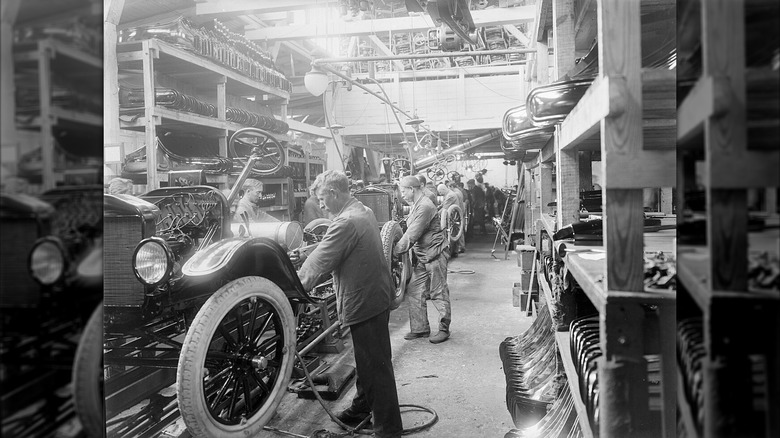
The word "car" was certainly used in the U.S. by the late 1820s as a descriptor for railway freight carriages (e.g., "railway car"). By the early 1860s, it had expanded to describe cable cars, streetcars, and tramway cars. Much in the same way it evolved from referring to train compartments to more localized modes of public transportation, it changed again to describe the "horseless carriage" as it went from one-off oddities to mass-produced mechanical marvels that forever changed the way we moved about our world.
In August 1897, "The New York Times" ran an article that many point to as the reason "automobile" took such a firm hold in the United States, stating that "the new mechanical wagon with the awful name automobile has come to stay" (via Jalopnik). However, before either word became solidified into our broader lexicon, other terms had been created: "autobaine," "autokinetic," "automaton," "automotor horse," "buggyaut," "diamote," "mocole," "motorig," "motor-vique," "Oleo locomotive," and "Truckle." All had their moments in the sun, but (thankfully?) none of these tongue-twisting exercises in verbal linguistics ever caught on.