

Why China's New Hypersonic Anti-Ship Missile May Be A Threat To The US Navy
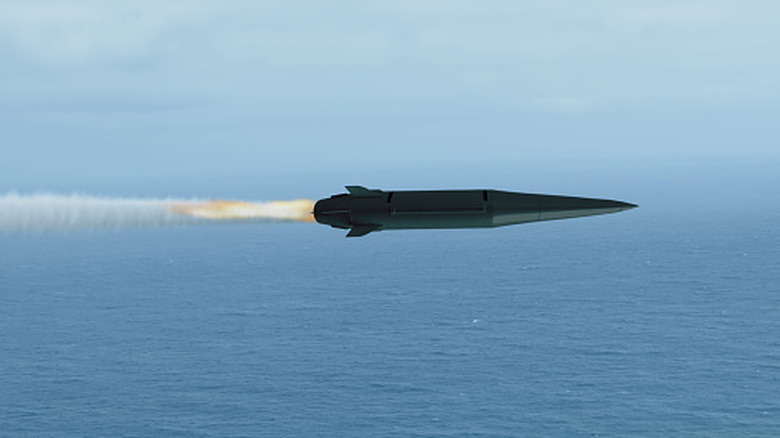
There's no denying that the People's Republic of China has led the world in the development of hypersonic missiles. The first modern hypersonic missile was produced by Russia, but China has seemingly surpassed it in variety, capability, and total weapons in its inventory. Its newest one could potentially endanger United States Navy vessels. China revealed the YJ-20 hypersonic anti-ship ballistic missile in September 2025 at its annual Victory Day parade, and it has Western defense officials taking note.
All anti-ship missiles pose a significant danger to U.S. warships, but when they're elevated to hypersonic, which is a speed of Mach 5 (3,836 mph) or higher, things get complicated. The YJ-20 is designed to strike and sink U.S. aircraft carriers, which makes sense, as they're the foundation of the U.S. Navy's strength. To counter threats from anti-ship missiles, carriers are at the center of a layered defense via their Carrier Strike Groups.
These include multiple types of surface and subsurface vessels that provide offensive and defensive capabilities to protect one another. Unfortunately, hypersonic missiles offer a complex problem in terms of interception. As of writing, it's almost impossible to intercept a hypersonic missile, and even if one were to be shot out of the sky, China has the arsenal to fire multiple YJ-20s at a single target, potentially overwhelming its defenses. While not much is known about the new hypersonic missile, the scant details that are available suggest that the U.S. and its allies need to step up their defensive game in countering these new, high-speed threats.
The dangers posed by China's new hypersonic anti-ship missile
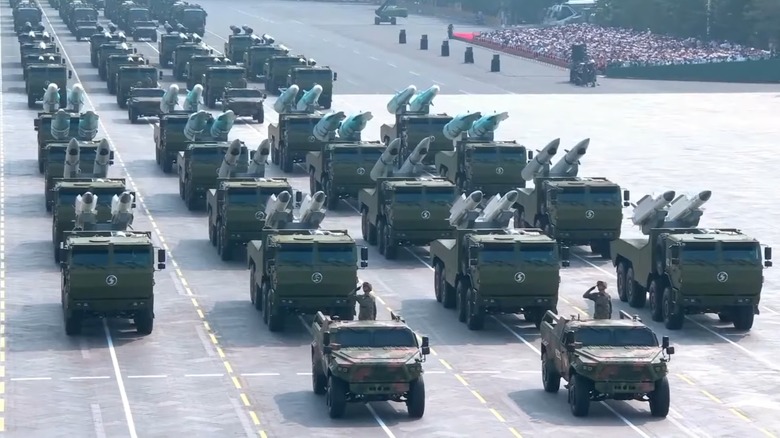
While most near-peer nations to the United States have a variety of anti-ship missiles, making them hypersonic is a huge technological leap that leaves most surface vessels completely vulnerable. A hypersonic missile travels at speeds of around one mile-per-second, a figure that's hard to fathom. As these missiles scream through the air, they fly so fast, the time between launch and striking the target is condensed to a point that onboard missile defense systems cannot keep up.
China will begin at-sea testing in short order, and it's likely that the YJ-20 will soon find itself in an operational status. While China isn't in the habit of attacking the U.S.' aircraft carriers, it maintains a ready supply of weapon systems to keep the fleet at bay. This kind of strategy requires an advanced offensive capability designed to mitigate the superior firepower and technological advantage presented by the U.S.' modern nuclear aircraft carriers.
China's advanced development of hypersonic missiles varies considerably, as the arsenal includes a variety of missile types that can reach the U.S. in as little as 90 minutes. For a ship that's in the water somewhere near China, that time would be cut considerably by a YJ-20, likely eliminating the Navy's ability to employ successful countermeasures and defenses. Because of this, the U.S. is working hard on the problem as the one-upmanship of technology continues between the two leading world superpowers.