

How Do Modern iPhones Stack Up Against An '80s Supercomputer?
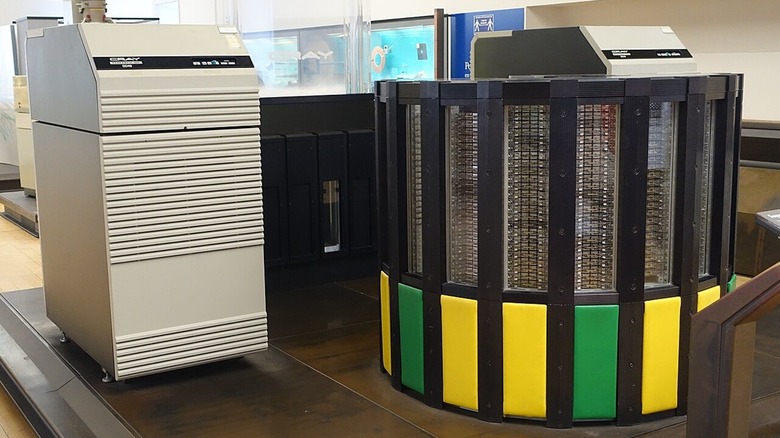
There is no denying that technology has improved — but by how much? People often take smartphones for granted. Everyone has one glued to their hand, with music, social media, texting, calling, and every app you can think of right at your fingertips at a moment's notice. However, you can get a better idea of how fast technology has improved by comparing a modern iPhone to the supercomputers of the 1980s — the ones that took up entire rooms (as modern supercomputers still do).
The CRAY-2 was built in the 1980s to handle extensive scientific research due to its record-breaking static memory and ability to rapidly calculate data sets with its vector processors. The Department of Defense and the Department of Energy used it for nuclear research, so it's a bit silly to compare it to a device made for TikTok doomscrolling and sending memes to your friends. However, that's sort of what makes the comparison even more eye-opening.
CRAY-2 vs. iPhone 17: Size and power
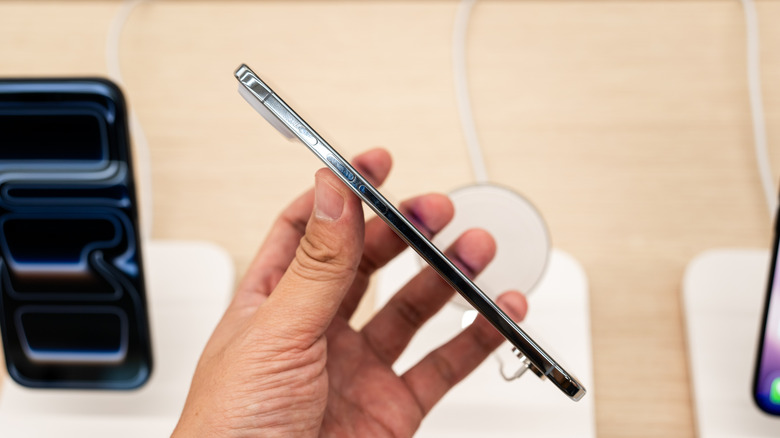
The CRAY-2 was 5,500 pounds and took up 16 square feet, compared to an iPhone 17's 6.24 ounces and 0.31-inch depth. Already... Wow. But that size doesn't really mean anything in modern tech — most companies are hoping to pack as much capability into the smallest devices possible.
The CRAY-2 was the fastest computer in the world back in 1985. With its four vector processors, it operated at 1.9 billion FLOPS (floating-point operations per second), meaning it could do that many mathematical calculations per second. But don't be amazed just yet — the iPhone 17 can do 5,000 times as many calculations.
To compete with modern iPhones, Adobe calculated that the CRAY-2 would have needed to weight 27.5 million pounds and would take up 80,000 square feet. It would have been more like a tech company's massive campus rather than something you take out of your pocket to watch cat videos on Instagram. iPhones basically have more power and speed despite being incredibly smaller, but the CRAY-2 was doing important scientific research so it's not exactly apples to apples.