

California's High-Speed Rail Just Took A Huge Leap Forward Towards Completion
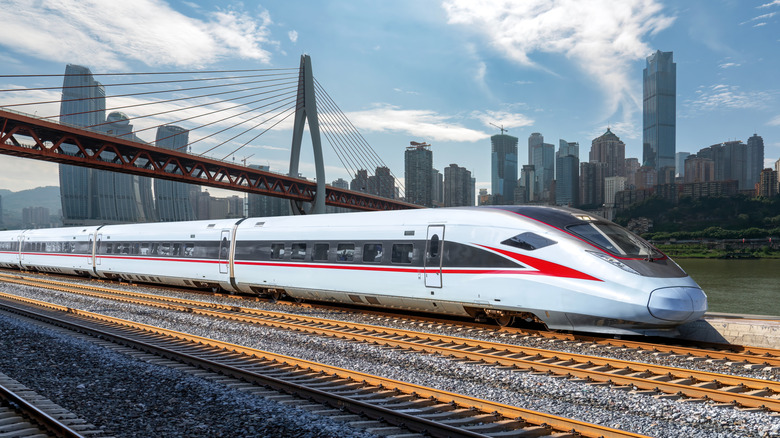
High-speed rail, or train systems that are capable of speeds of at least 186 mph, simply doesn't exist in the United States. High-speed rail had its start in Japan in 1964 with the bullet train, and only one year later, President Lyndon B. Johnson signed the High-Speed Ground Transportation Act into law, seeking a similar system in the United States. Sixty-one years later, multiple countries have robust high-speed rail systems, including China and much of Europe. We've landed a man on the moon and completely mapped the human genome, but high-speed rail has yet to take off in the U.S. In California, however, change is on the horizon.
Described as "a bold vision to transform the state's future by delivering fast, reliable, zero-emission train service," a high-speed rail system is being planned in two phases across Northern California, Central Valley, and Southern California. The project, delivered by the California High-Speed Rail Authority, faces skepticism from the public and critics alike, with Forbes describing the project as a "disgraceful boondoggle," in 2025.
However, the project recently hit a major milestone that literally paves the way for future success. Less than a year after construction started, work has been completed on a railhead facility located on 150 acres in Kern County. This facility will serve as a logistics hub, receiving, storing, and finally distributing material before it moves to active construction zones where workers can begin laying rail. Let's see what is next in this ambitious project.
The high-speed rail project is planning to soon lay tracks
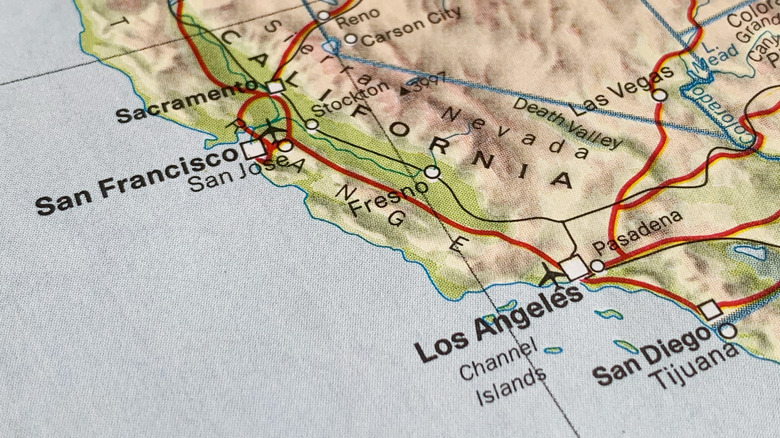
The first phase of the high-speed rail project encompasses 494 miles and is designed to connect San Francisco and Los Angeles. Because the new trains will reach speeds much higher than even Amtrak's Acela, the route will take less than three hours, with stops in San José, Fresno, Bakersfield, Burbank, and more. The second phase extends the route to Sacramento and San Diego, with stops in Stockton, Modesto, San Bernardino, and Riverside.
The new hub just south of Wasco, California is equipped with six rail connections for receiving and sending out equipment and supplies, with 10 miles of temporary rail lines that connect it to the national freight network. The facility also has a workshop and maintenance yard, along with the warehouse that stores everything needed for a new high-speed line, including rail, concrete ties, fiber optics, and crushed rock.
Now that the hub is open, crews will start staging material to lay tracks. The High-Speed Rail Authority eventually plans to open another railhead further north to support the project when it moves on to the second phase. Ultimately, the opening of the railhead marks a distinct shift in the project, from preparation to actual construction, something many critics thought they'd never see.
Other states have ambitions for high-speed train projects too

There are still lawmakers that support a national high-speed rail system, including Representative Seth Moulton of Massachusetts. In 2020, Moulton pitched a $205 billion national rail system that would be funded by the federal government. He re-introduced the bill with some support from fellow lawmakers in 2024, but it appears to have stalled.
Meanwhile, there are a few other high-speed rail projects scattered across the country. In Nevada, an affiliate of the company behind the Orlando-Miami train line is planning a 218-mile high-speed train line linking Las Vegas to Rancho Cucamonga, California. It will be constructed on land between the north- and southbound lanes of I-15, simplifying the project by avoiding negotiations with private landowners. Service is expected to begin in late 2028.
There's also a plan being partially funded by Microsoft for a high-speed line connecting Portland, Oregon with Vancouver, British Columbia in Canada, but it's still in the planning stages with some critics arguing that it makes more sense to improve service on the Amtrak lines that already exist in the region. In Texas, a line connecting Houston and Dallas was proposed way back in the 1990s. In 2023, Amtrak assumed control of the project, receiving a $64 million federal grant. It's now on the hunt for private partners for the 240-mile route.