

This Ford Trapped In Ice Over 40 Years Ago Is Finally Back On Dry Land
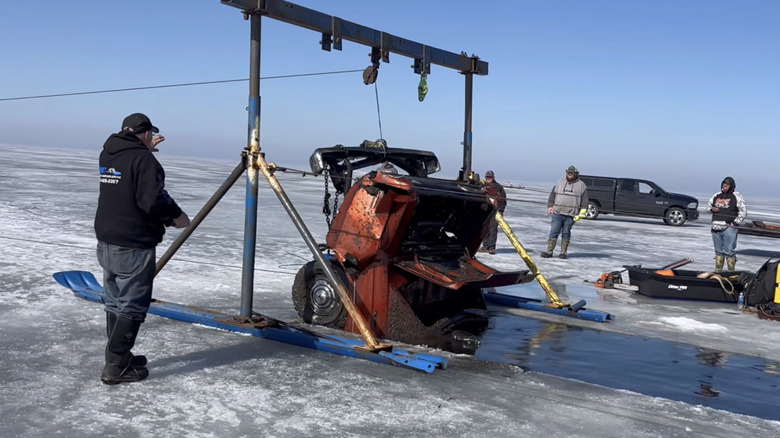
Driving on frozen lakes is not unusual in Wisconsin — people do it all the time for ice fishing. But there's a difference between parking on thick ice for a day's haul and trying to cross an entire lake for no good reason. The latter is exactly what happened somewhere around 1980. A guy at a bar in Stockbridge, Wisconsin, made a bet after a few drinks. The wager was that he could drive his four-door 1973 Ford Galaxie 500 across frozen Lake Winnebago to get to Oshkosh, roughly ten miles away. That's Wisconsin's largest inland lake, by the way. And the car is a heavy, full-sized sedan weighing between 3,900 and 4,000 lbs. Still, he felt confident enough to actually go for it.
He did not make it. About two miles out from Twilight Beach Road, a road located on the east shore of Lake Winnebago, the ice buckled under all that weight, and the Galaxie dropped straight to the bottom. Thankfully, the driver did manage to bail out before the car went under completely. He then simply walked all the way back to shore, soaking wet.
Perhaps the saddest bit was that without the car sitting there as proof, the whole thing eventually turned into one of those stories that nobody quite believed. As local Tom Zahringer told WLUK-TV FOX 11, "There's many discrepancies on the car and the true story. It's been told now for 45, 46 years now." Some people thought it was completely made up. Turns out, a fisherman named Randy Bodinger from the nearby town of Chilton would prove them all wrong about three years ago when his sonar picked up something unmistakable sitting in the mud.
A four-hour crane job and a lot of clams
Bodinger told the publication that the initial discovery was actually pretty nerve-wracking. When you find a vehicle sitting at the bottom of a lake, you don't know if someone is still inside it. He reported the find to authorities, and for a while, that was that. After all, it's not entirely unknown for classic cars to be found underwater in lakes like this. It wasn't until early March 2026 that a recovery team from a group called Sunk Dive Ice came out to survey the exact location and figure out how deep the car was sitting.
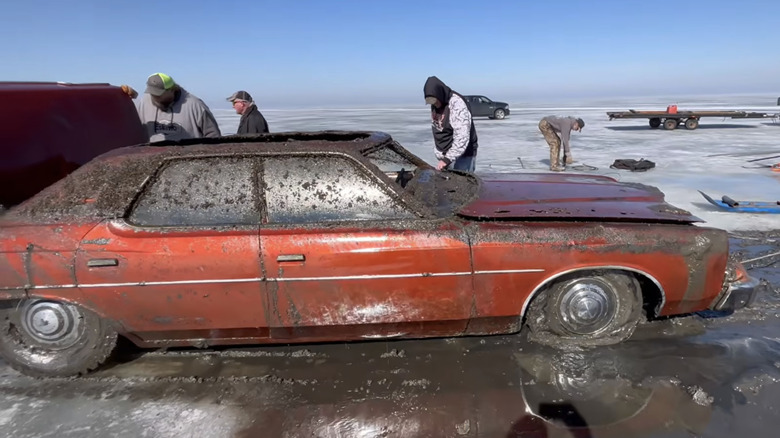
On March 3, they got to work. The crew brought an ice-cutting machine and a crane, and sent a diver down to strap the Galaxie to the rigging. The whole process took around four hours. As shown in the clip uploaded to YouTube by Sunk Dive Ice, the rear bumper broke the surface first, then the trunk lid, then the wheels, and finally the rest of it. The red paint was still intact, which is kind of wild.
Meanwhile, the roof had been almost entirely eaten through by rust, and both the windshield and rear window were gone. Inside the cabin, there was nothing but mud. Clams and snail shells had attached themselves to whatever metal was left. As for the engine, well, new car engines can barely work underwater, let alone work after being submerged for over four decades. Zahringer told the news crew that people had been traveling just to come look at it, and that they'd leave it out as a conversation piece before figuring out if anyone wanted to claim it.
What the Galaxie 500 was like in its heyday
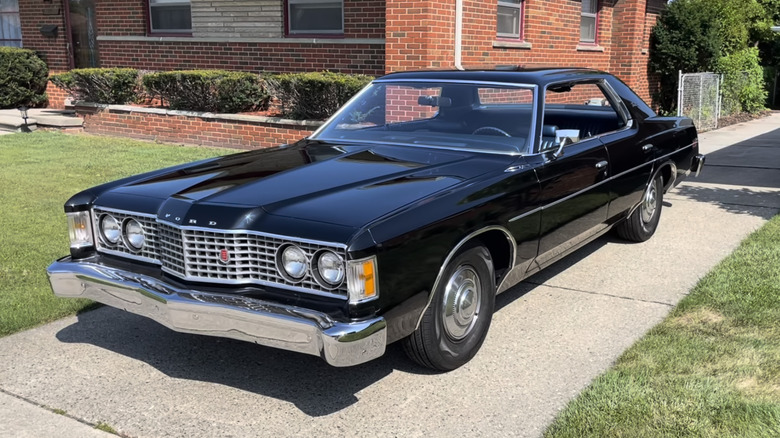
The Ford Galaxie actually has a pretty interesting backstory on its own. Ford gave the name to the most expensive version of its Fairlane 500 back in 1959. The whole country was deep into the Space Race at that point, so anything with a space-adjacent name had built-in appeal. A year later, Ford broke it out as its own car entirely. It ran through four generations before the last one rolled off the line in 1974.
The 1973 model that ended up at the bottom of Lake Winnebago belonged to that fourth and final generation, which ran from 1969 to 1974. These were big cars on a 121-inch wheelbase, and Ford offered a wide range of engines for them from its 385 series V8 family. That particular year saw the introduction of Ford's 460-cubic-inch V8, the largest engine ever dropped into a Galaxie. But like every other car from the early '70s, the model was dealing with tightening emissions rules that sapped its power. By 1974, Ford quietly retired the Galaxie name entirely in favor of the LTD, and that was it. Today, fourth-generation Galaxies actually remain some of the more affordable classic Fords you can find on the secondhand market.