

Kia's 2026 Carnival Hybrid Will Change Your Mind On Minivans
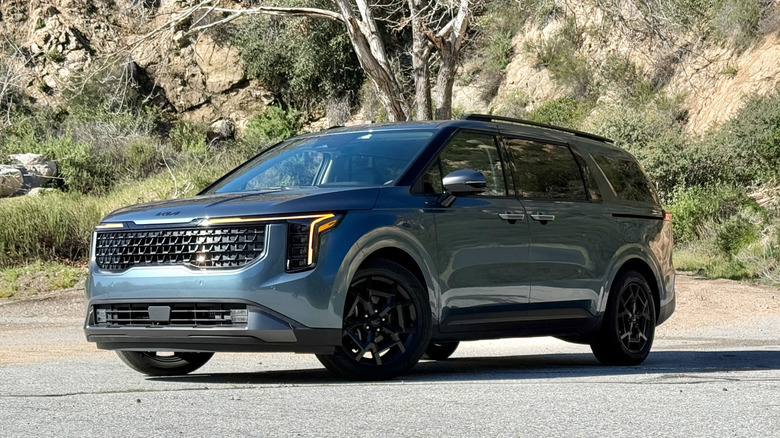
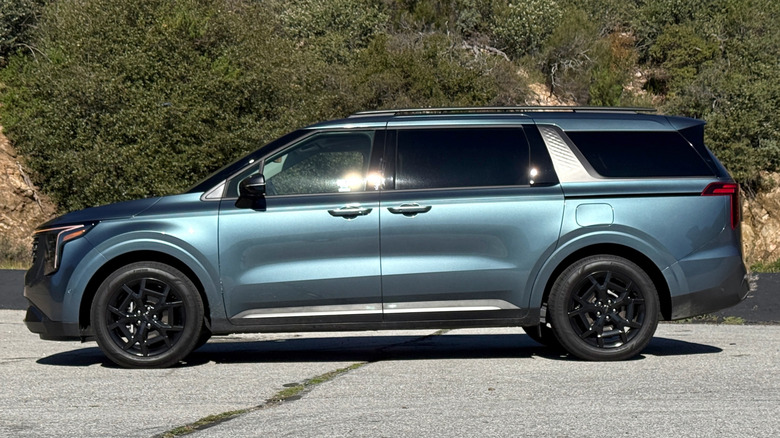
The Kia Carnival's styling tells a story. It says that it's a minivan trying to shake the uncool minivan image. There's no droopy front end, no soft corners, and no bland persona. The Carnival lives in the world of SUVs — or at least that's where it takes its biggest curb-appeal swing. SUVs dominate sales, and big, bulky family haulers line suburban driveways across America because we're concerned with what people think of us, instead of focusing on places where our money would be better spent: minivans.
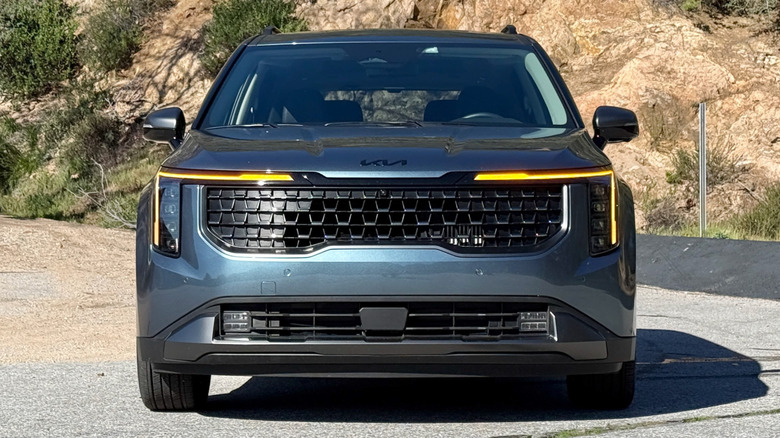
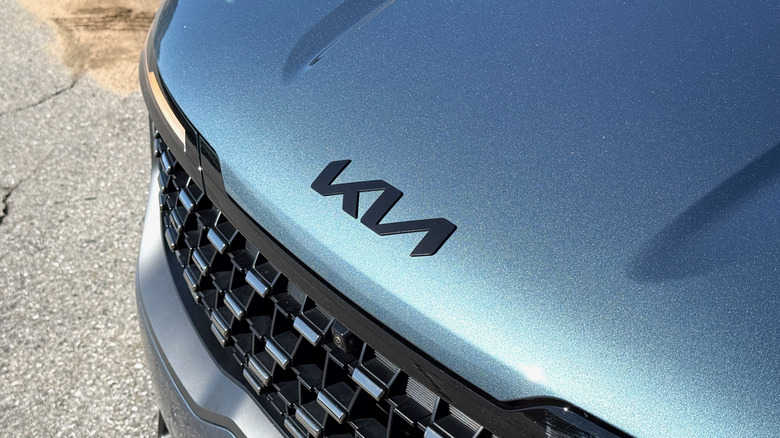
But the Carnival attempts to avoid that trap altogether. It's got bold "SUV-Inspired" styling that won't embarrass you in the carpool line at your local primary school. It's got squared edges, slicing angular headlights, and a big grille that says, "No, I totally promise, I'm an SUV."
 Travis Langness/SlashGear
Thankfully, its aesthetic choices don't have a negative effect on its core mission: providing a spacious, comfortable cabin, impressive fuel economy ratings, and lots of cargo space. After putting the Honda Odyssey through its paces recently, I was curious to see how the most-efficient version of the Kia Carnival stacked up in the minivan class, so I asked Kia for a loaner to see which one I'd prefer living with on a daily basis. The Kia offers much better fuel economy, and on the page, it's similar in terms of overall space and available features.
The hybrid makes financial sense upfront
There are two versions of the Kia Carnival: a standard V6-powered model and a hybrid. The V6-powered version starts with a base LX trim at $38,935 (including $1,545 destination fee). The Carnival Hybrid doesn't offer the bare-bones LX trim, so it starts with the LXS at $42,935 – a $2,000 premium over the V6 version of the same trim level. That premium carries its way up the rest of the trim levels, making for a pretty simple cost-benefit analysis.
 Travis Langness/SlashGear
Just $2k extra will get you the hybrid powertrain and all the same equipment along the way. Gas prices are fluctuating pretty significantly right now (also known as skyrocketing), and even the cheapest states for gas are still pretty expensive, so that $2,000 difference will likely pay for itself in a hurry.
The trim that was available from Kia, and the one I ended up testing, was at the top of the ladder: The SX Prestige. It had a starting price of $55,035 before any options were added on, and the as-tested price was even higher: $57,985. That's pretty costly, but there's a lot of kit worth mentioning, starting with the powertrain.
A loss of power but a big gain in fuel economy
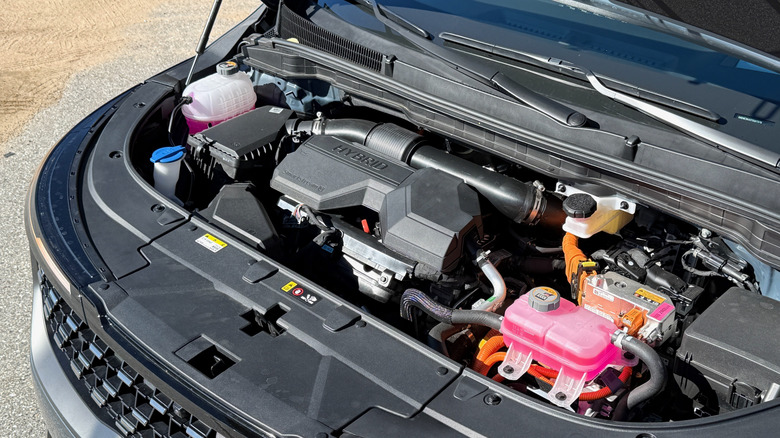
While hybrid powertrains can sometimes offer more power than their non-hybrid counterparts, that's not the case with the Carnival. The standard version of the Kia van with its 3.5-liter V6 makes 287 horsepower and 260 lb-ft of torque — nearly a dead-even match with the Odyssey at 280/262. The Carnival Hybrid, with its 1.6-liter four-cylinder engine and 74-hp electric motor combo, makes just 242 hp, but it nudges torque up to 271 lb-ft.
That power difference is already marginal, but it becomes even less consequential when you look at the gap in fuel economy. According to the EPA, the standard Carnival will return 21 mpg combined (18 city/25 highway). V6-powered rivals like the Honda Odyssey are similar, with an EPA estimate of 22 mpg combined. The Carnival Hybrid? It clocks in at 32 mpg combined (34 city/31 highway), and while that doesn't beat out the class-leading Toyota Sienna with its 36 mpg estimate, it's still a big improvement over the base V6. What's more, the EPA estimates that the Carnival Hybrid can go over 600 miles on one tank of fuel.
It's not a tire-roasting sports-van but, with the hybrid powertrain, the Carnival has enough power for most situations. Freeway on-ramps, long uphill grades, and carting around the kids to soccer practice should be no problem. With flat-footed acceleration, the four-cylinder engine does sound a bit stressed, but it's up to the task of hauling around its own weight and then some. It can even tow a 2,500-pound trailer if you need it to.
Getting your money's worth
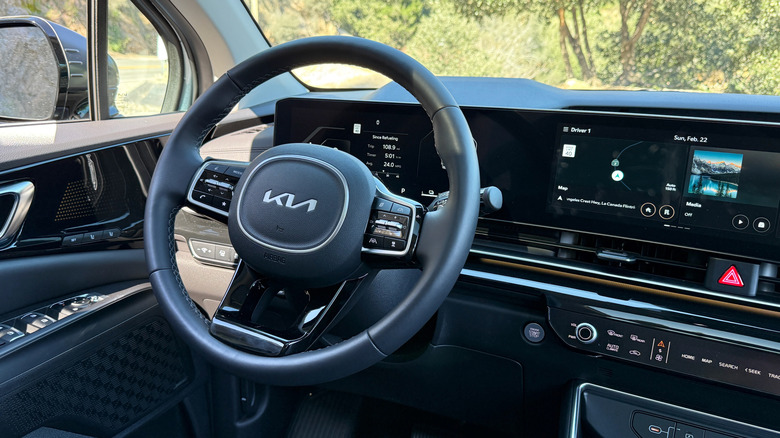
More than just efficient and capable, at the Carnival's SX Prestige level you won't want much for equipment or creature comforts. It comes standard with LED headlights and fog lights, dual 12.3-inch screens, a head-up display, wireless Apple CarPlay and Android Auto, wireless smartphone charging, a Bose stereo, a minimum of six USB charging ports (keeping the family's devices charged is paramount for road-trip peace), dual power-sliding doors, tri-zone automatic climate control, heated and ventilated front seats, heated steering wheel, dual power sunroofs, a power liftgate, and leather upholstery.
 Travis Langness/SlashGear
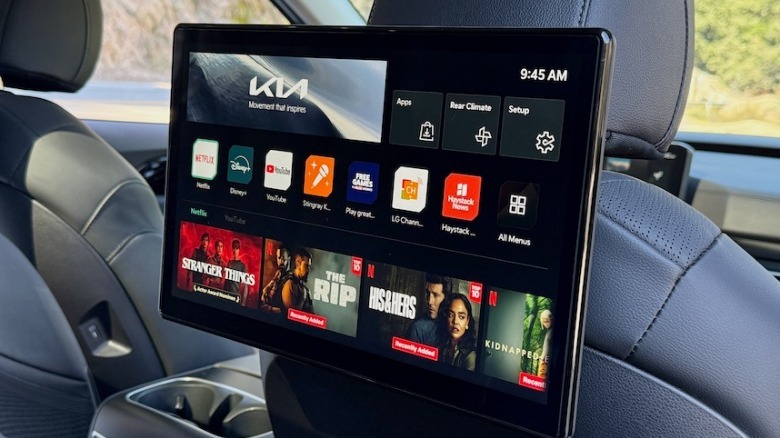
If all that gear isn't enough, there are some additional options you can select for maximum prestige. My test van came with the rear-seat entertainment package ($2,500) which gives you the massive dual rear screens, along with optional Astra Blue paint ($495), and a few smaller items like floor mats. All this gear, along with the Carnival's impressive build quality, make for a pretty luxurious vibe. The leather upholstery and other high-contact surfaces don't feel particularly plush, but they do feel sturdy, like they'd hold up to abuse over time.
Handling and steering get the job done, braking less so
While it wasn't particularly sporty, even by minivan standards, the Carnival did get me through some corners and curves without many complaints. No big squealing tire noises or undulating body motions, no unpredictable handling characteristics — just a simple family vehicle making its way through the world. The steering was well weighted, and the steering wheel itself had a nice, hefty feel in my hands.
The regenerative brakes on the Carnival Hybrid, though, were a bit fussy during my test. Every time I came to a stop, I could physically sense the hand-off between the Carnival's regenerative hybrid braking system and the physical disc brakes, and the transition wasn't very pleasant. The brakes brought the Carnival to a stop just fine, but at slow speeds, things felt a bit jerky. It took a few days to get used to the transition, and although the system can be adjusted, it didn't make a big difference in the driving experience. If you want something entertaining or engaging to drive, it's probably best to look at the Kia's competition.
Everybody needs a place for their stuff
The Carnival is excellent at providing places for all your stuff. There are cupholders, cubbies, and pockets all around you in virtually every seating position. Few manufacturers offer the sort of versatile small-item storage that leaders like Honda have been providing for years, but Kia is really giving them a run for their money in this department.
 Travis Langness/SlashGear
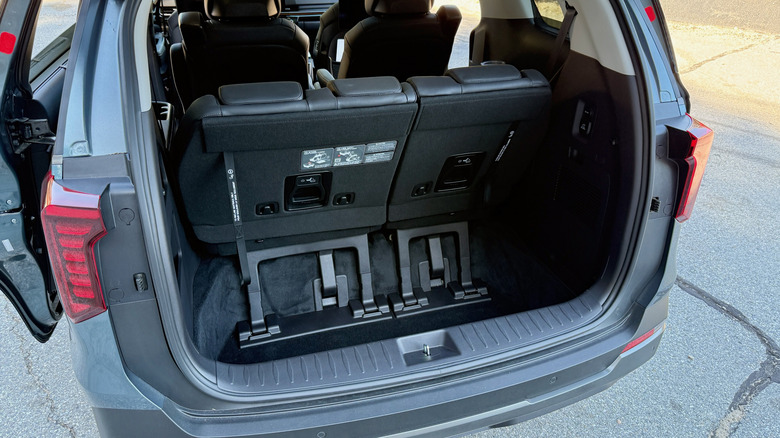
Behind the third row of seats, the Carnival offers 40.2 cubic feet of cargo space, and with seats folded and cargo space maximized, the overall cargo space measures 145.1 cubic feet. Those class-leading numbers are certainly enough to help a friend or two move, and way more than enough to load in several carry-on suitcases on the way to the airport.
A bit like a below-ground bunker, the dug-down cargo area in the Carnival's trunk is an impressive use of space, too. If you've got all three rows of seating filled up, you can use the area for luggage of all shapes and sizes, keeping things from falling out when you open the liftgate. Or, if you're making your weekly run to the grocery store, your bags can be placed below the belt line so they don't tip over on the ride home.
There's comfort and space, but there's a ceiling for both
Whether it was going over broken city streets or rough highways, the Carnival Hybrid was impressively comfortable. With 19-inch alloy wheels and tires that offer plenty of sidewall, the small bumps are absorbed, and the suspension does a good job at tackling the bigger stuff. Along with all its other impressive equipment, the SX Prestige has sound absorbing front-door glass, and the van I tested had the available second-row absorbing glass too, which meant the ride was quiet at highway speeds.
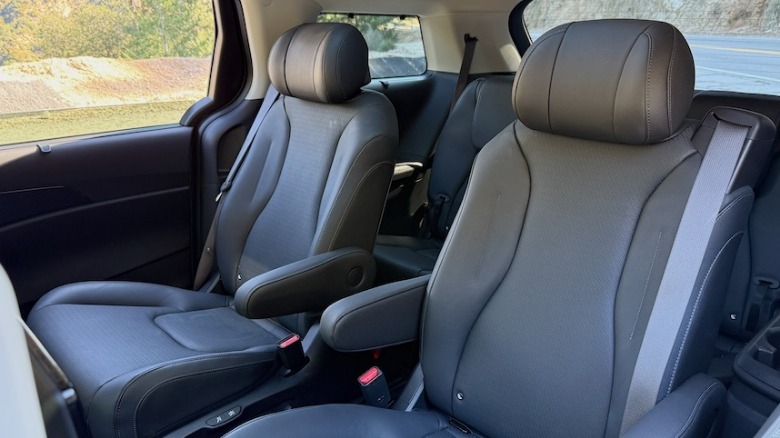
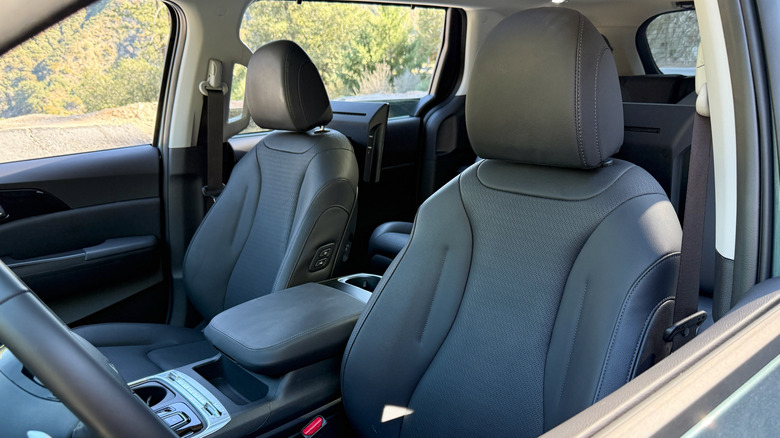
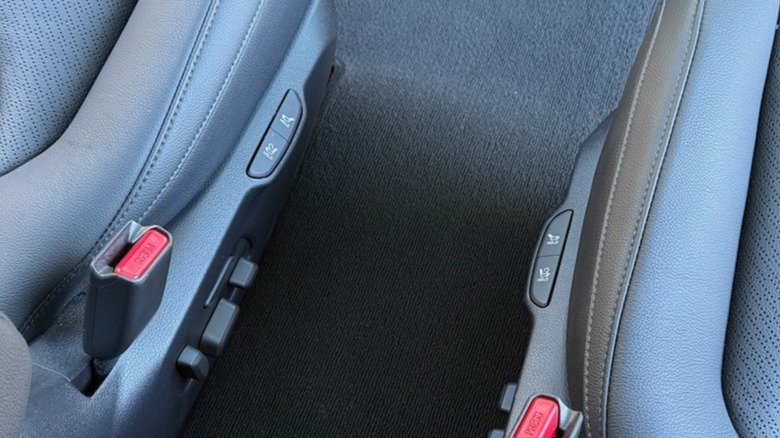
The front-row seats were comfortable, supportive, and well-padded, with lots of room to spread out for adults. The power lounge seats in the second row, with their leg extension and comfort headrest, were a treat, too. The mechanical components in those seats, however, clearly weigh them down. The second-row seats were slow and a bit difficult to adjust, and the controls to adjust them are located in a tough-to-reach location, at least with my big mitts for hands.
 Travis Langness/SlashGear
Slightly surprising and a bit less impressive than the first two rows, however, was the limited legroom and headroom in the third row. With some adjusting, there's enough room back there for adults, but it's not the largest third row in the class by a significant margin. In the third row, the Carnival offers 35.6 inches of legroom, a bit behind the Odyssey's 38.1 inches, but even further behind the Sienna's 38.7 inches of third row space.
Lots of driver aids, but they could use some tweaking
The Carnival has a number of standard and optional driver aids, and the SX Prestige gave me the chance to test nearly all of them out. There's an excellent high-res 360-degree parking camera, driver attention warning, rear cross-traffic collision warning, blind-spot monitoring, and blind-spot cameras that activate when you put on your turn signals.
The aids I interacted with the most, like adaptive cruise control, lane-departure warning, and lane-keep assist, were all a bit over-sensitive for my taste (and considering the aggressive nature of LA traffic). The adaptive cruise control, for instance, maintains a distance between the Carnival and the car it's following that allows for all sorts of other traffic to sneak in, even on the setting that's meant to allow for the least distance.
Going even further, the adaptive cruise control slows the Carnival down significantly around corners, dropping by as much as 5 or 10 mph for relatively slight curves in the road. That might be fine for someone using the system on sparsely-traveled rural roads, but in a city with aggressive drivers looking for the fastest lane, it'll get you cut off on a regular basis.
2026 Kia Carnival Hybrid verdict
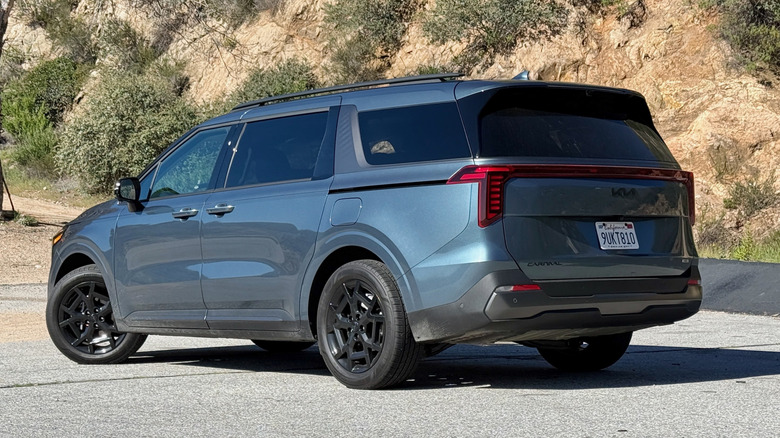
If the Carnival's two main goals are efficiency and versatility, then those two items have been authoritatively checked off the list. It's not the most efficient minivan you can buy, but it's one of the top performers in a small segment, and it does offer the rare choice between a traditional V6 and a fuel-sipping four-cylinder hybrid — an option few competitors have. The Carnival's use of space is pretty smart too, with a thoughtful approach to the location of cupholders, USB ports, and big storage areas like the drop-down trunk. It looks the part with its SUV styling, and if you're embarrassed to drive a 'van, this one might be the least-embarrassing-looking one out there.
Where the Carnival could use a bit of improvement, though, is on the secondary items. The in-cabin tech, while easy to use, isn't the simplest in the class. Passenger room, while adequate, doesn't quite reach class-leading status. And, as if to round out the theme, the cabin is quiet and comfortable, but not quite as posh as some top trim levels on other vans. It's also a bit pricey, but then so are its rivals. The latest Toyota Sienna, for instance, is also a strong choice with excellent fuel economy, but at a cost.