

How Quickly Can A Navy Supercarrier Travel From The US To The Middle East?
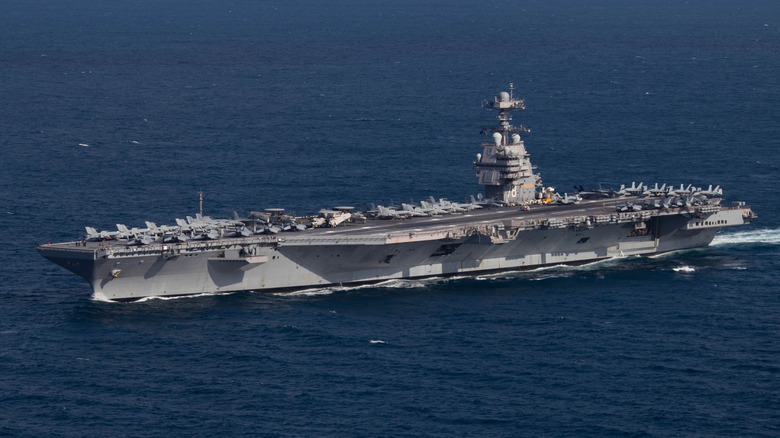
Aircraft carriers are the largest and most complex warships ever built. These behemoths are capable of projecting military air power thousands of miles from home. China's new aircraft carrier looks powerful, but the US Navy still has the largest and most technologically advanced fleet of aircraft carriers.
These ships can travel vast distances without refueling thanks to their nuclear propulsion. But when tensions rise in regions like the Middle East, a question often arises — just how quickly can a carrier strike group actually reach the area from the U.S.?
There are, of course, a multitude of variables to consider. Sea conditions, operational considerations, course deviations, and more will all affect this figure. But, for the sake of simplicity, if you throw all these factors overboard and look at the sea journey time to the Middle East in perfect conditions it's fairly simple math.
A reasonable starting point for the trip would be Naval Station Norfolk. From here, the most direct route would be across the Atlantic, through the Mediterranean and the Suez Canal into the Persian Gulf. Assuming a destination close to the Kuwait shoreline, this is a journey of around 8,560 nautical miles (9,850 miles). It's believed that the USS Gerald R. Ford, which is the most powerful aircraft carrier ever deployed, has a top speed of over 30 knots, but let's round it to an even 30 knots (about 35 mph). Apply some arithmetic, and we can infer that the optimum time for the journey is just shy of 12 days.
What factors can affect the journey time?
That time estimate dismisses some real-world factors that need to be considered. Perhaps most obviously, this time is only achievable if the carrier powers through the Suez Canal at that same 30 knots. While this would undoubtedly be a breathtaking spectacle, it's neither feasible nor allowable.
The canal has a speed limit of about 10 mph for ordinary vessels and about 8.5 mph for larger vessels. As the Gerald R. Ford is the world's largest aircraft carrier, it's reasonable to assume it fits into the latter category. So, there would be a speed restriction for the 120-mile length of the canal.
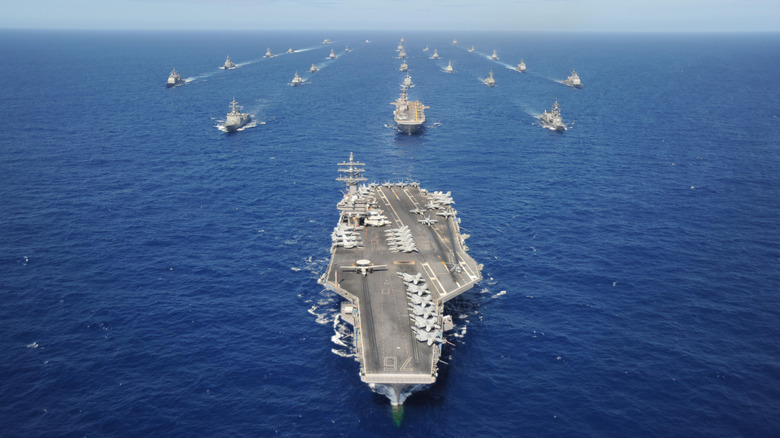
Another factor that can influence the journey time is the speed of the carrier group itself. While a nuclear-powered carrier may be capable of exceeding 30 knots, it rarely travels alone. Instead, it operates alongside a convoy of support ships. Rear Admiral Paul Lanzilotta, commander of the Gerald R. Ford carrier group, told Military.com, "Within one day, we can move this whole strike group 700-plus miles." While this is impressive, it pegs the top speed to about 29 mph.
Using these assumptions, the numbers obviously change. Applying an average speed of 29 mph to the 9,730-mile open-water stretch, then adding the slower Suez Canal transit, gives an estimated journey time of roughly 14.5 days. Of course, this is plain sailing without delays like when entering the canal, for instance. It's therefore reasonable to assume a journey time of just over two weeks to be about right.