

This Boeing Prototype Pioneered The Aerial Refueling Tech America Still Uses Today

The Boeing KC-135 Stratotanker is a widely used aerial refueling plane that's been in continuous service with the United States Air Force for over 60 years. The Stratotanker looks a lot like a Boeing passenger plane, and its set of CFM 56 engines are identical to what powers a 737. But the development of the Stratotanker is more of a case of divergent evolution than militarizing a passenger plane.
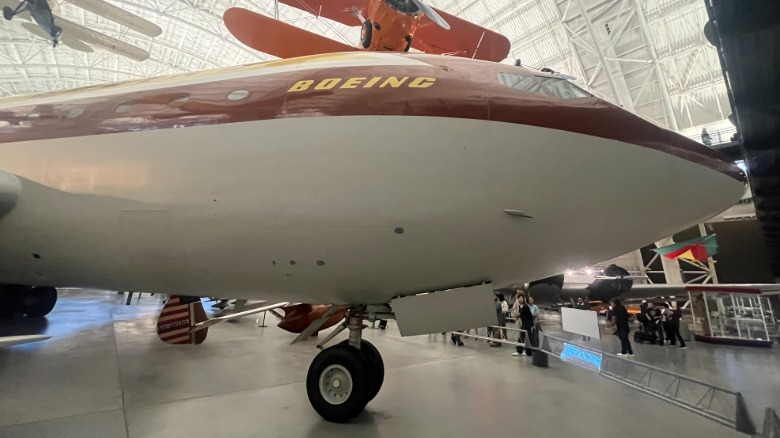 Alex Hevesy/SlashGear
In 1954, Boeing was developing the 367-80 prototype that, if you see it in person at the Air and Space Museum's Udvar-Hazy Center (like I have), looks a lot like a modern airliner. Boeing had a dual-purpose with what would be called the "Dash 80." Not even a decade after World War II ended and in the thick of the Cold War, Boeing first showed the Dash 80 to military personnel, and then to the air travel business.
To the businesspeople in charge of the airlines the Dash 80 was impressive. Boeing would eventually develop the prototype into the Boeing 707, a legend in aviation history.
The sales pitch worked
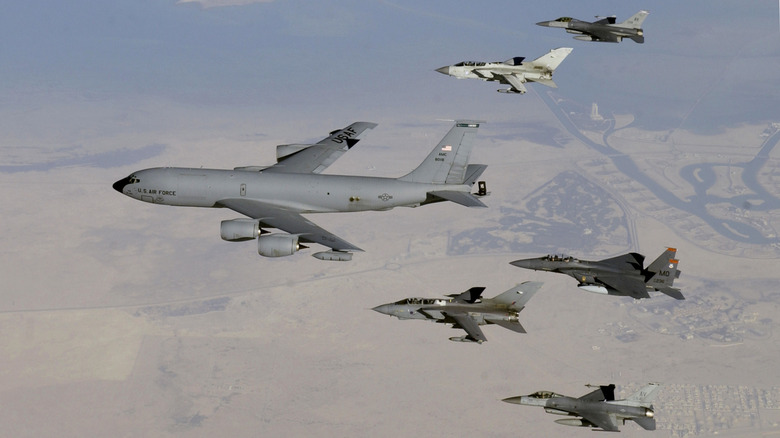
The military was also impressed. 29 aircraft that would eventually become KC-135s were ordered that year in 1954. 732 Stratotankers would eventually leave the assembly line. The Air Force wanted the Dash 80 widened by a foot to accommodate more flexibility as both a tanker and transport aircraft. In 1955, as the Dash 80 was getting shown to the world, test pilot Tex Johnston managed to perform a few barrel rolls in the prototype to get more buyers hyped and to show off what the plane was capable of.
The rest, as they say, is history. 72 years later and the Air Force and Air National Guard are flying the cousin of one of the first ever jet airliners. The current iteration of Stratotanker is a bit different. Namely, it is much more powerful at 86,536 pounds of thrust compared to the Dash 80's 40,000, and the avionics are firmly in the 21st century, given the Stratotanker's sometimes dual role as a command center or reconnaissance plane.