

America's Abandoned Coal Mines Could Become Massive Underground Batteries
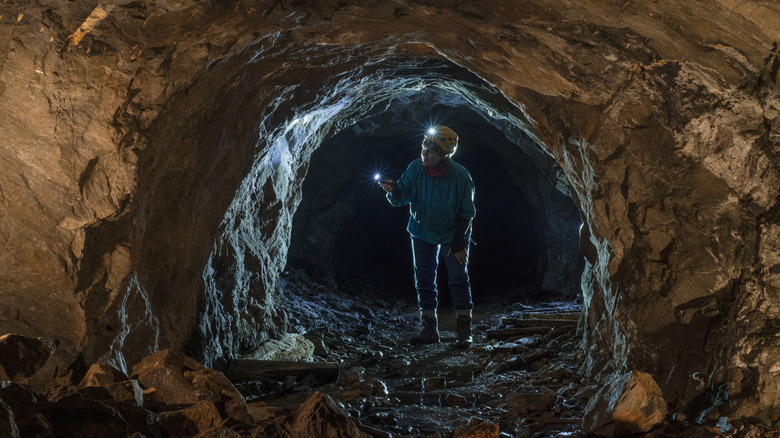
Across the US, hundreds of thousands of abandoned mines sit scattered across the landscape. Many of these are coal mines, relics of an industry that once powered the country. There is, therefore, more than a touch of irony to be found in the fact that these mines could be repurposed to store the energy gathered from renewable sources like wind and solar.
The premise is simple, and follows similar lines to another scheme called UGES, which could also transform old mines into batteries. Both schemes utilize the principle of gravitational potential energy. This scheme uses excess electricity to pump to store energy in the form of the aforementioned potential energy. This addresses one of the technical challenges associated with renewable energy — nature isn't always considerate enough to produce electricity when demand is highest.
While the earlier UGES system proposed lifting sand in and out of mineshafts, new research suggests that abandoned mines could function as pumped storage hydropower (PSH) systems. In this system, the surplus electricity is used to pump water to higher levels within the mine, storing energy until it's needed. When the demand rises, the water is released back down through turbines to generate electricity. Researchers at Oak Ridge National Laboratory (ORNL) have developed modeling tools that allow scientists and engineers to evaluate whether existing mines could support the system.
How abandoned mines could store renewable energy
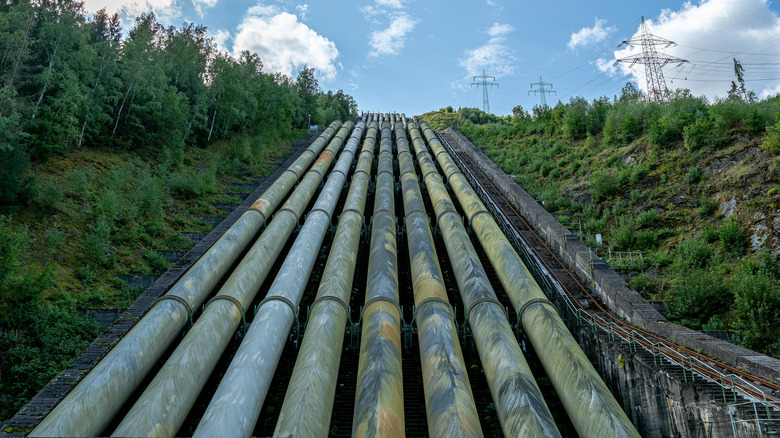
The concept of PSH isn't new. In fact, the technology already plays a major role in storing utility-scale electricity in the US, accounting for about 88% of the country's total energy storage. The principle is relatively straightforward and works very much like a typical hydroelectric system — both use the force of running water to power a turbine and produce electricity.
However, while a typical hydro scheme consists of a reservoir and dam that releases the water downstream, PSH is often a closed system in which the water is re-pumped back to the top reservoir when required. This is why such schemes can be referred to as batteries, with the surplus electricity effectively "charging" the battery. When electricity demand rises, it's as simple as using gravity to discharge the battery and convert potential energy back into useful power.
What the latest research adds is a better way to understand where this could work. Not all mines have the structural integrity or chemical composition to support a PSH system. The ORNL team has developed advanced modeling tools that can predict the corrosion risks posed by leftover minerals and how this can affect the turbines. It also allows engineers to assess whether the tunnels are capable of withstanding the force of high-pressure water rushing through them. Essentially, the research allows for a far more accurate way to evaluate potential energy-storage sites.
Why this matters
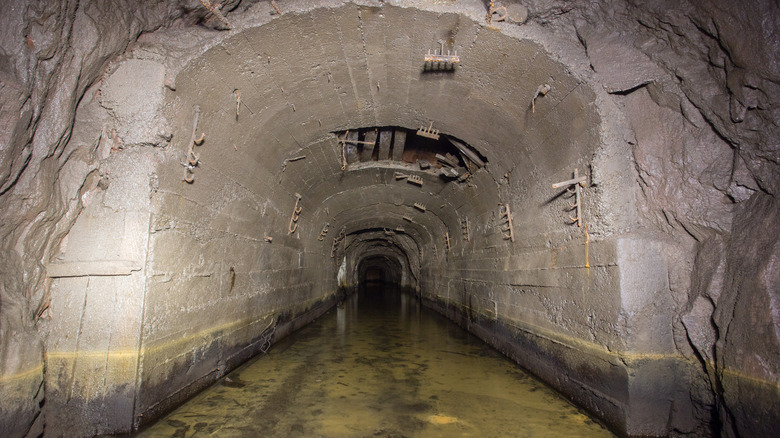
If the concept proves viable, the implications for energy storage could be significant. Pumped-hydro systems already dominate grid-scale storage in the US, but there is a big problem when it comes to scaling it even further — geography. Large reservoirs and significant elevation differences are required. This is all very good if a scheme is planned for a mountainous state like Colorado, but it isn't quite as useful for regions like the Great Plains.
This is why this research is more important than it might appear. There are about 500,000 abandoned mines across the US, and although many of them have never been fully mapped or studied, repurposing even a small fraction of these could provide a new way to expand long-duration energy storage. They also have a distinct advantage over that other modern-day powerhouse — the lithium-ion battery. Lithium-ion batteries, including those used to power tools, lose charge even when not in use. Whereas, as long as the water is stored properly, a PSH system will store all that potential energy for far longer periods.
While the ORNL team says they are excited about the 'potential' of the scheme, they acknowledge that there are still challenges to address before we see mines repurposed into PSH batteries. However, the new models can help to identify corrosion risks and structural weaknesses before projects begin. In a twist of history, the same mines that once fueled the industrial age could end up supporting the transition to renewable energy.