

Apple's M5, M5 Pro, And M5 Max: Which One Do You Actually Need?
It's been a busy early March for Apple, which has launched a bunch of new products as part of its early 2026 launch cycle. The new products chiefly center around Apple's popular notebook lineup that includes the MacBook Pro and MacBook Air series. In addition to these two products, Apple also gave a much-needed upgrade to its standalone professional-grade monitors: the Apple Studio Display and the Studio Display XDR.
While we have discussed the major upgrades to the 2026 MacBook Air and MacBook Pro models separately, the major upgrades to these models chiefly concern the new chips these machines use. For anyone considering one of these models for purchase in 2026, it is vital that they understand the key differences between these chips and whether it is worthwhile to spend more on notebooks equipped with the more expensive M5 Pro and M5 Max chips.
Do note that the baseline Apple M5 chip has been around for a while now, having debuted in October 2025, and was already used on several products, including last year's 14-inch MacBook Pro, the Apple iPad Pro, and the updated Apple Vision Pro. The M5 Pro and M5 Max models, on the other hand, debuted in March 2026 and are Apple's newest (and fastest) chipset offerings as of now. To make things simpler, there are three M5-grade chips currently on offer: the base Apple M5 chip (which debuted in October 2025), and the newer M5 Pro and M5 Max chips, announced in March 2026. While the entire MacBook Air lineup gets the M5 chip, the MacBook Pro lineup uses all three chips, with the base model using the standard M5 chip and the pricier models using the M5 Pro and M5 Max chips.
Who should buy Apple notebooks with M5 chips?

When Apple first launched the MacBook Pro with the M5 chip in October 2025, the model made little sense compared to the standard MacBook Air and Pro models that featured older M4 chips. This model was also nearly identical to the M4-powered Pro and Air models in almost every aspect save for a higher 4TB storage option on the M5 powered MacBook Pro (compared to 2TB on the M4 models), faster memory bandwidth (154 GB/s compared to 120 GB/s on the M4 models), and the addition of a neural accelerator that the M4 models lacked.
Now that the MacBook Air models have also been upgraded to the M5 chips, the M5-chip-toting MacBook Pro makes even less sense. You are essentially paying a higher price for a machine that delivers near-identical performance. The only aspects where the M5 MacBook Pro betters the M5 MacBook Air models include the base 1TB of storage (compared to 512GB on the Air), the higher battery life (24 hours vs 18 hours), the higher resolution, faster refreshing, and brighter display.
All Apple notebooks powered by the M5 chips are designed to be entry-level machines that offer reasonable performance while executing everyday tasks like browsing, coding, handling spreadsheets, and consuming multimedia content. They are also ideal for students. While these machines can be occasionally used for more demanding tasks, if such tasks are the primary use case, it is better to upgrade to either the M5 Pro or M5 Max models.
Who are the MacBook Pro with M5 Pro and M5 Max chips for?
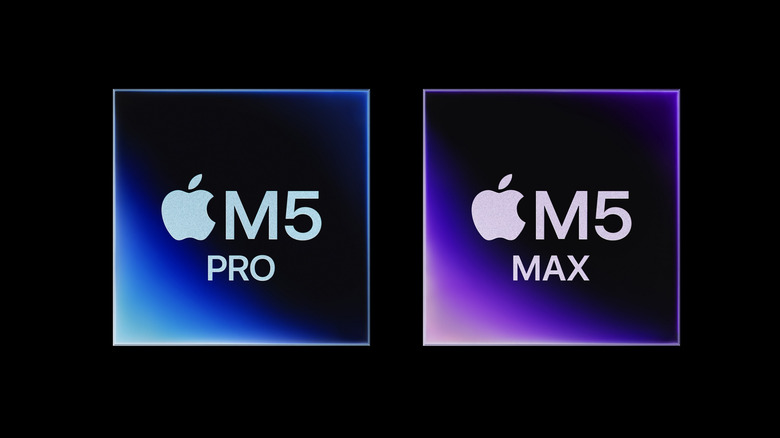
The MacBook Pro models with the newer M5 Pro and M5 Max chips are designed as high-performance machines that offer significantly better performance over standard M5 chips. This translates to improved performance while processing demanding single-threaded and multithreaded applications. The typical target customer for notebooks powered by these chips is professionals on the go involved in demanding, CPU- and GPU-intensive tasks.
With the M5 Pro chip, Apple claims significant performance gains over the older M4 Pro chip. Notable among those include 3x faster AI image generation, 4x faster performance in LLM prompt processing, and nearly 1.6x faster gaming performance with ray tracing-enabled games. The new chip is also nearly 1.4x faster in 3D rendering tasks when compared to its immediate predecessor. These new machines, therefore, make sense for professionals deeply involved in data modeling, post-production sound designers, and STEM students who are seeking an upgrade from an older generation MacBook Pro model.
As for the new MacBook Pro models with the M5 Max chips, these machines are tailor-made for professionals seeking the highest performance possible on notebooks today. A typical user with a MacBook Pro with an M5 Max chip would be someone involved in high-end video editing, a developer working on training local models, or a 3D animator working on a major project. These machines can also be used by data scientists intending to run complex and CPU-intensive simulations even while on the go.