

Why Some Missiles Have Wings (But Others Don't)
Missiles are pivotal aspects of modern military tactics and strategy, and the technology behind them has evolved considerably over time. Primitive missiles flew in the 11th century as Chinese fire arrows, which were propelled by gunpowder. Modern missiles are fundamentally similar, though with some seriously impressive technology packed inside their narrow bodies. Today's missiles range in size, shape, and capabilities, with some being adapted for very short distances. Others, like intercontinental ballistic missiles (ICBMs), can cross the entire planet, flying high above the atmosphere to deliver nuclear payloads.
If you look at modern missiles, you'll notice that they all share similar designs. They all have fins of some sort, which are typically located in the rear, while others have a variety of wing designs. These design choices aren't aesthetic and instead serve vital functions during a missile's flight. Missiles with wings use them in much the same way as airplanes — they help guide the missile during flight while reducing the need to reorient the entirety of the missile's body.
Missile wings are considerably bigger than fins or canards, though everything jutting out of a missile body serves a purpose. Because its wings are large in comparison to the rest of the missile, they provide lift and control with quicker reactions during flight. Missiles that typically employ winged designs are used for long-range flight, as short-range missiles tend to not have them. Those that do use wings include cruise missiles and the first ballistic missiles used in combat, the game-changing V-2 rocket fired by Germany during WWII. Wings are less common in today's missiles, but they remain in many models.
Examples of winged missiles and their capabilities
Part of the reason why a particular missile has a winged design and others don't stems from the difference between rockets and missiles. A missile is a guided vehicle that can adjust its trajectory mid-flight. A rocket, on the other hand, is entirely ballistic and requires leading a target, adjusting for gravity over distance, and other factors to strike. Winged missiles are typically designed for long-duration flight that requires changing direction to ensure positive contact with a target. These include various air-to-air missiles (AAM) like the AIM-54 Phoenix, which was used by the F-14 Tomcat.
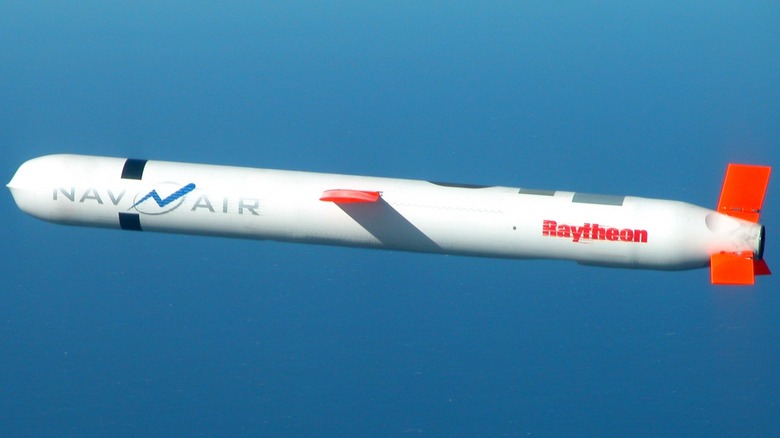
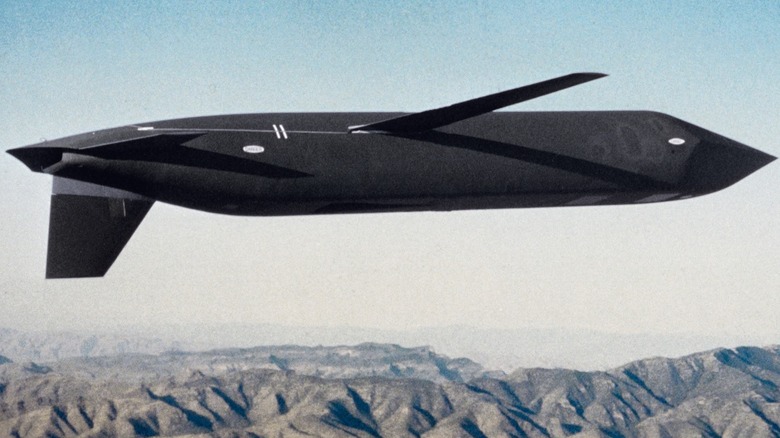
Many cruise missiles were also designed with wings, as these helped steer the vehicle to its target. The pictured AGM 129A Advanced Cruise Missile, used by the B-52H Stratofortress, is nuclear-capable and has stealth characteristics. These missiles have a range of more than 2,000 miles and feature internal guidance systems that can read the terrain to adjust altitude and position as it flies. Other modern missiles that have wings include the BGM-109 Tomahawk Land Attack Missile, pictured at the top of the article.
Unlike the wings of most missiles developed in the mid-late 20th century, the Tomahawk features ones that extend after deployment. This is a more common feature in newer missiles, though their purpose remains pretty much the same. These narrow-chord wings pop out from the fuselage after the missile's booster burns out. They provide lift during flights, which can be as far as 1,550 miles.
The rise of wingless missile technology
While winged missiles remain prevalent, wingless options are becoming the dominant focus of future technology. Missiles that have the shortest flight time to target are often built without wings, as they add drag without enough benefit to justify their placement. Some newer missiles eschew the use of wings for canards, which are small wing-like projections that provide more control and stability. While some winged missiles also have canards for additional stabilization, several feature only fins and canards. One example is the SA-18 Grouse Iranian Man-Portable Air-Defense Missile System (MANPADS).
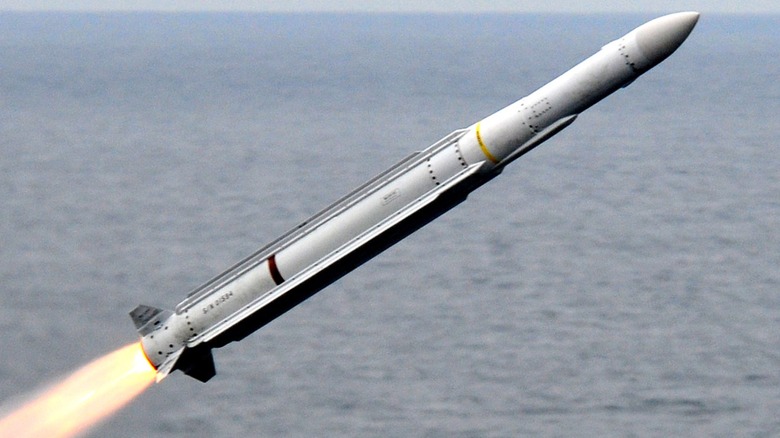
These missiles feature tail fins and are controlled via their canards. Similarly, the PAC-3, the U.S. missile used in air defense, is a highly effective, battle-tested vehicle that provides control via its tail, as it lacks wings. The pictured RIM-162 Evolved Sea Sparrow Missile is a short-range option designed to protect surface ships. It features four fins at the tail and canards along its wingless body, relying partly on thrust vectoring for better control.
While these are examples of wingless missiles, the future of missile technology is hypersonic (exceeding Mach 5, or 3,836 mph), and several working options lack wings. An example of this trend can be seen in the Russian Avangard; it instead adopts a triangular fuselage shape to provide lift. These types of missiles are designed to be fired atop ICBMs, where they're deployed high above the surface. While in flight, the fuselage enables guidance towards a target at incredibly high speeds, reportedly as much as Mach 20 (15,345 mph), making them impossible to counter with contemporary air defense systems — if these claims are accurate.