

Unmanned Fighter Plays Wingman For F-22 Raptor Pilots In US Air Force Test
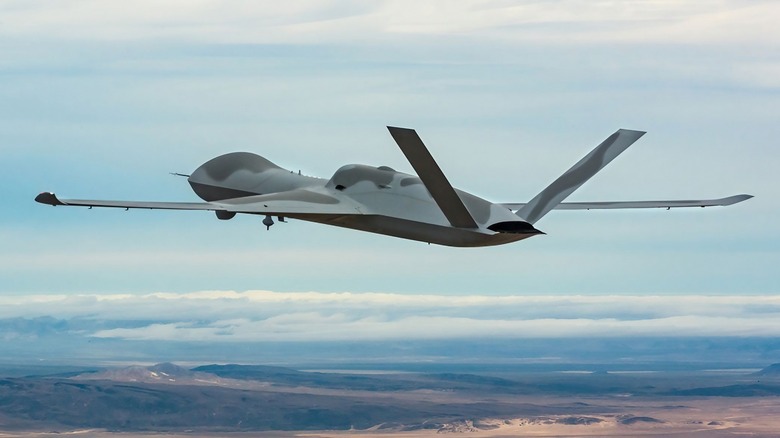
There's only so much a single pilot in a single jet can do in a fight, no matter how advanced that jet is. After all, it's a new world where drones are increasingly dominating the skies in warfare. So, the Air Force has a genius solution: getting a fleet of AI-powered wingman drones to accompany the fighter. Helping with the task is its long-time partner General Atomics. General Atomics has a jet-powered drone called the MQ-20 Avenger, which it's long been using as a stand-in for future combat aircraft. But the company announced on February 23, 2026, that the drone had flown alongside an F-22 Raptor at Edwards Air Force Base in California as part of a test earlier that month. In it, the pilot in the fighter actually commanded the drone using autonomy software and a tactical data link. The drone was directed to execute tactical maneuvers like performing combat air patrols and handling simulated threat engagement tasks.
Now, if you're not familiar with the idea behind all of this, the Air Force has a program called Collaborative Combat Aircraft (CCA). The program is essentially building a fleet of semi-autonomous drones designed to fly alongside human-piloted fighters like the F-22 and F-35. This will help add more sensors, more weapons, and more flexibility to a flight formation — without putting another pilot at risk. The Air Force likes to call CCAs "attritable," which is just a polite way of saying they're affordable enough to risk in combat. They basically provide a cushion of safety to the human-powered jet they fly alongside.
"This demo featured the integration of mission elements and the ability of autonomy to utilize onboard sensors to make independent decisions and execute commands from the F-22," said David Alexander, president of General Atomics Aeronautical Systems, in a press release.
What's changed since the first test
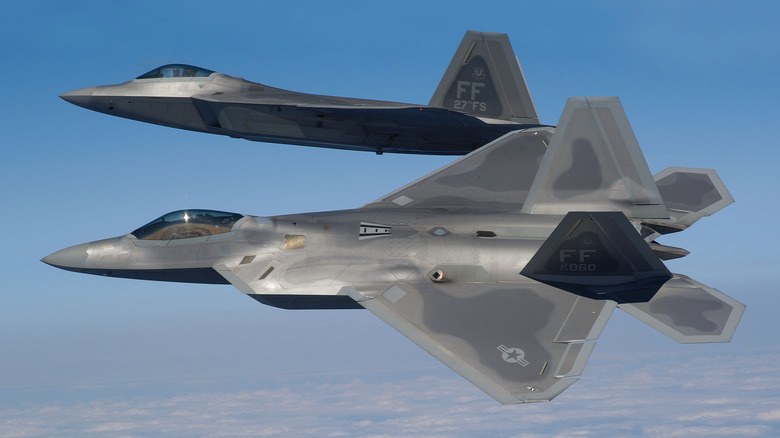
The latest demo builds on an earlier test from October 2025. Back then, General Atomics ran a company-funded flight over the Nevada Test and Training Range, where an F-22 pilot used a tablet in the cockpit to control an MQ-20. That effort relied on L3Harris datalinks and Lockheed Martin's open radio architectures. Software-defined radios are installed on both the drone and the fighter. It was the first known demonstration of its kind for the Raptor, and Lockheed Martin's secretive Skunk Works division led the whole thing.
Things have moved forward quite a bit since then. The more recent February test swapped out the tablet-based setup for government autonomy software, which ran directly on the F-22. The software was paired with something called the Autonodyne Bashi Pilot Vehicle Interface. This helped direct the MQ-20 to execute tactical maneuvers and adjust waypoints.
This is important because questions have been raised around using tablets during combat — they already demand far more attention than analogue controls in cars when driving. But using them during combat is a whole different story. In fact, as The War Zone reported, General Atomics' own vice president of advanced programs has admitted that managing a tablet while flying a jet and operating its weapons systems is really hard to do. The new interface provides more seamless control.
When CCAs do get ready, the F-22 is expected to be the first fighter to operate with them. The Air Force aims to have the capability ready by the end of the decade. Next in line is supposedly the F-35, with Boeing's upcoming sixth-generation fighter F-47 eventually getting it too. The F-47 is actually being designed from the ground up as a kind of flying command center that'll work with drones.