

Yes, Dollar Tree Sells Batteries - But Are They Any Good?
If you've grabbed a pack of batteries from Dollar Tree while picking up paper towels or party supplies, you might have wondered — at that price, can they actually be any good? Can they stand up against named brands? After all, battery quality varies by brand, with some obviously faring better than others.
Dollar Tree stores have built a reputation and business model on supplying a range of common staples for ultra-low prices. However, while this might be fine when stocking up on cleaning cloths, candy, or kitchen organizers, batteries are something where the quality matters more. A bad battery doesn't just disappoint — it leaks, it dies early, or leaves your remote, flashlight, or smoke detector useless when you actually need it (some of these are among devices that should not use rechargeable batteries).
The appeal is obvious. Why pay several dollars for a name-brand pack when Dollar Tree's options cost a fraction of that? Of course, Dollar Tree batteries will work, but do they work well? And how do they compare with costlier brands when it comes to overall value? The good news is that not all Dollar Tree batteries are to be avoided; their alkaline batteries perform well in tests. Although there are others that don't fare so well.
So, let's take a step inside Dollar Tree, that emporium of wonders, and see if their batteries come up to scratch or whether they're a bargain too far.
Dollar Tree alkaline batteries -- a solid performer
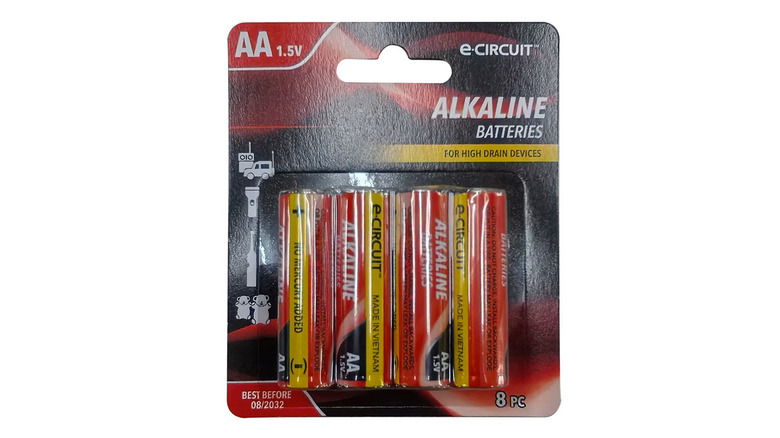
A 2022 feature by CBC's Marketplace, conducted with researchers at Ontario Tech University, tested 240 AA batteries from six brands under controlled low-, medium-, and high-drain conditions. The study compared major brands such as Duracell and Energizer with store brands, including Dollar Tree's E-Circuit brand.
As you'd expect, Duracell and Energizer delivered the longest overall runtime. However, giving them a close run for their money (and your money for that matter!) was the E-Circuit brand. These batteries performed surprisingly well, lasting nearly as long in several of the tests. While the researchers cautioned that lab simulations can't perfectly replicate everyday usage, they concluded that the Dollar Tree alkaline batteries offered the best-capacity-per-dollar value in the comparison.
At the time of writing, a 4-pack of Duracell AA batteries was listed at $5.25 from OfficeSupply and $7.19 at Walmart, roughly about $1.31 to $1.80 per unit. For comparison, the current price of a pack of four E-Circuit equivalents is $3.00 or $0.75 per battery. It's worth noting that at the time of the CBC study, the same E-Circuit 4-pack was priced at $1.25, and Energizer Max and Duracell batteries were priced at $1.00 and $1.06 per battery, respectively.
The surprisingly good performance of these batteries makes them a solid choice when runtime differences aren't critical, such as for devices like remote controls or wall clocks. They might not make it onto a list of Dollar Tree essentials for your garage, but they offer decent performance at a lower price point.
Dollar Tree Super Heavy Duty batteries -- a misnomer?
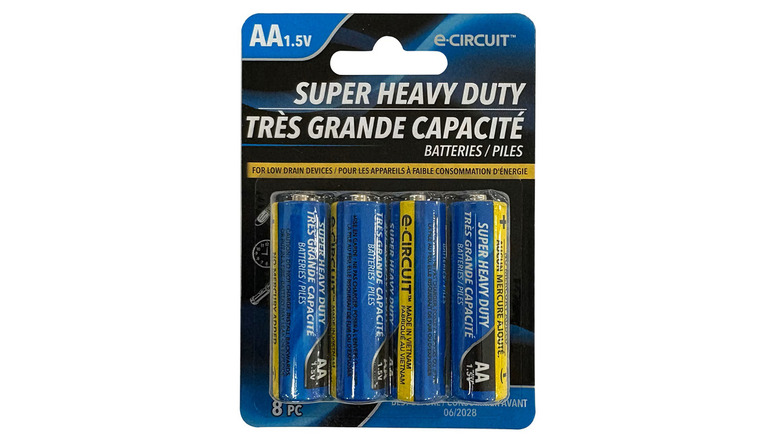
At $3.00 for a pack of four and decent performance, Dollar Tree alkaline batteries can be a good buy. But likely sitting somewhere nearby will be packs of E-Circuit Super Heavy Duty batteries. While this branding makes them sound, well, heavy-duty, the truth is different. These batteries use carbon-zinc chemistry, a technology that dates back to the 19th century.
At the time of writing, these were priced at $1.50 for a pack of eight, so it's easy to be tempted. However, before you grab a packet or more of these batteries, it's worth looking at what the CBC study said. In the test, the Ontario Tech University researchers found that these batteries didn't break the seven-hour mark in low-drain simulations. By comparison, alkaline batteries often lasted more than 20 hours in the same tests.
In high-drain situations, the story worsened. In these tests, the Super Heavy Duty label of these batteries can only be described as optimistic — and that's being kind. The researchers found that the zinc-carbon batteries lasted less than seven minutes, compared to nearly an hour for alkaline batteries.
Perhaps the last word on these batteries should be left to Professor Dan Steingart of Columbia University. Speaking to CBC, he said, "I couldn't find a single use case where the zinc carbon outperformed in any way the alkaline cells.... There's no reason to sell a zinc-carbon system in 2022."
Advice that is just as relevant in 2026.