

5 Niche Landscaping Tools (And What They're Used For)
We may receive a commission on purchases made from links.
Winter weather has plenty of downsides, but at least you don't have to do as much landscaping. It might be nice to hear birds singing again and feel the warm sun on your face as spring approaches, but it also means that soon it'll be time to grab the yard tools out of the shed and get to work. But which tools? There are the basics, like hedge clippers and a rake, and there are outdoor power tools you'll want before spring arrives.
There are also some tools that may not immediately come to mind. These more niche items may have very specific applications that you don't often need — but when you do need them, you'll be glad you already have them on hand. Others might have more generic purposes but operate in a unique way that you don't often see other tools adopting.
Whether it's for landscaping or otherwise, niche tools can easily fall into novelty territory, where the form becomes more important than function and they're basically useless in the real world. That's why so many different offbeat yard tools can be found from various retailers like Amazon, Home Depot, Harbor Freight, or Costco. If you're wondering which ones can actually be helpful — or at the very least what they even do — here are five niche landscaping tools and what they're used for.
Weed Torch
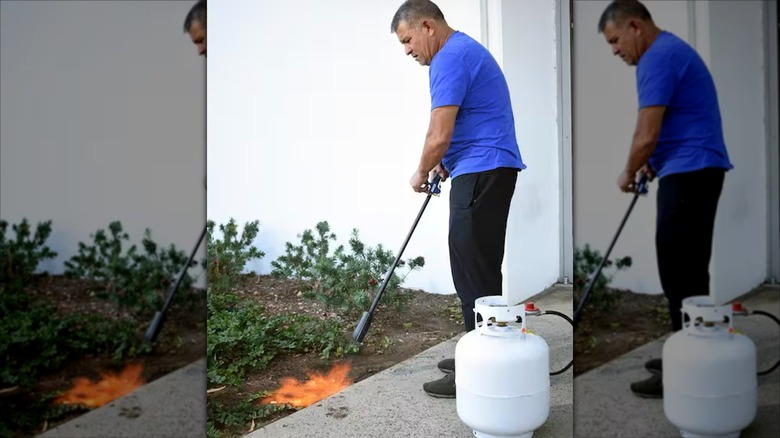
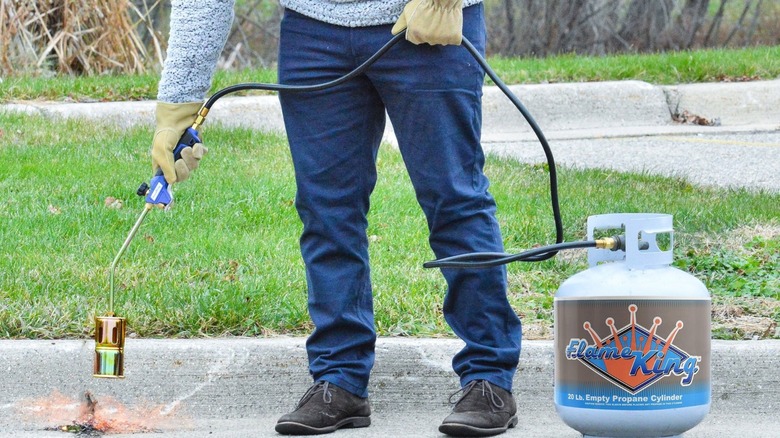
Weeds are the archenemy of any landscaper or gardener, which makes a weed torch not only useful but downright cathartic to use. Why break your back pulling and cutting weeds when you can just incinerate them? A weed torch is exactly what it sounds like — a tool that allows you to burn away unwanted vegetation in your yard. Obviously, you'll want to use one very carefully and safely. Not only do you want to avoid burning the nice parts of your lawn and garden, but ideally you won't burn your home to the ground in the process. Weed torches are widely available from different companies and may vary slightly in form, but for the most part they all work the same. A weed torch connects to a fuel source, which is usually a propane tank just like the one (or perhaps the very same one) used for backyard barbecues, and releases a small, contained flame. Some will connect to smaller tanks of gas or liquid propane that can be carried by hand.
The idea isn't to burn weeds completely to ash but instead to kill them, just as a chemical herbicide would. The intense heat of the flame boils the water inside plant cells so that the weed dies within hours. Not only is it easier than cutting or pulling weeds, but it's especially useful for narrow cracks in sidewalks or other places where it's harder to reach weeds at their roots, such as gravel surfaces or along fences. Examples of weed torches include the Sondiko Weed Burner, which has a 30-inch head, and Flame King Heavy-Duty Weed Burner, a 100,000-btu torch with adjustable flame size and a flint striker for ignition.
Soil Block Maker
Thriving, beautiful plants are a core component of a well-landscaped property, but sometimes the best greenery starts its life indoors. Getting seedlings started in a warmer, controlled environment allows them to get a head start before spring and can often result in stronger, more vibrant growth after they're transplanted outdoors. However, young plants that first sprout indoors sometimes have trouble acclimating to open nature as their roots become acclimated to the confines of their containers.
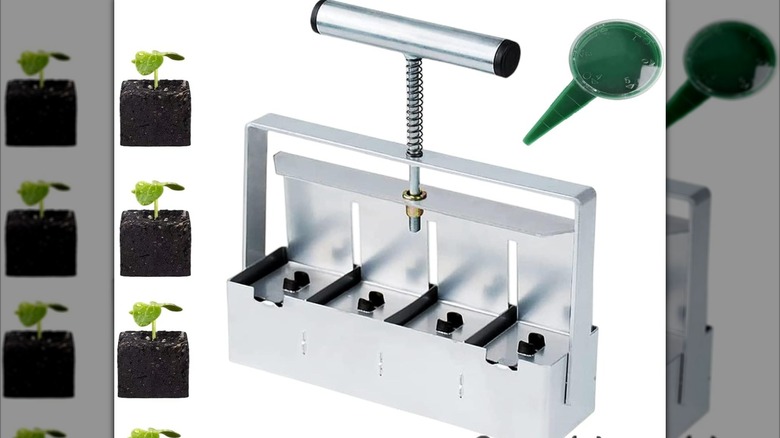
That's why there are gadgets that help indoor plants thrive in the winter, such as seedling heating mats. A simpler landscaping tool that also helps young plants is a soil block maker. When roots, which grow as they seek more water and nutrients, hit the inner walls of a seedling's container, they begin to wrap around themselves. Using a soil block maker helps prevent this in a process called air pruning — when roots reach the edge of the soil but no plastic, they instinctively know to stop growing rather than circle back. New roots grow instead, giving the seedling a stronger, denser foundation. Once moved outdoors, they're likely to grow more lush and more quickly. As an added benefit, creating soil blocks helps reduce plastic waste.
With soil block makers, you can even grow certain fruits and vegetables, such as cucumbers, squash, and melons, indoors before transplanting them to your garden without hindering their growth. Soil block makers, like the Fiskars Soil Block Maker, use the same principle as molds for Jell-O or Play-Doh, compacting soil into a shape that you then release onto a flat surface, like a tray. Many models, such as the Melvtata Handheld Soil Blocker, can make multiple molds at once.
Digital Measuring Wheel
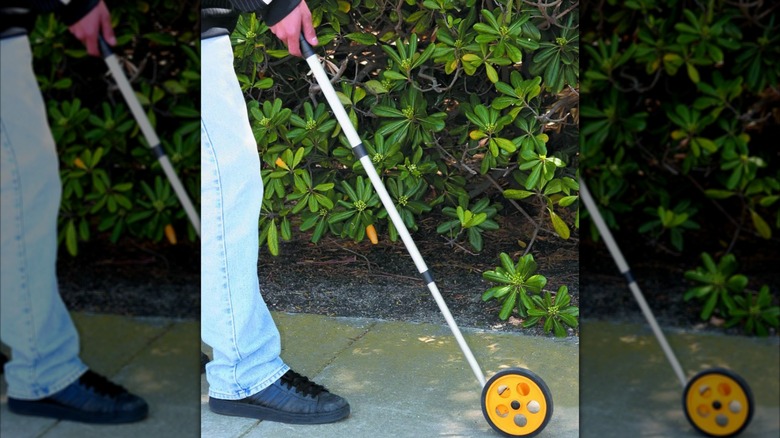
A measuring wheel may not be considered niche for surveyors, construction workers, or insurance adjusters, but it's not commonly thought of as a landscaping tool. But it should be, as it can be extremely useful when creating or refining a new property layout, whether it's measuring lengths for fences, hedges, patio boundaries, and other parts of your yard. A digital measuring wheel, which easily displays the number of feet, yards, or meters, is an even more niche variant of the tool.
Besides measuring for planned layouts, the device can also be helpful when spacing sprinkler heads or figuring out underground piping runs. However, it's not just a one-and-done tool that will collect dust in your toolshed after everything is laid out. A measuring wheel is also very useful for determining exactly how much soil, mulch, sod, fertilizer, or similar landscaping material you'll need for a given area on your property. A tape measure could theoretically do the same if the planting area has an entirely straight perimeter, but a measuring wheel — in addition to being easier to use — is much more effective for rounded or otherwise irregularly shaped plots of land.
Digital measuring wheels are generally pretty cheap, and different models from different brands may have slight variations when it comes to pole length, wheel size, or special features. For example, one of the niche Harbor Freight tools available from the retailer is its Pittsburgh 10,000-ft/Meter Digital Measuring Wheel, which costs $15. Its digital display is simple and attached at the end of its telescoping pole, by the wheel. The $60 Zozen Digital Measuring Wheel, on the other hand, is foldable and includes a kickstand and storage backpack. Its range is 99,999-ft/meters and its display is a separate, handheld accessory with a backlit screen.
Hori Hori Knife
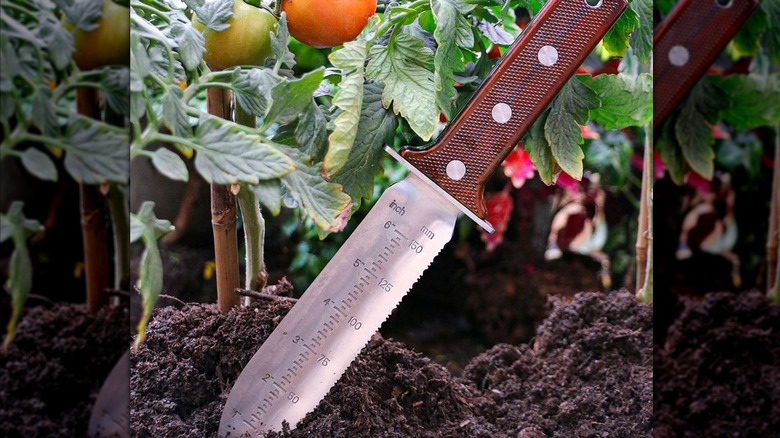
A hori-hori knife isn't just a knife — it's a multi-tool explicitly made for gardening that includes several different functions you'll need for your yard. Also called a soil knife or a weeding knife, "hori-hori" is actually a Japanese onomatopoeia for the sound of digging ("hori" translates to "dig"). The tool is essentially a hybrid of a heavy, sharp blade and a gardening trowel, making it useful not just for cutting through tough roots or thin branches but also for digging and transplanting.
One side of the blade is flat and can make sharp cuts, while the other is serrated for light sawing. A ruler is etched into the blade (in imperial, metric, or both units), allowing users to quickly determine planting depth to correctly place seeds and bulbs in the optimal space. Landscapers and gardeners may not even think of including a knife in their toolset, but the tool can also be handy for quickly cutting twine or opening bags of fertilizer or other materials.
There is no shortage of options when it comes to hori-hori knives. You can find many different models on Amazon alone, including the Workpro 7-inch Stainless Steel Hori Hori Garden Knife, which comes with a sheath and rubberized grip. The handle comes in either green or pink and includes a small hanging hole built into its base. One of the best Amazon tools for gardeners under $10 is the Akakd Hori Hori, which also comes with a sheath, as well as non-slip gardening gloves. Currently top-ranked on Amazon is the Perwin 6-inch Hori Hori, which has a black blade and walnut handle and a full-length tang for additional strength and stability.
Gardena Aquabloom Automatic Plant Watering System
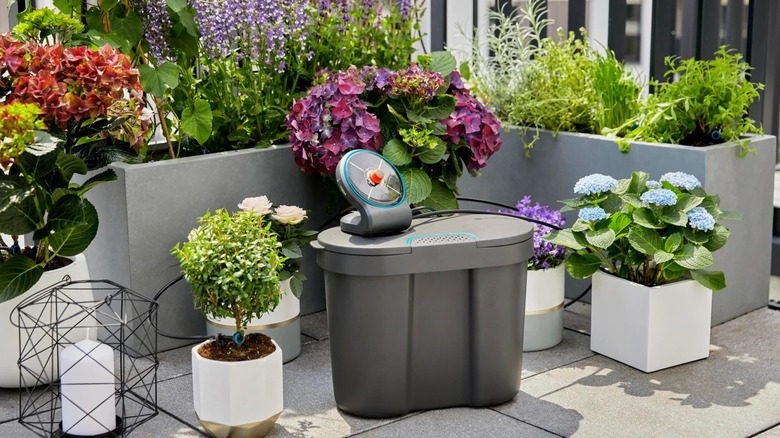
Not all niche landscaping products are simple hand tools or power tools. There are also smart gardening gadgets that offer many of the same benefits as other internet-connected appliances and home devices these days. One such smart gadget is the Gardena AquaBloom Automatic Plant Watering System. If you don't want to manually walk around your yard and water plants yourself, sprinklers have long been an option.
However, sprinkler systems can be costly, require a lot of maintenance, and can be a hassle to install. Many homeowners with smaller yards don't find them worth it, and a regular sprinkler attached to a hose may not be precise enough for the needs of a particular garden. The Gardena Aquabloom is a low-key alternative to a sprinkler system, allowing you to automatically water up to 20 different plants using one of 14 preset watering settings.
At the heart of the Gardena AquaBloom Automatic Plant Watering System is a water container and pump that also includes the control unit and a solar panel. The integrated solar panel powers the rechargeable batteries used by the Aquabloom. Not only is this more eco-friendly, but it also means no power connection to your home is required. It will run continuously and can be placed farther from your house. No water connection is required either, making it simple to install — though you'll need to manually refill the 2.77-gallon (10.5-liter) container periodically. The preset programs allow you to choose the frequency and amount of dispersed water for your yard, and the pump can feed plants up to 13 feet above it.