

China's New Aircraft Carrier Looks Powerful – But It Has A Major Problem
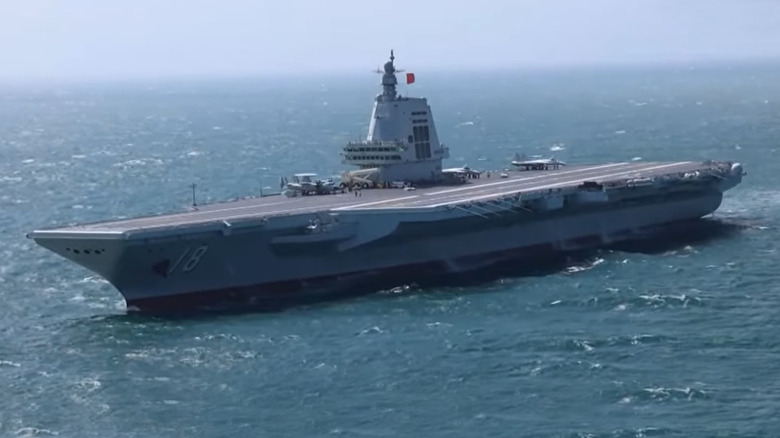
On paper, China's latest aircraft carrier looks awesome. The Fujian was commissioned on the 5th of November, 2025, and is the third and most powerful addition to China's carrier fleet. Its introduction saw it crowned as the world's largest non-nuclear powered warship. Which should be a distinct feather in the cap for the builders of China's first domestically designed aircraft carrier.
And while its conventional power is a disadvantage when compared to American carriers like the Gerald R. Ford, the rest of the ship looks like a pretty serious upgrade for China's naval capabilities. For instance, other than the aforementioned Gerald R. Ford, the Fujian is the only carrier in the world boasting electromagnetic catapults.
In theory, this system allows the carrier to launch heavier aircraft with greater fuel and weapons loads — attributes that should greatly improve the carrier's potential reach and operational flexibility. But scratch just below the surface, and it appears that Beijing's latest carrier has at least one serious flaw.
The nature of the problem was raised after military analysts questioned the efficiency of the ship's flight deck layout. Technical assessments of this design trait seem to point to a layout that can potentially create launch and recovery bottlenecks during combat operations.
This is critical, as the flaw introduces constraints in the very area that ultimately defines a carrier's combat value — just how quickly it can launch and recover aircraft.
A flight deck layout problem
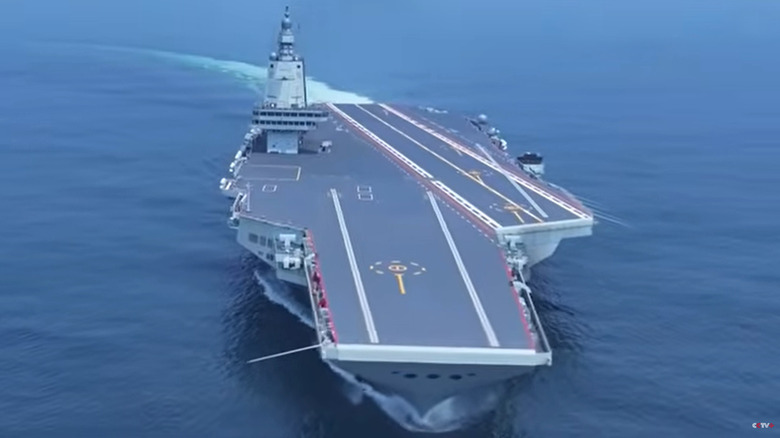
Modern aircraft carriers are far removed from the early carriers that appeared almost as soon as aviation was a thing. However, regardless of the generation of carrier, one attribute has been critical throughout the type's history — how quickly it can launch and recover aircraft. This tempo is referred to as sortie generation, and it depends heavily on flight deck geometry, hardware, and a carefully choreographed flight deck sequence.
We already know a lot about China's newest aircraft carrier, but there are cracks appearing in its powerful facade. In interviews with CNN, former US Navy captain Carl Schuster and retired Lt. Cmdr. Keith Stewart pointed out aspects of the Fujian's deck configuration that could limit the sortie generation metric.
After reviewing images of the carrier, they noted that the angled landing area crosses the deck at a narrower angle than on US carriers, reducing space between the recovery strip and the forward catapults. One of those catapults also appears to intrude into the landing area, which means it can't be used while the carrier is recovering aircraft.
Speaking to CNN, Schuster said, "The Fujian's operational capability is only about 60% of that of the Nimitz class." Essentially, it appears that the carrier can't launch and recover aircraft simultaneously, something that is considered a prerequisite for carriers of this size.
The ship's flaws were also noted in a documentary shown on Chinese TV. The broadcast featured a crew member explaining how landing aircraft cross two of the launching catapults before stopping in a maintenance area.
A stepping stone toward something bigger
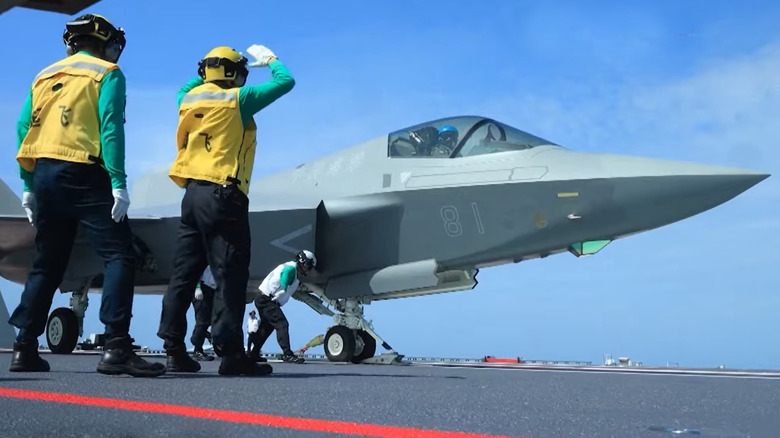
This problem doesn't make the Fujian ineffective; the carrier still represents a significant leap forward for China's navy. The inclusion of an electromagnetic catapult system alone expands the types of aircraft it can launch and the payloads they can carry. As noted, the Gerald R. Ford is the only other operational ship boasting such a system. Although the John F. Kennedy has just completed a major milestone on its way to commissioning and will soon join this exclusive club.
However, the propulsion systems remain a defining difference, and this has played a part beyond merely how the ships are powered and how long aircraft carriers can stay at sea without refueling. The Fujian's conventional power system is believed to have contributed to the design constraints with the elevators, island, and support areas beneath the flight deck. For comparison, nuclear propulsion frees more internal volume and allows designers more leeway when considering deck layouts and aircraft manipulation.
This is why analysts now widely expect China's next carrier, often referred to as the Type 004, to be the first Chinese nuclear-powered sub, and to incorporate the lessons learned from the Fujian's layout.
For now, despite its undoubted powerful look, the Fujian appears less like the finished object and more like a transitional design. A design that bridges China's move away from ski-jump carriers to a future where it potentially joins the US and France as the only countries to operate nuclear-powered aircraft carriers.