

This New Marine Drone Looks Like A Killer Whale, But Is Much Deadlier
While most people think of aircraft like the fast-moving MQ-1 Predator when they hear the words "military drone," that's not the only option. These days, drones can fly, as well as swim or travel overland; throughout the 21st century, they've proven their worth in the battlespace. The United States employed them throughout the War on Terror, and both sides of the Russo-Ukraine War have followed suit, though innovations in all areas of drone technology have increased the lethality of these devices in surprising ways.
Marine drones in particular are becoming more important throughout the world, and Ukraine has already demonstrated their value in taking out large, strategic, and tactical targets. In February 2026, Lockheed Martin revealed its latest marine drone, Lamprey, a multi-mission autonomous undersea vehicle (MMAUV) capable of all manner of missions, but it's not the only drone of its kind. The Cardona Marine Group, Inc. (CMG), a defense tech startup, has been developing a similar technology for the past 15 years, and it's now in the functioning prototype sea trial stage.
The Sea-Predator-7 (SP-7) is an uncrewed surface vehicle (USV) that features a unique design. At a glance, it looks a bit like an Orca, but with the potential to be far deadlier; its payload capacity allows for the use of a variety of lethal armaments delivered stealthily to target enemy ships. Additional components and sensors allow for remote and potentially autonomous operation in the future, while the SP-7's components can be quickly fabricated for rapid production should the Department of War select them in a future defense acquisition contract.
The specifications and capabilities of the Sea-Predator-7
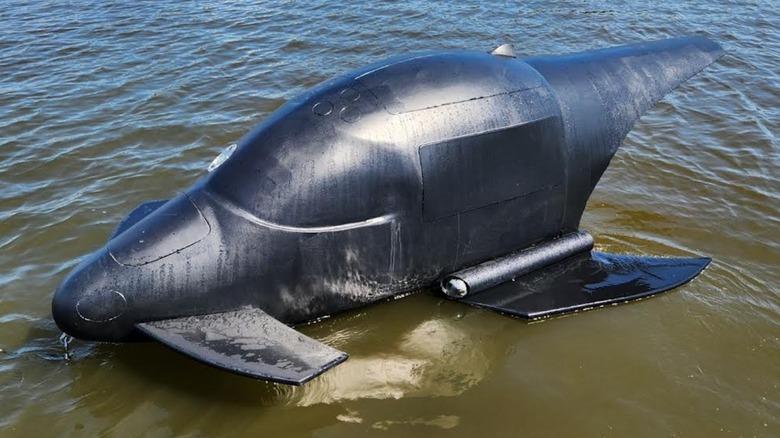
The Sea-Predator 7 is designed with custom Kevlar, carbon fiber, ceramics, and ballistic fiberglass in its composition. It features a proprietary ballistic riblet coating and structure designed to mimic a shark's skin, combining with its design to enhance stealth and speed while also reducing power consumption during movement. These drones can be deployed in several ways, including dropping them from Navy MH-60R Romeo helicopters or Navy MV-22B Osprey tilt-rotor aircraft, miles from a target ship, either independently or within drone swarms.
The SP-7 can carry more than 800 lbs. of explosives for one-way attack capabilities alongside two specialized torpedoes. Additional armament options for the SP-7 include two CMG Mk 6 stealth riblet coated drone torpedoes, four CMG Mk 4 high-explosive torpedoes, a Mk 19 automatic 40 mm grenade launcher, twin M240B 7.62 mm machine guns, or six 40 mm smoke grenade launchers. It can be outfitted with four mini aerial drones used for reconnaissance. Additionally, the SP-7 itself can function as a remotely-operated underwater vehicle (ROV) ship mine, slamming into a target's hull and detonating.
The USV measures 13 feet long with a 5-foot beam, and is 3 feet high. Its weight is 700 lbs. before payloads are added. It moves through the water via a custom electric CMG flume drive for surface and sub-surface operations with electric bow planes and pulse thrusters for maneuvering. When you put it all together, the potential uses for SP-7s are widespread with the potential for changing marine offensive warfare.