

Here's How Much A 2021 Subaru Outback Has Depreciated In 5 Years
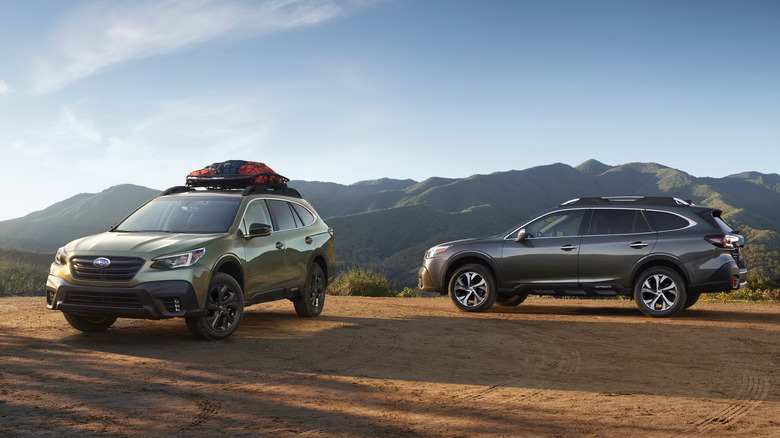
The Outback, maybe more than any other Subaru model, symbolizes the trajectory of the Subaru brand itself. When it first launched in the mid-1990s, the Outback was a quirky yet groundbreaking lifted, body-cladded version of the Subaru Legacy station wagon. Now, more than 30 years later, the Subaru Legacy has been discontinued entirely, and the Outback has evolved into one of Subaru's bread-and-butter products.
Although the Outback has gradually become more SUV-like, moving away from simply being a station wagon with a lift kit, the car has nonetheless maintained a unique position in the market, blurring the lines between the now nearly extinct family station wagon and the much more popular crossover SUV. And longtime Outback fans have certainly contributed to Subaru's excellent reputation for brand loyalty.
So what does this mean for Outback depreciation and resale value? Using the common five-year yardstick, we can see that a used 2021-model-year Outback has depreciated right around the average for SUVs of its type, neither holding its value nor dropping it in an outstanding way. While specific figures will vary by source and also by regional market conditions, a five-year depreciation of around 40% should be expected for a 2021 Outback.
A proven commodity on the used market
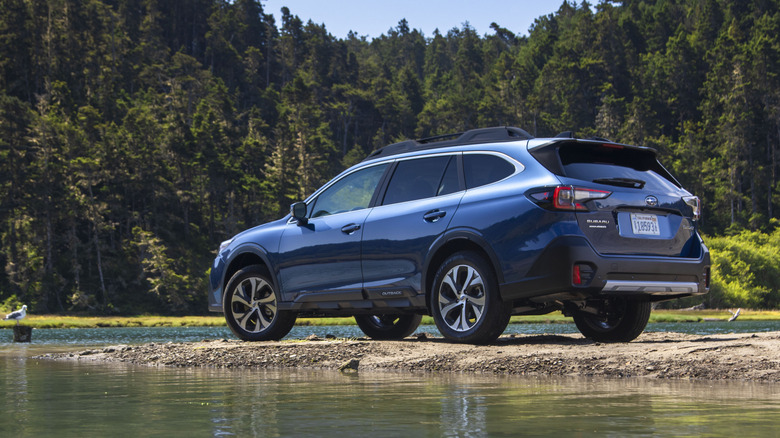
2021 was the second model year for the 6th-generation Outback, and it was available with either a 2.5-liter naturally aspirated boxer four-cylinder or a turbocharged 2.4-liter boxer four-cylinder engine. Our testing has found the Outback of this generation to deliver a well-rounded blend of rugged capability, comfort, and easy road-going manners.
Before we get into specific resale values and depreciation curves, it's important to note that exact figures can vary depending on your specific location and market conditions, and will, of course, also vary by the options, mileage, and how well the car has been maintained. Kelley Blue Book, a long-trusted source for used car values, shows that a 2021 Outback 2.5 Limited, which originally had an MSRP just below $35,000, has a current resale value of $19,550. Edmunds' depreciation figures, meanwhile, also show that the 2.5-liter-powered 2021 Outback has a current estimated value on the used car retail market of around $20,000.
Figuring an original MSRP around $35,000, in terms of resale value after five years, both of these suggest a ballpark depreciation rate of about 40% from the original MSRP. When compared to other 2021 model year SUVs, KBB ranks the Outback's depreciation as "Average," falling in between the 25th and 75th percentiles in the segment.
Will the loyalty continue?
CarEdge's depreciation figures tell a similar story for a five-year-old Outback, with a claimed depreciation of 42% off its original price. Interestingly, CarEdge also points out that Outbacks tend to have less depreciation early and more depreciation as they age, perhaps due to rust and wear in areas with winter climates, where Subarus are especially popular.
Looking at retail used car listings is another good place to get an idea of what a given car might be worth on the market. Looking at the CarMax nationwide listings for 2021 Outbacks, current prices range from $20,000 for lower trim or high-mileage examples, up to the $30,000 ballpark for high-end XT models with low mileage. Keep in mind these are retail prices from a major dealership, which will be higher than private party or trade-in values.
For the new 7th-generation 2026 Outback, Subaru made one of the biggest leaps in the model's history, with a taller, boxier profile that's more SUV-like than ever. 'Divisive' is the word we used to describe the new Outback's look, and as these next-gen models get out into customers' hands and eventually onto the used market, it will be interesting to see if there are any changes to the depreciation trends of this Subaru stalwart.
Methodology
To determine depreciation rates and resale value for the 2021 Outback, we looked at a variety of sources, including third-party data from Kelley Blue Book, Edmunds, CarEdge, original factory MSRPs, as well as current used car listings to include real-world asking prices.