

This High-Performance Military Radar Can Do More Than Just Detect Threats
Radio detection and ranging, commonly known as radar, is used to detect objects at distances beyond the normal range of vision. While it might feel like this technology was conceived in modern times, its first practical demonstration happened in February 1935, when British physicist Sir Robert Watson-Watt used radio waves to locate an aerial bomber. Crazier still, we have to jump back almost 50 years before that to find when this phenomenon was first observed. In 1886, German physicist Heinrich Hertz first determined that bouncing electromagnetic waves off something allowed it to be "seen."
The point is, radar has been around for a very long time, and since its discovery, great strides have been made to improve it. Interestingly, radar was considered a top-secret project leading up to World War II. Today, it's used by planes and boats to navigate, for enforcing traffic laws without the need for police officers, forecast the weather, track satellites in space, and, of course, by the military for defense. Enter Northrop Grumman's AN/TPS-80 Ground/Air Task-Oriented Radar (G/ATOR).
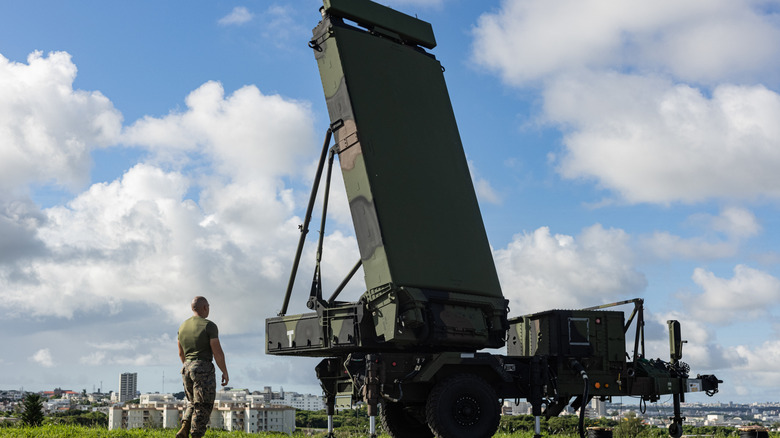
Currently used by both the United States Marine Corps and the Air Force, G/ATOR is a long-range pulse-doppler active electronically scanned array that combines the capabilities of five radar systems. It can serve as air and ground surveillance to defend against airborne and ground-based threats, perform fire-control duties, and manage flight operations via its air-traffic control capabilities.
This G/ATOR takes a bite out of enemy attacks
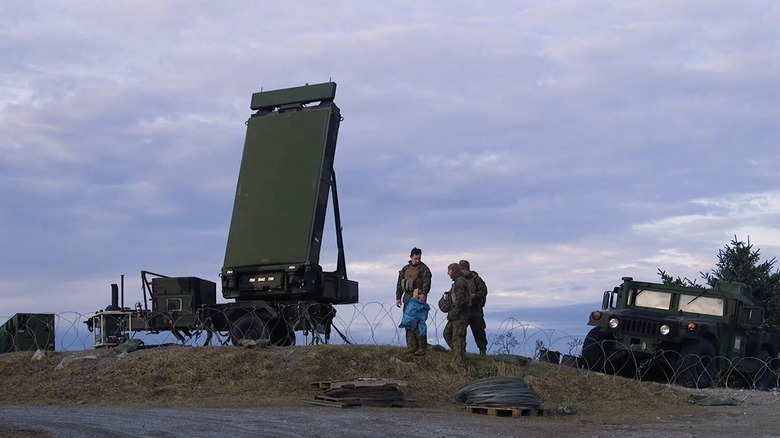
The G/ATOR uses S-band radar for 360-degree surveillance. It can locate the launch points of enemy rockets, missiles, artillery, and mortars, then seamlessly calculate return-fire coordinates. It also has anti-jamming capabilities and is very mobile, since it's built on a trailer. This means it can be towed by a standard military vehicle or transported via a cargo plane.
The semiconductors used are made with Gallium Nitride (GaN) instead of Gallium Arsenide because it provides superior power density, better thermal conductivity, and higher efficiency. The use of GaN also significantly increases radar detection range. The G/ATOR is built with an open system architecture, so both its software and hardware can be upgraded, creating what amounts to a plug-and-play radar system that can spot threats faster and from farther away.
To prove this very point, a software update was released in December 2025 to all actively deployed units in the field, instantly improving several of its capabilities. For starters, it extended the G/ATORs' range, allowing it to detect threats at much greater distances. It also improved its ability to identify those threats and more quickly share that information with allies. Northrop Grumman stated that it had delivered 39 G/ATOR radars to both the USMC and USAF as of early December 2025, with the 40th expected to be delivered later that month. That's all well and good for now, but China's attempts to develop the world's first quantum radar system might eventually push this G/ATOR back into the swamp.