

5 Fun And Simple Toys You Can Make At Home With A 3D Printer
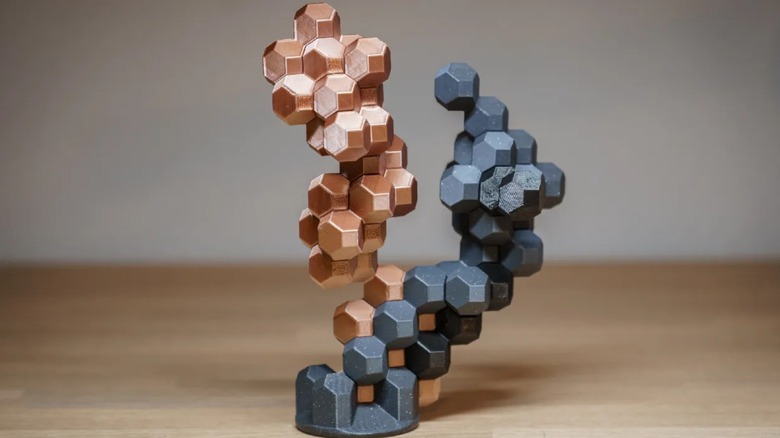
There are many practical 3D-printed items that can upgrade your home office and organize your living area, but sometimes it's just more fun to make some goofy little toys. These easy-to-print games and models can be great for makers of all skill levels, but they're particularly nice for those new to 3D printing.
Starting with simple projects like these can be great for calibrating your printer and slicing software, helping you lay down those first filament layers on the print bed and build confidence before taking on bigger and more challenging projects. After all, you probably don't want to jump straight into the more complex articulated or awkwardly shaped toy designs right off the bat. Instead, starting with prints made up of solid pieces that don't require the headache of overhang supports might be the way to go.
There are plenty of free and paid 3D print files available from sites like My Mini Factory, Thingiverse, and Printables that fit these criteria perfectly. Of course, while these can be fun to browse, not all of them have been tested, and some may even be unfinished. One of the best ways to find reputable designs is to look at the most popular toys, then check to make sure others have successfully printed them and can attest to their quality.
Crossbow Kit Card
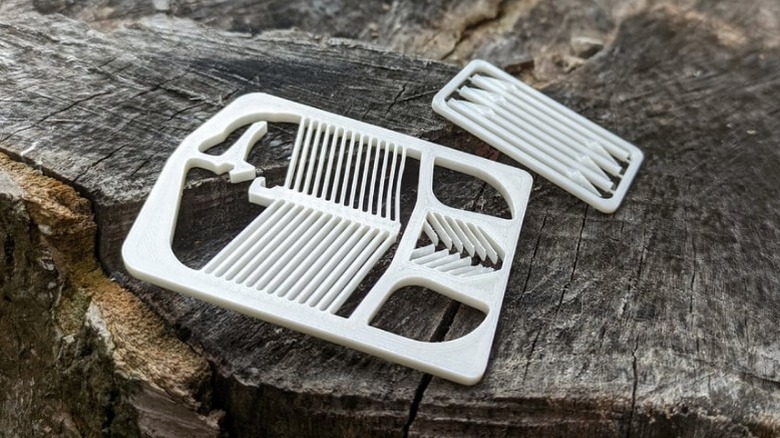
If you want to make something quick and easy to help ensure your print bed is level and your extruder is working properly, one fun little project is the Compliant Crossbow Kit Card. This design was uploaded to Thingiverse by the maker Pardogo, and is a print-in-place crossbow that's about the size of a credit card.
The rectangular crossbow has several wave-shaped springs attached to a launching point at its center. A locking mechanism at its base allows you to pull back the tension and keep it "drawn" until it's ready to fire. Finally, there is a slot at the top of the card for loading the arrows. Pardogo states that the little "crossbow" has a 3-kilogram (6.6-pound) draw weight and can launch its tiny plastic projectiles up to 5 meters (16.4 feet). That might sound like a surprising amount of engineering for a little card-sized toy, but the print itself is completely flat and doesn't require rafts or support. The arrows come as a separate file, so you can make as many as you want without reprinting the bow.
Several users have reported successful prints, claiming that it printed without issue and works exactly as promised. Prodogo recommends using PLA filament at 0.12 resolution with 100% infill. That said, some commenters claim they've had even better luck printing it with PETG. Some have also reported varying results when it comes ot the bow's tension and elasticity, though that may ultimately come down to the quality and condition of the filament used.
Simple Lightweight Glider
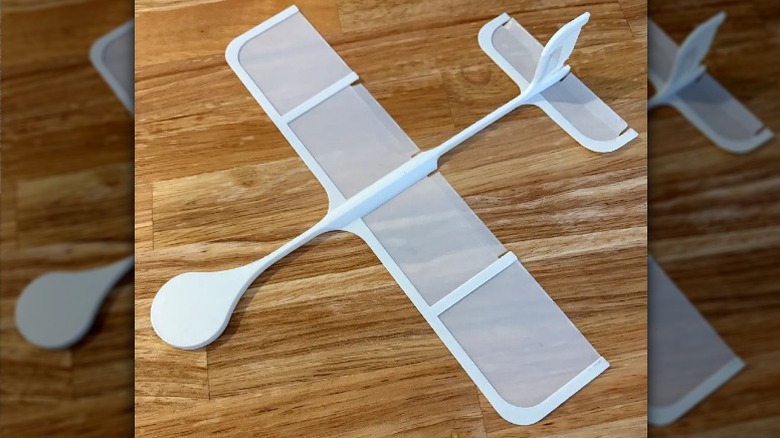
Another single-piece print that you might consider is the Simple Lightweight Glider by Printables contributor Ryan (@Ryan_3690341). This is a 10-inch x 10-inch glider with a rigid chassis and exceptionally thin wings and adjustable flaps. This helps it to minimize weight and maximize flight distance, with Ryan claiming that it can fly 35 to 50 feet at the standard print size.
The toy prints out as a single piece, with no assembly, rafts, or supports, using just 20 grams of filament. This makes it particularly good as a bed leveling tester, since it takes up a lot of space and has thin wings that will make uneven bed surfaces apparent early in the printing process. The only downside is that the glider's fragile construction can make it difficult to remove from the bed without damaging it.
The Makes and Comments section of the Printables listing features dozens of successful prints. One user noted that the glider "[f]lies farther than you might think" and appreciated its adjustable flaps, but added that it's also "[h]ard to get off of a print bed ... because of how thin it is." But while many commenters state that the glider prints and flies well, several have complained that it breaks easily, sometimes in the first few throws. So while this is a fun and easy print, you probably shouldn't expect it to last super long, particularly if you expect it to be making some hard landings. The project doesn't have specific printing instructions, but one commenter had success printing the glider in PLA with 0.15 mm layers and 15% infill.
Army Truck Kit Card
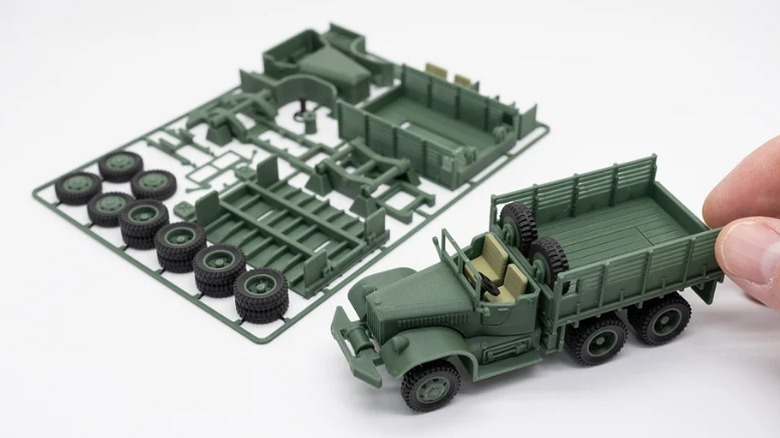
Printing a complex model with moving parts can be tricky, but it's a lot easier if you can print the parts separately and make the assembly process itself part of the fun. Kit cards allow you to print all the pieces of a model as a single unit, then snip the individual components off the card and put them together.
There are quite a few of these available on the usual maker sites, but one of the more popular designs across Printables, Maker World, and Thingiverse is the basic 1:64 print-in-place Army Truck Kit Card by agepbiz. This allows users to print a small army transport truck with a large open bed and a winch at the front. The design also has settings for printers that support multiple filament colors, so they can print the tires and upholstery in different colors. Agepbiz includes a detailed printable assembly instruction sheet with graphics on the listing and has even made a YouTube video of the building process for anyone who might get stuck.
There are dozens of reported prints across the three sites, with the vast majority claiming success. A handful of people noted that the tire connections come out a bit small, but these seem to be a relative minority. Agepbiz recommends a 0.16 mm layer height, and commenters have reported success printing in PLA, PETG, and TPU. Those who like this concept but want an even easier starter might be interested in the Jeep Kit Card and its associated trailer, also designed by agepbiz. They're similar in design, but smaller and have fewer parts.
Secret Butterfly Box
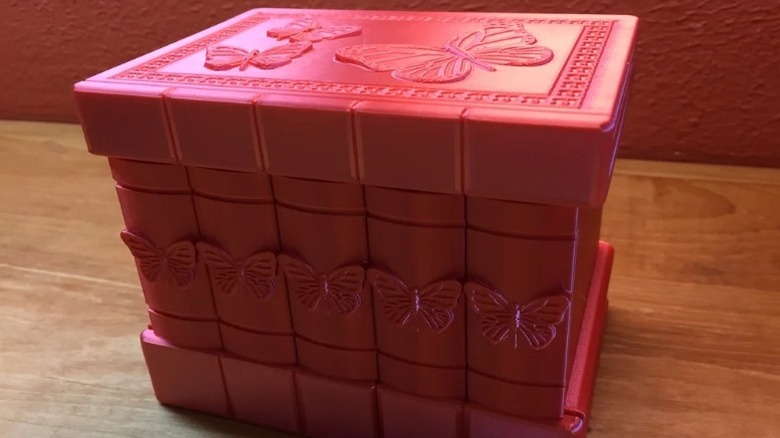
Those who want to make an intricate toy from a collection of relatively simple prints might want to check out 3D Printing World's Secret Butterfly Box. This ornately designed puzzle box requires users to find a hidden key and its corresponding keyhole before they can open it. There are 15 print files in the kit, so making it is a bit more involved than most of the others on this list. That said, all of them are designed to be printed with a 0.4 mm nozzle or smaller without rafts or supports, though 3D Printing World recommends using a skirt for some of the smaller pieces.
They recommend PLA for everything except for the plastic spring, which they state is better printed from ABS or PETG. Assembly also requires a 5-inch length of extra 1.75 mm filament, a pen spring, and some super glue. While this might sound complex, it's actually pretty easy, and the designer has provided a video demonstrating the full assembly process.
This project has been verified by hundreds of makers on Thingiverse, with makers showcasing the box printed in a wide variety of colors and materials, including PLA wood. Some have even modified the design to include different symbols and even their children's names.
HedronStack game
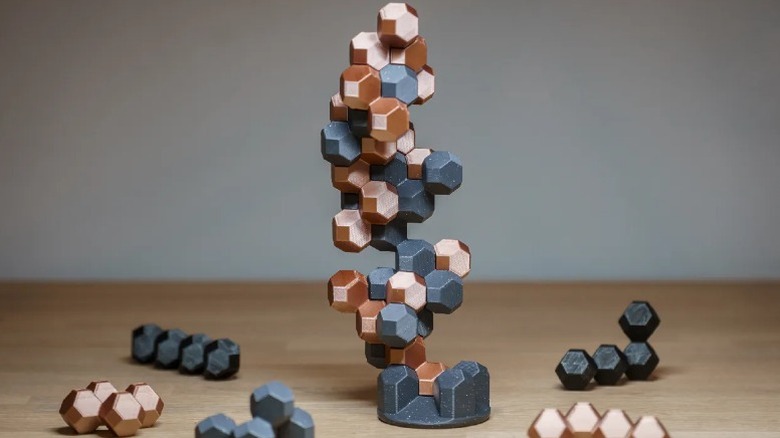
Tabletop games can be expensive, but 3D printing can save you money by letting you print something for your next game night. One such project you might consider is the HedronStack game designed by LaisVoon, available on Printables. This is a stacking game that is sort of like a reverse Jenga, with the goal being to build a taller structure than the other players without collapsing. The complete rules for the game are listed on the Printables post.
There are five files in this kit, but only because the base is offered in multiple sizes: A small base for one to two players, a medium base for three to four players, and a large base for five or more players. There is also an expandable base that players can use for more building freedom. You really only need to print a single small base set of the HedronStack Pieces to play it on your own, or two sets for multiplayer (optimally in different colors to represent opposing players). None of these prints requires rafts or supports.
LaisVoon recommends printing in PLA using a 0.4 mm nozzle. There are currently 47 reported makes on the Printables site, with nearly all of them claiming the game pieces printed very easily and that the game proved surprisingly challenging for something that appeared to have such a simple premise. LaisVoon has also shared the HedronStack Pentacells and HedronStack Cofounders expansions for those who want to add new, and even more dynamic, pieces to the game.