

This Factory In China Builds A Car Every 60 Seconds - Here's How
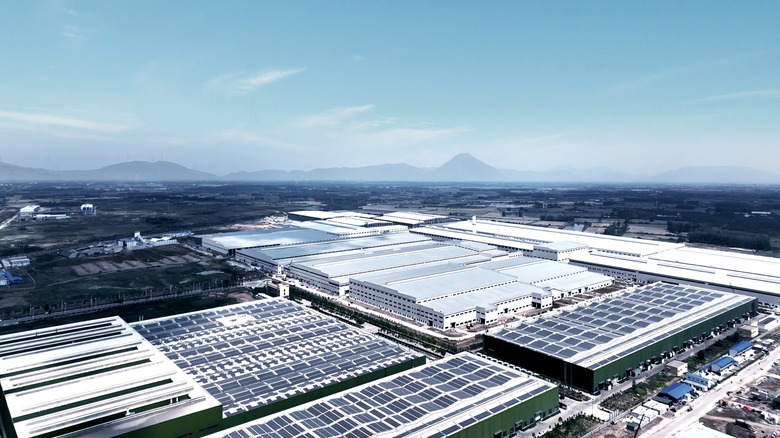
In the first quarter of 2025, Chinese electric car major BYD surprised auto pundits in the West when it dislodged Tesla to become the world's biggest EV maker. By the end of 2025, BYD would only widen its lead over Tesla and would sell more than 2.25 million cars, compared to Tesla's 1.64 million. One of the major reasons for BYD's meteoric growth as an EV player is the sheer scale of its operations. To cater to the needs of the automotive (and EV) market that is beating America to Elon Musk's EV vision, BYD has built several manufacturing facilities across China.
One of these factories, located in the small town of Xiaomo — a part of the Shenzhen-Shanwei Cooperation Zone — has earned quite a reputation for itself in recent times. The facility, which only began operations in September 2023, uses high levels of automation and intelligent manufacturing and is claimed to churn out an astonishing one car every 60 seconds. The factory, on average, produces around 1,280 vehicles every single day, which, extrapolated over a year, translates to an annual production capacity of over 400,000 cars. The cars manufactured at this facility include the BYD Yangwang U9 EV supercar, which is part of the company's premium YangWang sub-brand. The facility also manufactures several cars from BYD's Dynasty series, another premium sub-brand from the company.
This factory's location in the Shenzhen-Shanwei Cooperation Zone also keeps it close to China's EV-focused automotive supply chain hubs, making sourcing parts easier. The location is also home to production facilities operated by other EV-focused vehicle and component manufacturers, including BWI (known for brake and suspension systems), Lesar-DFM (manufacturers of seats), and Forvia (formerly Faurecia), a large automotive components supplier headquartered in France.
Automation, optimization, and robots behind BYD's incredible manufacturing speed
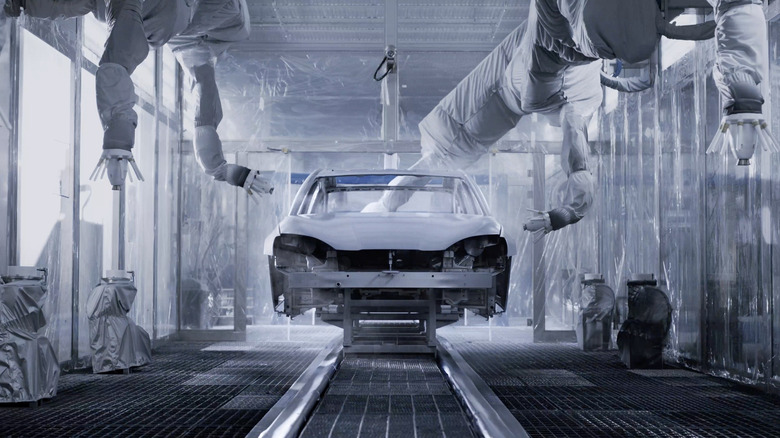
To achieve this high production rate, the factory has optimized almost every single part of the manufacturing process, which begins with the stamping and welding of the metal body, followed by painting, and concluding with the final assembly of the vehicle. The factory's stamping facility alone is spread over 140,000 square meters (1.5 million sq. feet) and is the place where BYD manufactures the various metal body parts that come together to create a car.
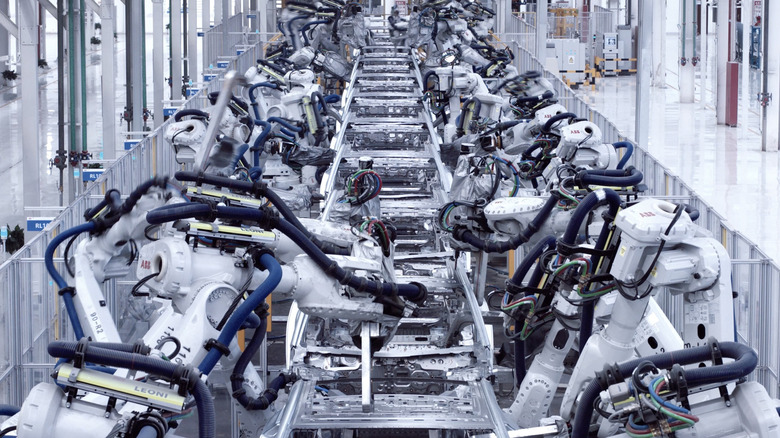
At the welding facility, an army of advanced robotic arms (also self-developed by BYD) precision-welds thousands of car parts. These welded parts are then sent to the paint booth, where the vehicle gets its coat of paint. The last section of the manufacturing process is the final assembly, where workers give finishing touches to a completed BYD electric car. Following mandatory inspections and quality checks, the completed vehicle is ready to be shipped out and reaches consumers in a matter of days. All these different processes happen simultaneously, resulting in an impressive headline-grabbing production speed of one new BYD electric car coming out of the factory every minute.
Now, there is no denying that a single factory producing one car every single minute is an astonishing feat of engineering and optimization. However, even these superlative figures pale in comparison to what BYD's largest production facility, located in the city of Xi'an in northwest China, is capable of.
BYD's Xi'an factory is even bigger
As outlined earlier, BYD has production facilities scattered across China, including a new, under-construction, but partially operational megafactory in Zhengzhou. Before the advent of this new facility, BYD's largest production plant was located in the city of Xi'an. This megafactory has been BYD's most prolific production facility for several years now and has been in operation for over 20 years. It made headlines in late 2024, after more than 1 million fully manufactured BYD electric cars rolled out of the facility.
The Xi'an factory was able to hit these astonishing figures thanks to the presence of four separate assembly lines that mass-produce EVs at a rate that might have never been witnessed before. We are talking about anywhere between 4,000 and 4,400 cars rolling out of this facility every single day. If we do some simple calculations, this facility churns out an average of 3 cars per minute, making BYD's aforementioned Xiaomo facility's one-car-per-minute output seem comically slow.
It is pertinent to note that we are referring only to a single BYD facility that has produced well over a million EVs in a year. BYD's entire production for 2025 across all its factories was around 4.5 million cars, of which 2.25 million were pure EVs, while the rest were PHEVs (plug-in hybrid electric vehicles) and commercial vehicles that integrate a gasoline engine and an electric motor. It would be interesting to see whether BYD is able to sustain this level of exponential growth for the foreseeable future, given that recent data has indicated that EV sales in the burgeoning China market have started signs of slowing down.