

Google's Quantum Echoes Might Actually Live Up To The Hype
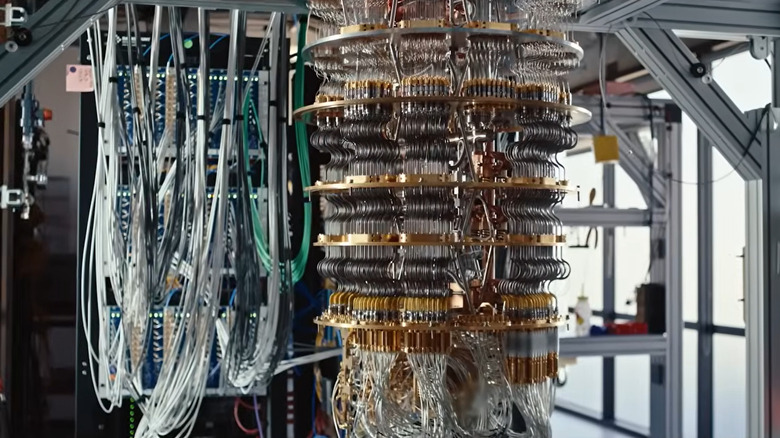
In October 2025, there was a groundbreaking scientific breakthrough that might have passed you by. Google claimed its Willow quantum chip ran a task that would take today's best classical supercomputers about 13,000 times longer to simulate. The speed boost wasn't the most interesting part. We all know that quantum computers are fast.
The interesting part was Google's other claim: The result is verifiable. One of the biggest concerns in quantum computing is if a quantum computer solves a problem that classical computers can't, how do we know the answer is correct? Quantum Echoes, Google's new algorithm, is designed to produce an output that you can repeat and expect to get the same answer again.
Google published a paper in Nature explaining how the algorithm produced verifiable results. It also carried out a proof-of-principle experiment to demonstrate how this works and why it might be useful in the future. Using nuclear magnetic resonance — the technology used in MRI machines — researchers estimated real chemical properties and then used a quantum processor to simulate the echo signals.
This particular experiment used problems that could still be verified in other ways, in order to confirm its accuracy. Next, the algorithm could be used on larger-scale challenges, bringing us closer to a world where quantum computing is actually useful. Currently, as cool as quantum computing is, it doesn't really have any real-world applications. Google hopes that after Quantum computing-enhanced NMR has proven to be successful, it can be developed for practical applications, including materials science, astrophysics, and medical research.
How does Quantum Echoes work?
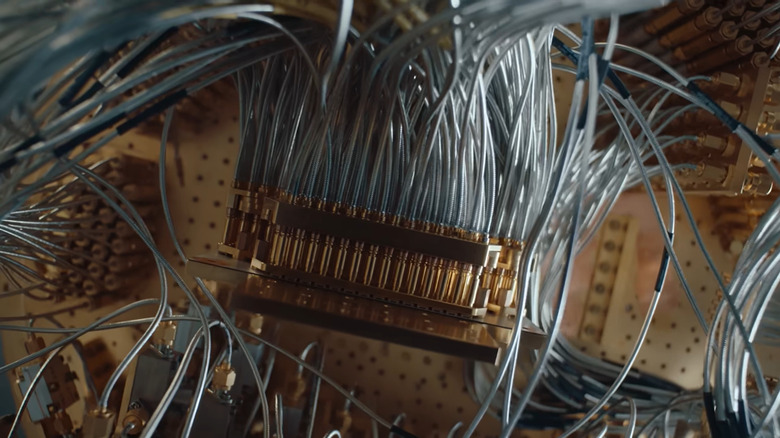
The new algorithm is called Echoes, and it works in a similar way to the kinds of echoes we are more familiar with — but instead of sound, it's information bouncing around inside a bunch of quantum bits (qubits). Quantum computing can be quite difficult to explain, but basically, the chip runs a complicated sequence of operations that scrambles the qubits, then it runs the whole thing backward, like rewinding a video. Right in the middle, it adds a tiny so-called poke to one qubit. At the end, it measures whether the tiny poke spread through the system enough to mess up the rewind.
This technique — known as an out-of-time-order correlator (OTOC) — was used in the NMR experiment by tracking how nuclear spins behave in a magnetic field. The paper describes the echo experiment where polarization starts on one spin, spreads through a network, and then a carefully engineered reversal tries to refocus it. If you add a disturbance before it refocuses, the echo degrades — and how it degrades tells you about the molecule's internal structure. This technique could lead to important insights into other quantum structures like cells, magnets, or even, according to Google, black holes. It will, however, take years to get there.
This is just one step on a road to properly useful quantum computers. We predicted that Quantum computing will finally evolve from being purely cosmetic in the top tech trends we expect to see in 2026. Google has a far-reaching quantum hardware roadmap and knows what it wants to achieve next. The next goal is a quantum bit stable enough to carry out around a million steps before it makes a mistake.