

Scientists Say Cleaning Plastic Out Of Our Oceans Could Do More Harm Than Good
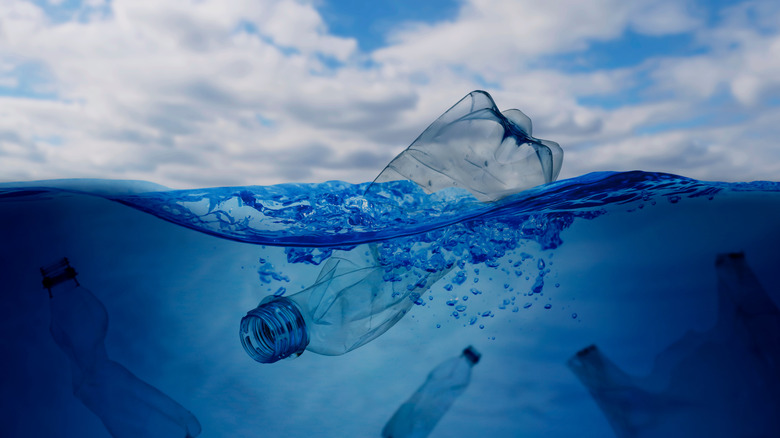
Plastics tend to break down into microplastics rather than biodegrade (though there are biodegradable plastics as well). Another issue is the amount of plastic entering the oceans: approximately 11 million tons annually, according to Surfers Against Sewage. All of this waste can cause significant harm to the various species that reside in and around the waters, and to the delicate ecosystems of which they're a vital part. Curiously, though, some scientists believe that the global effort to remove polluting plastic from our oceans is actually rather counter-productive. In the specific case of one type of ocean dweller, namely the neuston.
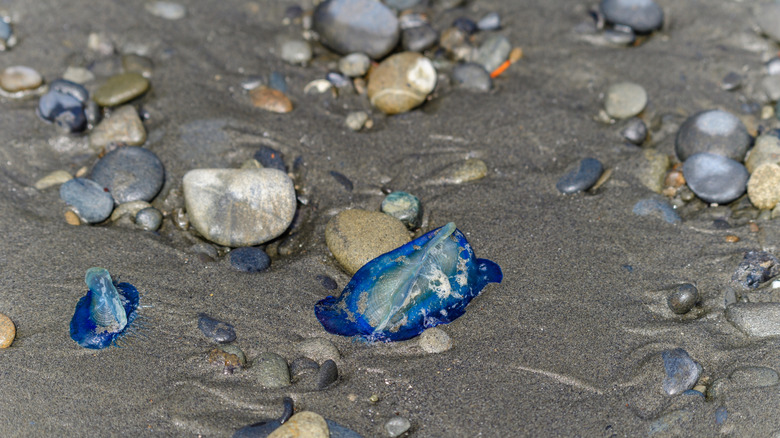
This is not simply the name of a species, but of a whole variety of critters defined by Britannica as a "group of organisms found on top of or attached to the underside of the surface film of water." This encompasses a range of life forms from whirligig beetles to the likes of worms and the Pacific man-of-war. Though the species that make up the neuston vary a lot depending on the specific area, it's a critical part of the ecosystem. A part, moreover, that seems to have learned to live with (and even within) the accumulations of plastic such as the infamous Great Pacific Garbage Patch.
For this reason, disturbing and removing all that plastic could harm the neuston too. Marine biologist Rebecca Helm is one expert who has advocated for caution in conservation efforts, stating, as quoted by Earth: "Some of these cleanup projects have the potential to get rid of an entire ecosystem that we do not understand and that we may never be able to restore."
The importance of the neuston
Apex predators like the polar bear and orca, two talismans of worldwide conservation efforts, have crucial places at the top of their respective food chains. It's fortunate, then, that scientists have discovered a secret of polar bears. This isn't to say that the animals they eat are any less important, though, nor are seemingly "insignificant" life forms like the insects that make up the neuston.
In fact, marine biologist Rebecca Helm writes for PLOS Biology, lifeforms that are part of the neuston include "keystone organisms like the golden seaweed Sargassum that makes up the Sargasso Sea." Another important point is that "many ecologically and economically important fish species live as or rely upon neuston." Whether from the perspective of conservation, financial interest, or its unique place in the gray area of importance to both land and sea ecosystems, there's no denying the importance of the neuston. Even so, it's poorly understood. Professor Kylie Pitt of Griffith University explained, The Guardian reports, that this is because its "transient nature makes it difficult to study. You'll see large numbers of jellyfish or bluebottles and then you won't be able to find them again."
The neuston is an underexplored enigma in science, but there are suggestions that some such organisms can use the ocean's plastics. An October 2012 Biology Letters study by Miriam C. Goldstein et al., for instance, finds that water striders may use microplastics as egg-laying surfaces, thereby increasing numbers. Neuston drifts with the currents, just as plastic does, raising concerns that they could accumulate naturally. This raises concerns that efforts to collect plastic may also remove neustonic populations.
The ongoing issue of plastic waste
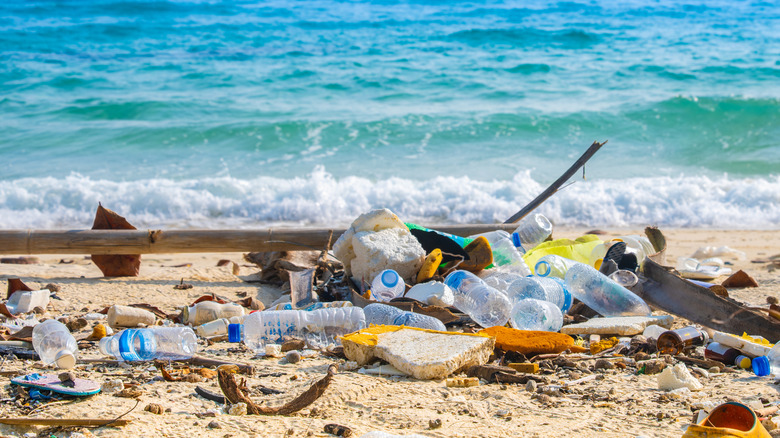
Of the many human-made products that have had a negative effect on the environment as a whole, plastic has had a truly bad rap over the years. It's the sheer quantity of it in production that's been a big part of the issue, because different types of plastics are so widely used. From children's toys to shopping bags and drinking straws, it is ubiquitous. Some cars even have bodies made of plastic. Being cheap to produce, too, has only given more incentive to create it, which is another reason why it's just so common. The European Environment Agency paints a grim picture: "Over half of the plastic production ever manufactured has been produced since 2000 and we are set to double our current global annual production by 2050."
Removing some of the plastic from the oceans, and the many vessels, tools, and other water disturbances that are necessary in doing so, could pose a danger to such surface-dwelling populations. The more productive way forward, according to some scientists, would be to attempt to tackle the issue of the large quantities of plastic that are still being produced and entering the world's waterways, rather than concerted efforts to retrieve and dispose of what's already in there.
The Ocean Cleanup is engaged in ongoing efforts to remove some of these huge accumulations, such as the Great Pacific Garbage patch. Scientists such as Rebecca Helm, however, continue to contend that wide, sweeping efforts to remove trash could also be harmful to the neuston. Both sides of the argument, such as it is, support cleaning oceans and protecting life, and further research may yet provide more definitive answers regarding neuston populations and how best to protect them.