

Seismic Swarm: This Small US City Had 75 Earthquakes In Just One Day
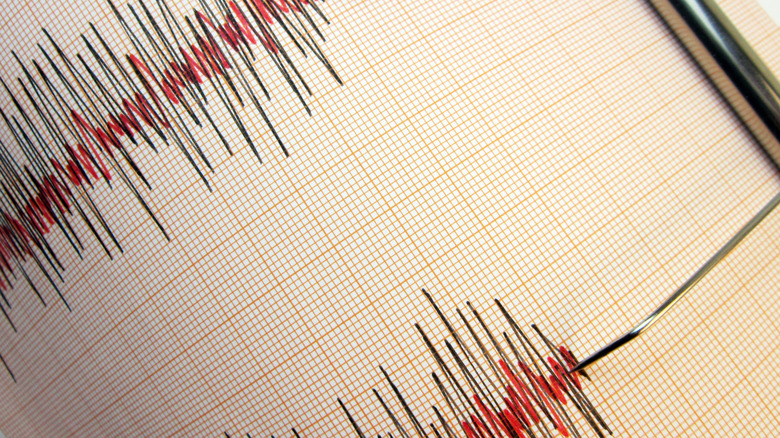
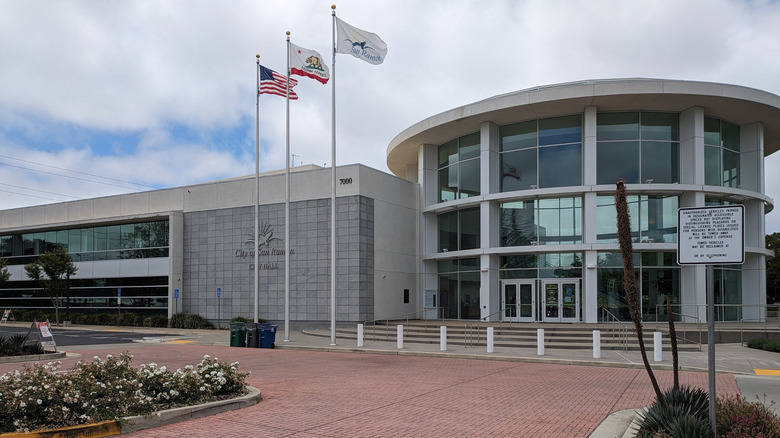
There's no shortage of stunning cities in California. Take San Ramon, for instance, famed for its majestic green hills, its critical place in the Tri-Valley economic hub, and its wonderfully boastful tagline, "everyone loves it here." Idyllic as it may seem, though, the city is troubled by earthquakes. While this is unsurprising for the Bay Area, which is renowned for such activity, San Ramon really does seem to experience more than most.
February 2, 2026, may have started like any other Monday morning in the city, but it would see something extraordinary: 75 earthquakes in one day. It was around 6:30 am when the first of the quakes struck, and it was quite the way to herald what was to come. Sue Wild, who lives in the city, told the San Francisco Chronicle that the impact "felt like a freight train was coming through the middle of the bed." If you live in San Ramon or any region that's prone to earthquakes, emergency supplies, like those sold at Harbor Freight, can be invaluable.
Earthquakes are not uncommon events, sadly. The British Geological Survey reports that even the United Kingdom, which isn't exactly renowned for tectonic activity, records around 300 earthquakes each year. Even so, San Ramon's single-day tally is extraordinary. It's largely because of the geography of the area, a factor that influences the whole of the region's vulnerability to earthquakes.
Why San Ramon is so vulnerable to earthquakes

The positioning of the continents and the movement patterns of tectonic plates mean that some areas are far more prone to earthquakes than others. Fault lines are cracks in the crust of the Earth from which the energy from plates impacting each other can escape. One of the most infamous on the planet is the San Andreas Fault. It's more than ten miles deep in places, and runs for more than 650 miles along the surface. It is impacted by two tectonic plates, the North American Plate and the Pacific Plate, pushing back against each other. Continual movement, as in this case, reduces the pressure built up between the two plates, generally resulting in more frequent, but less intense and powerful, earthquakes. Given its vastness, it's no surprise that this fault system incorporates a complex web of more minor ones, which combine into the broader San Andreas Fault system.
The significant thing about San Ramon's placement in particular is that it lies not on the San Andreas Fault itself, but one of the related parts of that wider network: The Calaveras Fault. The city is directly on top of this volatile fault, and that's the reason for the extent of the tectonic activity there. As for why quite so many earthquakes struck in such a short space of time, in an event referred to as a swarm of quakes, that's a more difficult question that experts are still grappling with. We do know that San Ramon is frequently affected by swarms, with two of the most recent occurrences in 2018 and 2015.
The nature of the earthquakes that struck San Ramon
Notably, of the many earthquakes that struck San Ramon on that February day, a magnitude of 4.2 was the highest recorded, all the way down to magnitude 1.3. CBS News reported at the time that "No significant damage was reported on Monday, but residents and some businesses reported items falling off shelves." The United States Geological Survey (USGS) classes a 5.3 magnitude quake as a moderate one and a 6.3 magnitude event as a strong one, demonstrating that, as formidable as it sounds to be struck by so many earthquakes over the course of just 24 hours, they were, mercifully, mostly small ones. If you're ever not sure, there are ways to check whether there was just an earthquake near you.
Small earthquakes may not be the most damaging, but it's the sheer number — and unpredictable nature — of these events that caused such concern among the community. Being awoken by an earthquake, 'moderate' as it may be, is undoubtedly distressing. Scientists haven't been able to determine a specific cause for the behavior. One belief, according to the San Francisco Chronicle, is that fluid activity in smaller fault systems in the area produces these alarming bursts of earthquakes. Swarms are, in some regions, indicative of volcanic activity beneath the Earth's surface, but a USGS report notes that this is not the case with San Ramon. Instead, it's simply a region with unique earthquake swarms that behave like magmatic ones, but aren't. Scientists are doing what scientists do best, and continuing to probe exactly why.