

Shell Owns All 6 Of These Popular Motor Oil Brands
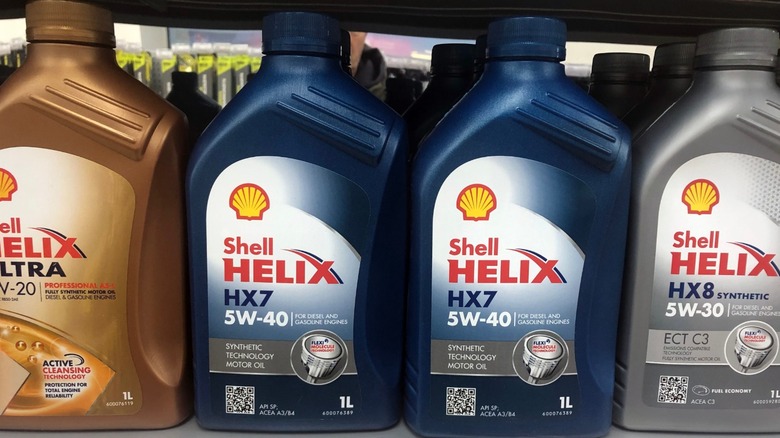
Competition in the world of business is a good thing for the consumer, right? It keeps prices down and forces innovation. Well, the motor oil space isn't as competitive as you might have thought. For example, many consumers may think that Quaker State, Pennzoil, and Shell are all made by separate companies. We can't blame them, considering how they're marketed. But it turns out that Quaker State and Pennzoil are both owned by Shell and have been for the past couple of decades.
There are other, less distinctly positioned, brands in Shell's lineup. These include Shell Helix, Shell Advance, Shell Rotella, and Shell Rimula. Of course, Shell's ownership of these brands is more obvious, given that "Shell" is in the name. Still, each of them serve a different market. Helix is the flagship brand for passenger cars. Advance is for motorcycles and scooters, Rotella is for heavy-duty diesel engines in North America. Rimula is for heavy-duty diesel engines everywhere else.
One thing that most of these brands have in common is how they make some of their synthetic products. Using a process that was pioneered by Pennzoil and called "PurePlus," they derive synthetic motor oil from natural gas. This produces an extremely pure base oil used to make motor oil and other automotive liquids. Shell's ownership of multiple brands has allowed this technology to be used in various products. It's probably why Shell, Pennzoil, and Quaker State all made our list of the best motor oil brands of 2025.
Quaker State
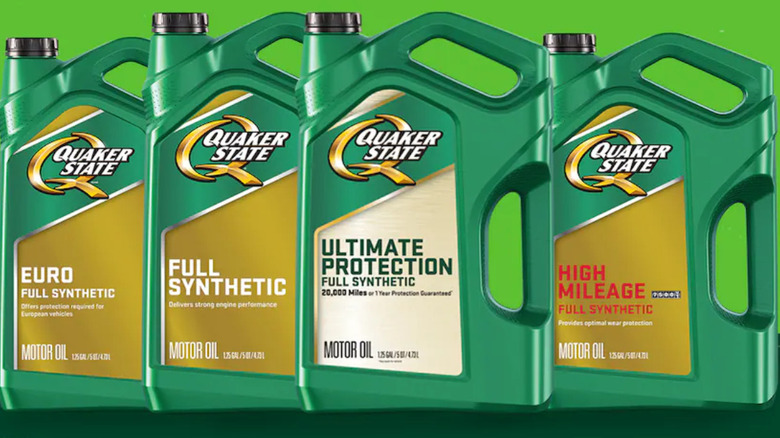
Quaker State has been around a long time. Its history goes back to 1914 when it was known as Phinny's Quaker State Medium Oil. Later, in 1921, the Phinny brothers acquired the trademark for "Quaker State." Then, in 1931, it merged with 18 other companies to form the Quaker State Corporation. Pennzoil bought the company in 1998 and formed the Pennzoil-Quaker State Company, keeping both brand labels and becoming the largest automotive consumer products company in the world, grabbing up a third of the U.S. oil market. Finally, Shell took over the company in 2002, making it the largest lubricant manufacturer in the U.S. The Quaker State name survived all of that and still retains a distinct enough identity that you probably didn't even know it had ever been owned by anyone else.
How does Quaker State set itself apart enough to keep its own identity? The brand presents itself as being all about durability. For example, the Quaker State website touts its synthetic oils as being engineered for "performance and ultimate protection" and its conventional oil products as able to fight engine sludge "mile after mile." It's so confident in its product that it will warranty its customers engines for up to 10 years or 300,000 miles (whichever comes first) for a trade-in value of up to $3,000, as long as they use Quaker State oil exclusively. The company claims that it has the only warranty program that pays that much back in trade-in value.
Pennzoil
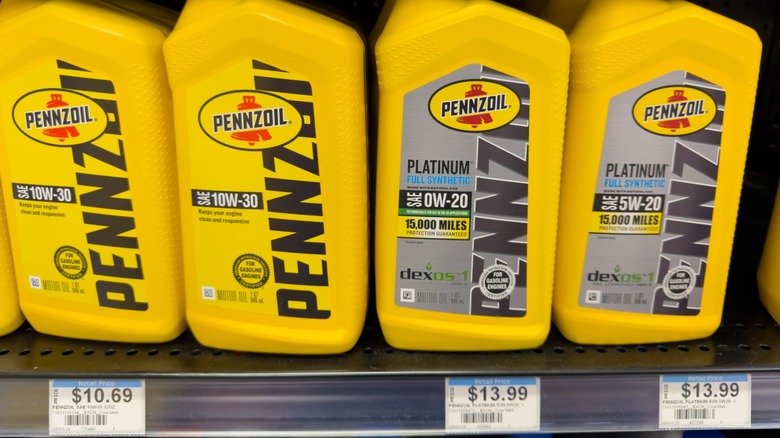
Like Quaker State, Pennzoil has been around for a long time. Pennzoil can trace its roots all the way back to the 1800s to the Pennsylvania Refining Company, one of the brands that would come together to form it. But the Pennzoil name would not be used until the second decade of the 20th century. As we said, Pennzoil would buy Quaker State by the end of the century and form Pennzoil-Quaker State Company, and Shell would buy that company just a few years later in 2002.
Pennzoil was the first of the brands to make its synthetic oil from natural gas instead of crude oil. Pennzoil claims that synthetic oil derived from natural gas performs better because it contains fewer impurities than products made from crude oil and that its product is the first of its kind. While it was the first, it's no longer the only Shell brand to use natural gas technology.
Pennzoil positions itself as the high-end brand, touting its innovations and its "top-tier" products. Our impression is that it markets its oil to consumers who are willing to pay for quality. In fact, Pennzoil Ultra is highly regarded as being on par with brands like Royal Purple, and it's well-suited for high-performance cars. It doesn't emphasize durability like Quaker State does, yet its warranty lasts even longer than Quaker State's, offering protection for 15 years or 500,000 miles, whichever comes first.
Shell Rotella and Shell Rimula
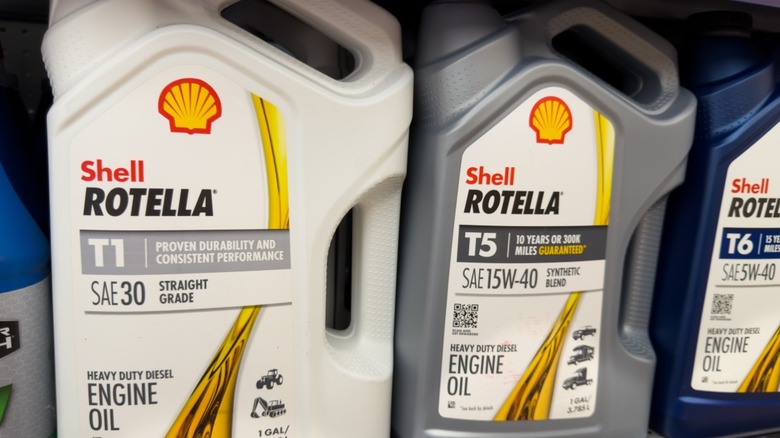
Shell has two brands that are formulated for heavy-duty diesel engines: Rotella and Rimula. It makes sense to have a separate brand for diesel oil, since diesel oil and gas engine oil are different. But why two brands? They are each marketed in different regions. Rotella is Shell's North American diesel oil brand family. Its full synthetic oils include T6, which is exclusively for diesel engines, and MV (multi-vehicle), designed for both diesel and gas engines. It also makes synthetic blends, T5 and FE, as well as heavy-duty diesel oils, T4 and NG.
Rimula is Shell's global brand of oil for heavy-duty diesel engines. Marketing material and product descriptions for Rotella often mention how its products meet CK-4 requirements, specs designed by the American Petroleum Institute (API). In comparison, Rimula emphasizes how its products meet European OEM standards, like Renault Trucks RLD-3/RLD-5 and Volvo VDS-4.5, though there is some overlap in that area between the two brands.
Rimula products include its synthetic R7, R6, and R5 products for heavy-duty diesel engines, as well products like R4 L, which is suitable for multiple diesel vehicle types. R3 MV is especially designed for construction, mining, and quarrying applications. Nothing really stands out in how Rimula seems to position itself in the global market. Its webpage talks about viscosity and protection against acid, deposits, and engine wear, which is nothing special among major oil brands.
Shell Advance
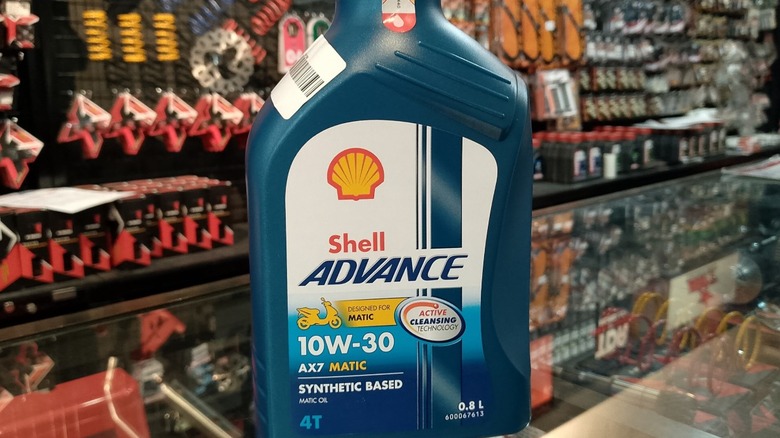
Motorcycle and scooter engines require different oil than automobiles, so Shell created a separate brand for its motorcycle oil. But that's not the only thing that stands out about Shell Advance. Last year, it took a page out of Pennzoil's playbook and launched its own synthetic oil made out of natural gas. Shell claims that the proprietary technology used to make its Shell Advance Ultra synthetic oil produces a 99.5% pure base oil, with "virtually none of the impurities found in crude oil."
Shell Advance happens to be the official oil partner of Ducati. The manufacturer uses Shell Advance in its bikes in races like MotoGP and the Superbike World Championship. It is also the oil found in every Ducati motorcycle when it leaves the factory. Additionally, Shell Advance was the first title-sponsor of the Asia Talent Cup, a competition designed to promote new riders in the world of motorcycle racing. Of course, every bike in the competition uses Shell Advance Ultra. In 2015, Shell made a deal to be the factory-fill and aftermarket supplier for BMW Advantec oil.
Shell Advance claims that its synthetic Advance Ultra product doesn't degrade between oil changes, eliminating power loss. It also claims that Ultra will get you 5 more kilometers per liter (11.76 more miles per gallon). However, that's based on a test comparing Shell Advance Ultra with Shell Advance AX5, one of its own conventional products.
Shell Helix
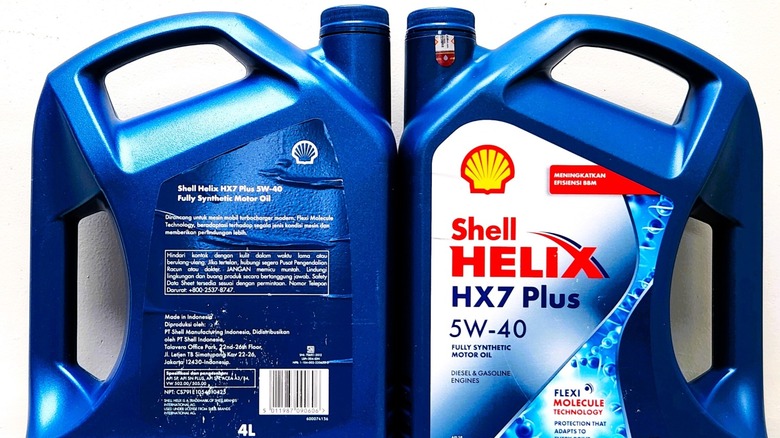
Of course, we can't have this discussion without talking about Shell's flagship brand for passenger cars, Shell Helix. The Shell Helix brand is sold globally and includes a variety of products, including fully synthetic oil, as well as conventional oil for certain international regions. Shell Helix has partnered with the likes of Scuderia Ferrari to provide its Formula One cars with Helix Ultra products, as well as to be the oil placed in Ferrari's new GT consumer vehicles. Other partnerships have included BMW Motorsports, Hyundai Motorsport, and Maserati.
Like the other Shell brands, Helix uses PurePlus technology to derive synthetic motor oil from natural gas. There is a small graphic in the Helix section of the Shell website that briefly explains some of the steps involved in turning natural gas into motor oil. Apparently, this process includes several awesome terms like "gasification," "Syncrude," and "hydrocracking." The way it works is natural gas is exposed to oxygen, creating synthesis gas, which is then put into a reactor and turned into a liquid called Syncrude. The molecules in the Syncrude are broken down in a machine called a hydrocracker. That creates new molecules that get distilled into multiple liquid products, including, of course, Shell Helix motor oil. Leave it to Shell to make a chemical engineering process sound cool.
We covered Shell's main motor oil companies, but it also owns other lubricant brands, plus the Jiffy Lube chain. Its global reach is impressive, to say the least.