

These Four SUVs Aced IIHS's New Whiplash Prevention Test
The IIHS, or Insurance Institute for Highway Safety, periodically reviews its safety tests to ensure that its ratings reflect the real-world performance of tested cars as accurately as possible. It recently published the results of its newly updated whiplash prevention test, which was carried out on a range of popular SUV models. In the report, the Institute's president, David Harkey, said that "neck sprains and strains are the most frequently reported injuries in U.S. auto insurance claims," making this new test a particularly important update.
Only four out of 18 small SUVs that were put through the new testing process received top marks. These included a pair of Japanese SUVs, namely the 2025 Toyota RAV4 and 2025-26 Subaru Forester, plus the Audi Q3 and the all-electric 2025-26 Hyundai Ioniq 5. The Korean brand's EV might have scored well, but its combustion sibling, the 2025-26 Tucson, did not. It was one of three SUVs that earned a "Poor" rating in the test, alongside the Ford Bronco Sport and Mazda CX-50 from the same model years. The BMW X1 and Nissan Rogue didn't fare much better, earning a "Marginal" rating.
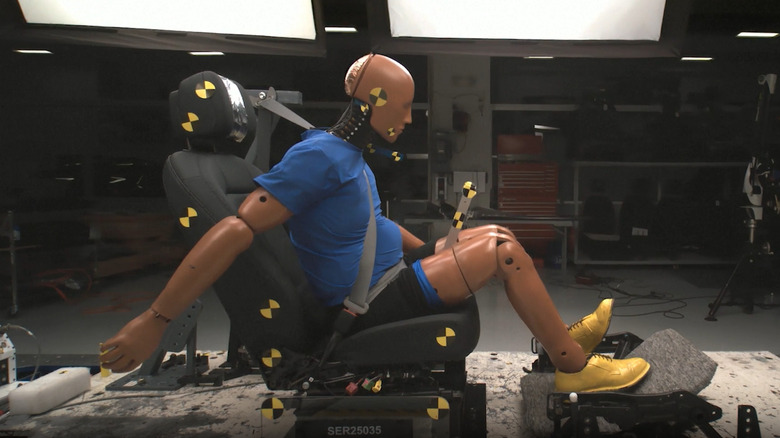
The revised test focuses on three key areas, with one being the interaction of the dummy's head with the restraint, and another being the overall support of the dummy's head and spine. The third consideration was how the car's seat absorbed the energy of the collision.
The new test differed in several key ways from the old test
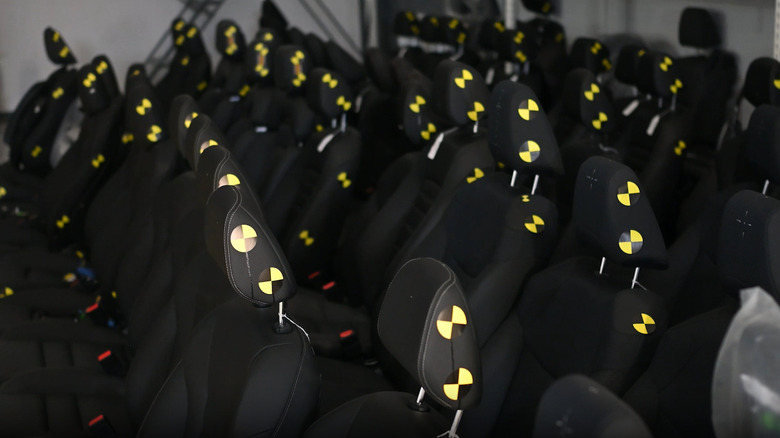
Although the IIHS was already testing how well a car occupant's head and spine were protected during a collision, its researchers decided to rework the older methodology after finding that insurance claim data didn't match its safety ratings. In some cases, there was a mismatch between the amount of whiplash claims for a particular car model and its safety rating, and so the IIHS redesigned the test to provide a more accurate analysis of a seat's restraint capabilities.
To conduct the test, the IIHS straps a dummy into a car seat that has been taken out of the vehicle. Both are attached to a testing sled, then the sled is launched to simulate a crash at 20 mph and 30 mph. A variety of criteria is then used to determine the car seat's score, including measuring the movement of the dummy's pelvis during the collision and the tilting of its head. Also considered are the amount of time that the head spent in contact with the restraint and the acceleration of the dummy's T1 vertebra in its spine.
This newly launched test is just one of a list of procedures that cars have to go through in order to receive a safety rating from the IIHS, with all of its latest ratings available to search via its website. Inevitably, some SUVs receive worse safety ratings than others, and so it's always worth checking the rating of any particular car you're considering before you sign the dotted line.