

This Lockheed Flying Aircraft Carrier Concept Would Have Been Terrifying
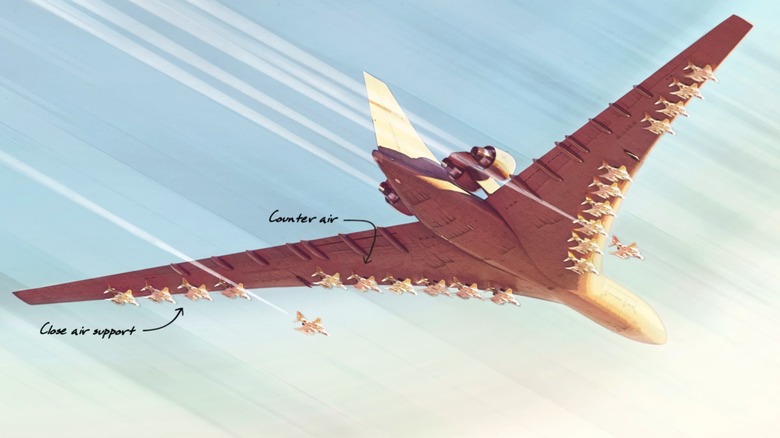
The Cold War was a difficult time, with elementary school children practicing "Duck and Cover" nuclear attack drills while some families set up fallout shelters in their homes and yards. The chief concern was nuclear war with the U.S.S.R. that could have seen the use of intercontinental ballistic missiles (ICBMs), submarines, and bombers, but there was more on the drawing board. In the late '60s, engineers at Lockheed reportedly brainstormed something remarkable: a flying aircraft carrier. If you're picturing the Helicarrier from Marvel's "The Avengers" you're not too far off, as Lockheed's LC-1201 was also meant to travel on water and in the air.
It was never built, but the rumored design for this massive aircraft made it potentially terrifying to America's enemies. There are no official specs from Lockheed or the U.S. Air Force, but multiple outlets have published figures taken from possibly leaked NASA schematics.The LC-1201 would supposedly have been 560 feet long with a 1,120-foot wingspan and weighed around 5,265 tons (over 11 million pounds). It could have housed hundreds of crew members and stayed in the air for over a month with its 1.83 gigawatt (1,830-megawatt) nuclear power generator.
For comparison, one megawatt powers around 200 homes in Texas, according to ERCOT, the organization that manages the state's power grid. That means that the LC-1201's powerplant could have theoretically powered 366,000 Texas homes. Using the state's average of 2.84 people per household, that's more than 1 million customers served. For a fictional comparison we can use the 1.21 gigawatts required to power Doc Brown's flux capacitor in the "Back to the Future" movies, but the LC-1201's nuclear reactor would have been tasked with keeping millions of pounds of metal aloft (plus the weight of the multi-role fighters docked under its wings) instead of time travel.
The Lockheed LC-1201 presented engineering challenges
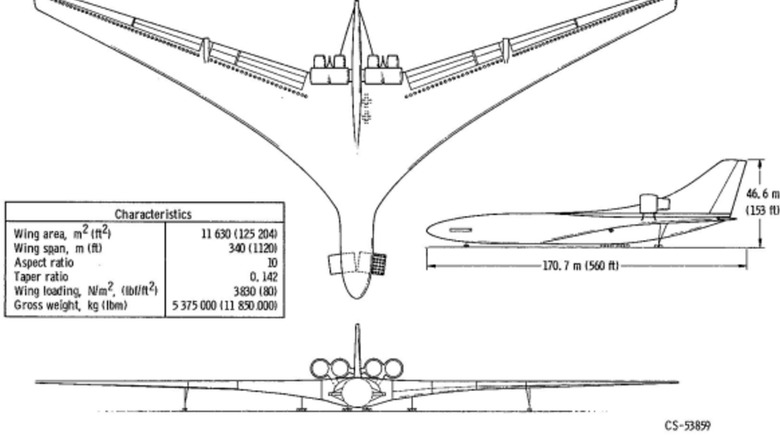
While the design of the Lockheed LC-1201 was certainly ambitious, there were more than a few challenges preventing it from coming to life. Lockheed's engineers reportedly dedicated much of their work to calculating power production and consumption, and designing a powerplant capable of moving the massive aircraft was a big problem.
The plane was meant to carry a brigade of troops and their gear anywhere in the world, and the need for nuclear propulsion would have made it an obvious (and very large) target. There was no stealth technology back then to hide it from enemy radar, although the reactor would have been able to operate for 1,000 hours at a stretch. That's 41 days and 16 hours, long enough to fly anywhere in the world at the LC-1201's reported max speeed of Mach 0.8.
Two versions of the aircraft supposedly made it through the design stage, though the details of one of them have been lost or remain secret. The so-called Attack Aircraft Carrier could have carried F-4 Phantoms or similar fighters and been armed with a variety of weapons and defense systems, making it a true terror of the skies. Unfortunately (or fortunately for Congress, which would have had to pay for it), there were far too many problems with for the LC-1201 to be practical as envisioned.
Why the LC-1201 would never be able to fly
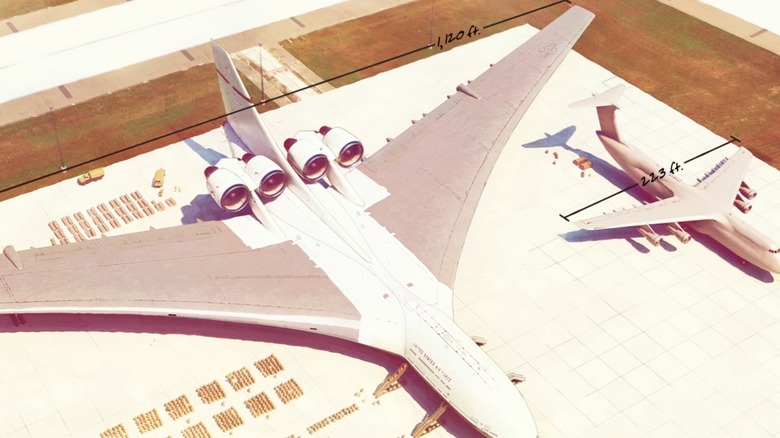
The biggest problem with the LC-1201's design was its size. There simply weren't any runways on earth long enough to allow it to take off and land using regular thrust engines so Lockheed leaned into the Vertical/Short Takeoff and Landing (V/STOL) technology used in the legendary Harrier jump jet. Dozens of turbofan engines would be used to lift the behemoth off the ground; once in flight nuclear power would take over.
This was a technological impossibility at the time and remains highly improbable today, and a major challenge would be fitting a reactor capable of generating 1.83 gigawatts of energy on an aircraft. The largest nuclear reactor complex on earth is the Kashiwazaki-Kariwa plant in Japan; it produces around 8 gigawatts and takes up about 4.2 square km (over 1,000 acres). There's also no guarantee that a typical pressure vessel (the protective chamber around the core) would survive a crash or anti-aircraft weapon attack.
The defensive tech available in the 1960s would have left the LC-1201 a giant sitting duck as well. The project died on the paper where it was printed due to technological limitations and likely cost. While there aren't any reliable budget estimates to draw from, we can use a modern megaplane to build an educated guess. The largest American military plane in use today is the Lockheed-Martin C-5 Super Galaxy; each plane costs over $150 million to produce and they're "only" 247 feet long. At more than twice that length it's safe to assume that each LC-1201 would cost closer to $1 billion if making them was even possible. With all this in mind, it's safe to say that the LC-1201 was almost as scary for Lockheed and military logistics experts as it would have been to enemies.