

This 1970s Car Was Known As The Flying Fishbowl (And We Can See Why)
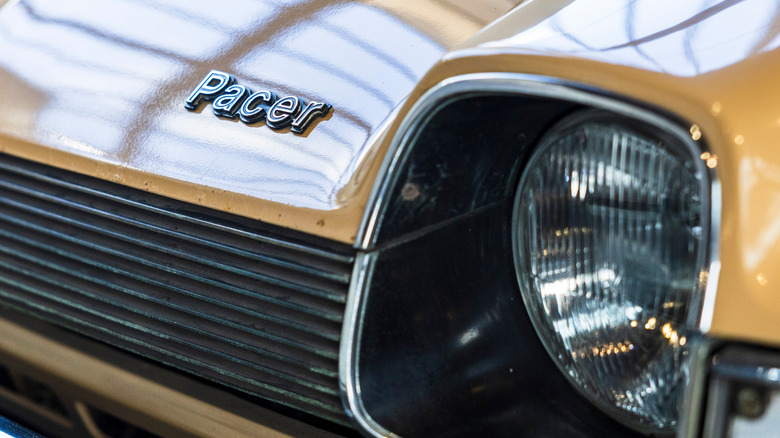
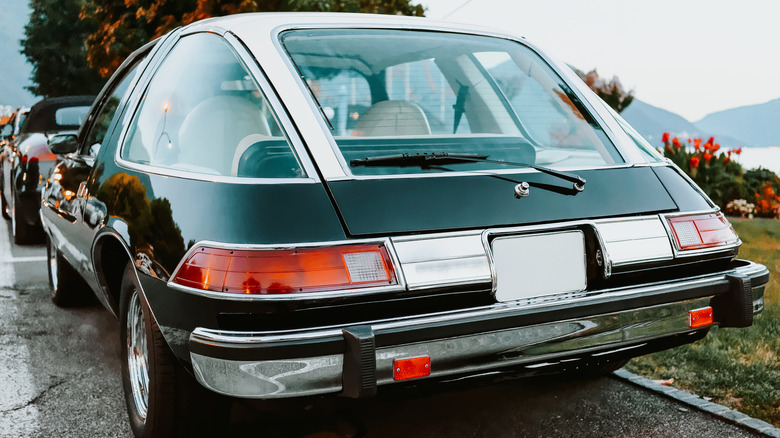
The car that came to be known as the Flying Fishbowl was the 1975-1980 AMC Pacer, which lived up to its name by having 37% of its body surface made of very heavy glass. While this glass was intended to provide the driver and occupants with better outward vision, it only made the exterior design ridiculous and infamous. Car and Driver magazine's Stephan Wilkinson humorously quipped in the May 1976 issue to, "consider the addition of air conditioning if you live anywhere south of Nova Scotia." Over the years, the AMC Pacer has evolved into one of the worst-looking cars from the 1970s.
The AMC Pacer was AMC's attempt to give small-car buyers more room inside the. This resulted in a vehicle with a 100-inch wheelbase being 77 inches wide. The Pacer was designed to be powered by GM's compact rotary engine, which never came to pass, thanks to major issues GM could not overcome related to durability, emissions, and fuel economy.
In its place, AMC had to rely on its trusty but heavy inline six-cylinder engines, in displacements of either 232 or 258 cubic inches, or 3.8 and 4.2 liters, respectively. A V8 engine option was added later. These engines were partially responsible for the AMC Pacer tipping the scales at 3,432 pounds, far more than competitors like the Chevrolet Vega at 2,304 pounds, and the Ford Pinto at 2,065 pounds.
How well did the AMC Pacer perform?
As you might expect, with such a weight penalty from its heavy engine and massive glass area, the AMC Pacer provided extremely leisurely acceleration. A June 1975 test performed by Car and Driver, on the optional 258 cubic-inch engine with its single-barrel carburetor producing 95 horsepower resulted in a 0-60 mph time of 16.2 seconds, with a quarter-mile run taking 20.4 seconds at a trap speed of 66 mph.
A later Car and Driver test in May of 1976 used an upgraded, two-barrel carb version of the 258 with 120 horsepower to post an improved 0-60 time of 13.4 seconds, with the quarter-mile going by in a somewhat quicker 18.6 seconds at 71.0 mph. Observed top speed also increased with the power boost, from 84 to 90 mph.
A V8 engine was added to the Pacer lineup in 1978, with a 304 cubic-inch displacement and an output of 130 net horsepower, which was reduced to 125 in 1979. The good news you should know about the 304 was that performance improved, but the V8's additional weight meant that fuel economy suffered as well. Most buyers apparently did not see the point of the V8, since only around 10% of all Pacers were equipped with the V8 engine during the years it was offered, from 1978 through 1980.
The Flying Fishbowl has a cult status nowadays
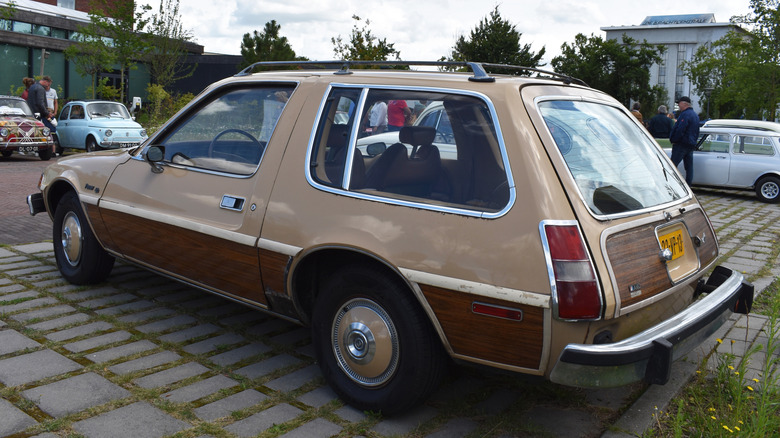
In 1977, AMC, which also made muscle cars that are totally underappreciated, introduced an additional body style to supplement the Pacer line. It was a wagon (pictured above) which was stretched by three and a half inches in length, and it offered more space for cargo inside. Buyers responded, with around two-thirds of all Pacer sales in both its initial model year and its second model year after that going to the wagon version.
The most famous AMC Pacer is likely to be the light blue model that had a starring role in the 1992 "Wayne's World" movie, starting with the opening credits in which Wayne, Garth, and friends sing Queen's "Bohemian Rhapsody" while riding through the streets of Aurora, Illinois, though the movie was actually shot in Chicago. Known as the Mirthmobile, the "Wayne's World" Pacer sported orange flames behind its front wheels. Fun fact — star Mike Meyers didn't know how to drive during filming, so Garth, played by Dana Carvey, had to do the driving honors.
AMC sold 72,158 Pacers in 1975. This increased to 117,244 in 1976, dropped to 58,264 in 1977, of which 37,999 were the newly-added wagon, and it eventually came crashing down, with a dismal 1,746 units sold in 1980. Auction prices for AMC Pacers, according to Classic.com, have ranged from a low of $14,000 to a high of $40,000 for the five cars in original condition sold within the past year.