

This Chinese Automaker's EV Supercar Comes With Hennessey Venom Horsepower
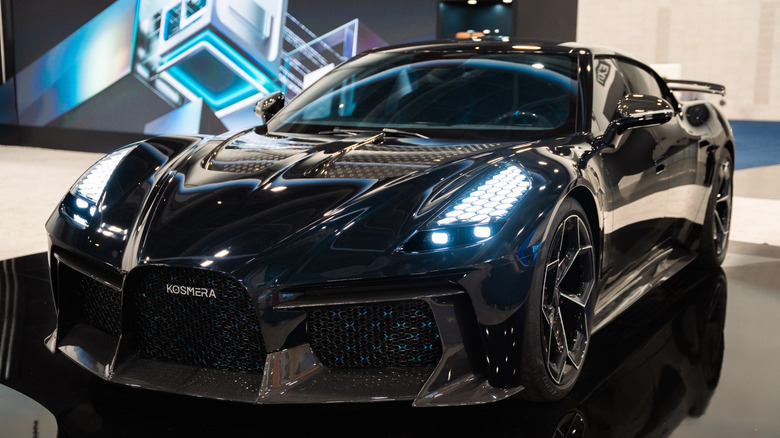
There aren't many hypercars made in the U.S. that are more instantly recognizable than the Hennessey Venom. This formidable model, however, is set to be matched or even exceeded in terms of its horsepower by an upcoming car you may never have heard of: The Kosmera Star Matrix.
China is becoming a real competitor in the global supercar market. Yangwang's U9 Xtreme, for instance, boasts 2,978 bhp and is good for approximately 308 mph. Kosmera is out to prove the potential of Chinese engineering in this area with another extraordinary model. Its in-progress Star Matrix and Star Razer, it claims, are both targeting 2,040 hp, which is enough to top the U.S. Venom.
The American brand is incredibly proud of its F5 Venom engine, which CEO John Hennessey declared on VenomGT to be "the most furious engine ever built" with its formidable "very broad power band with over 1,000 lb-ft of torque available from 2,000 to 8,000 rpm" and 1,817 horsepower. In April 2025, Hennessey Special Vehicles announced the Venom F5 Evolution variant, which it declared to be "the world's most powerful internal combustion road car," offering 2,031 horsepower.
Though there's much more to a vehicle's overall strength than horsepower alone, it's remarkable that Kosmera's Star models are targeting topping even the Venom F5 Evolution in that area. Let's take a look at exactly what Kosmera has to say about its new creations, and where they might fit into the fascinating landscape of Chinese supercars. There are two distinct variants of this new Kosmera Star family, and each will have something very special to offer.
The Kosmera Star Matrix and the Komsera Star Razer
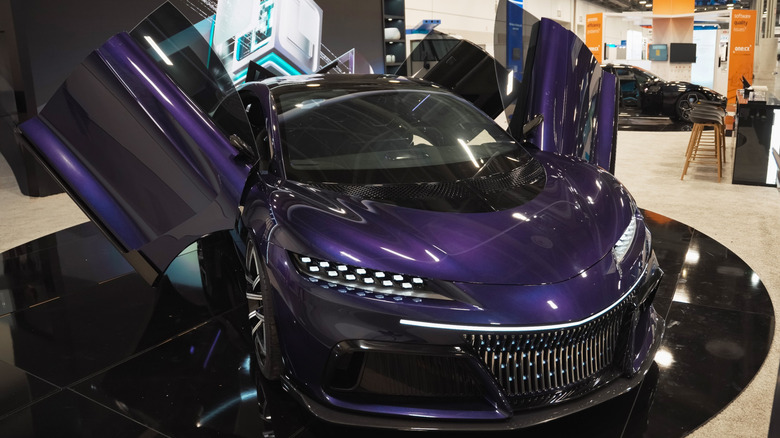
Kosmera reports that its two models, the Star Matrix and the Star Razer (pictured here), will share something fundamental in common: their platform. Of course, with China's prominent global role in the renewable energy space, it's unsurprising that Kosmera has made its new supercar family a duo of EVs, and their capabilities certainly seem very impressive in that regard. The brand stresses that the Star Matrix and Star Razer are prototype models as of the time of writing, and their specs are target numbers rather than confirmed totals, but they're exciting.
Both vehicles use a four-motor system, with each individual motor offering 350 KwH apiece. This is on top of a 120 Kwh semi-solid state battery. EVs with true solid-state batteries are still in the research and development stage as of the time of writing, but this system is the key to the model's success: the combined output of the motors adds up to the target 2,000+ horsepower.
Kosmera also reports that it's targeting a 0-60 of approximately 1.7 seconds. There is also the fine print that it targets such numbers only when conditions from the track surface to the weather are absolutely optimal, but if achievable in real life, this would put the model in esteemed company indeed. Koenigsegg's mighty Gemera is estimated to take approximately 1.9 seconds for a 0-62. In addition, one particular weakness of an EV is that it sports a hefty battery, and one that's especially big with behemoths like these. Aerodynamics is particularly key in the case of such vehicles, then, and so Kosmera is aiming for a drag coefficient of less than 0.20.
How the two models will set themselves apart
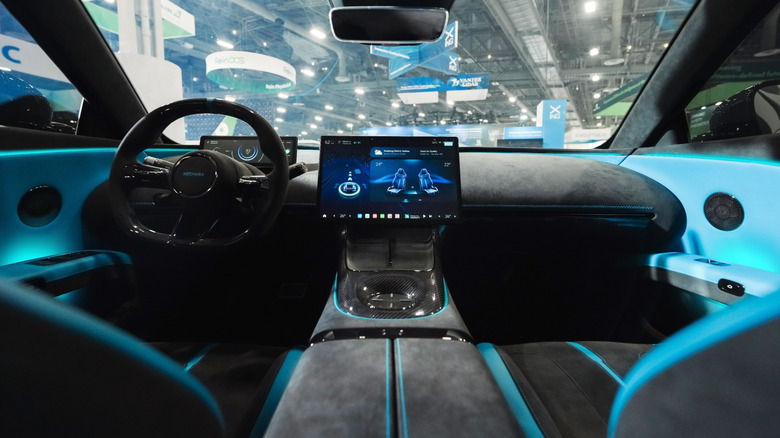
The models were first shown to the public at CES 2026 in Las Vegas. Aside from their potential specs, Kosmera's press release, via the Khaleej Times, notes that the Star Razer "concept features a trunk-integrated modular system designed to automatically deploy and retrieve devices such as drones and robotic companions." Meanwhile, the Star Matrix's "AR-HUD concept demonstrates dynamic racing lines, highlighted braking points, and apex guidance projected onto the windshield or AR display, seamlessly aligned with real-world roads or tracks."
Boasting of potential new capabilities and specs, however, is very different from demonstrating them for real. Kosmera CEO Winter Chen notes, the outlet goes on, that the company's intent isn't to "build concept cars that stay under lights," but that its creations are "meant to be driven hard, tested honestly, and pushed to their limits." ATP Automotive Testing Papenburg in Germany is famed for offering the perfect conditions to push a model to its limits, and Kosmera notes that this is exactly where it's taking its two Star family models later in 2026.
It's far too early to say whether these intended specs will ultimately be achieved. What can be said for certain is that it'll be incredibly impressive if that turns out to be the case. The standards of which EV supercars are capable may be changed forever. Take the aforementioned goal of a 0-60 of 1.7 seconds, for instance. With the Aspark Owl, a Japanese supercar design constructed in Italy, the intent was to be the fastest-accelerating EV on the planet, targeting about 1.7 seconds to speed from 0-60. EVs are indeed devilishly quick off the line, but if the Star family tops the Owl, it could set a new standard.