

Tesla's 'Blade Runner' Lawsuit Isn't Looking Good For Elon Musk
Lawsuits involving AI and materials generated by AI continue to move through the United States legal system, and electric automobile manufacturer Tesla is about to be dealt a heavy blow. A judge's tentative ruling in a copyright claim brought by the production company behind "Blade Runner 2049" would allow a copyright case against Tesla and its CEO, Elon Musk, to proceed.
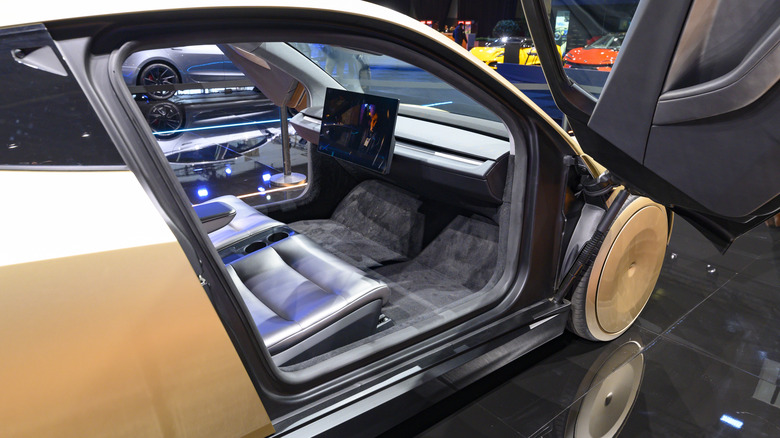
At issue is an AI-generated graphic used to promote the Tesla Cybercab at an unveiling event in 2024. At the time, the image went without much attention as the media instead focused on other event oddities. The Cybercab seemed worse in person than it sounded when initially pitched. It is a driverless car which Tesla intends to ship without a steering wheel, pedals, or any other driver interface. It was unveiled alongside the Optimus robot, which Elon Musk has said will be the company's future. Nevertheless, it quickly became clear that the robots demonstrated at the event were remotely controlled by Tesla employees. Suffice to say that some knock-off cyberpunk art in a slideshow was the least attention-grabbing element of the unveiling.
But the graphic used as a backdrop for the Cybercab event is proving to be a headache all its own for the company and its controversial figurehead. Alcon Entertainment claims that the AI-generated image shown for 11 seconds during Elon Musk's keynote presentation violates copyright due to its similarity to a promotional poster for the acclaimed "Blade Runner" sequel. Here's why the case is likely to move forward.
AI-generated images used by Tesla for Cybercab event may infringe copyright, judge agrees
In a tentative ruling filed by U.S. District Judge George Wu in California on February 3, the copyright claim brought by Alcon Entertainment against Tesla and Warner Bros. Discovery, Inc. appears poised to proceed, overruling the defense's motion to dismiss. While Wu was willing to waver on a concurrently filed trademark claim, the core copyright contention can proceed if the judge formally rules in accordance with the tentative ruling.
According to the filing, it appears that Musk and Tesla had fewer than five hours to adjust their plans for the Cybercab event after being denied the rights to use images from "Blade Runner 2049." Rather than using generic cyberpunk imagery or finding another solution, they may have placed stills from the film into an AI generator and prompted it to create an image directly inspired by "Blade Runner 2049." Alcon claims that, by clearly referencing the film, Tesla and its CEO damaged the IP. The suit explicitly names Musk's controversial political presence, alleging that his "hate speech" damaged the brand by association.
Ultimately, the judge found that fair use was not obvious and that Alcon's claims were sufficiently plausible to survive to the discovery stage. He noted that the court is obligated to "construe a complaint in the light most favorable to the plaintiff." For their motion to dismiss to succeed under the relevant standards, Tesla and Musk would have needed to demonstrate that Alcon did not present a sound legal theory of damages or the facts to support such a theory. The decision, if solidified, would represent yet another of Elon Musk's less publicized failures.
'Blade Runner 2049' distributor Warner is also named in the suit
Warner, which distributed "Blade Runner 2029, is also named as a defendant in the suit. Alcon alleges that Warner reached out for permission to use stills from the movie in promotional materials for the Cybercab and Optimus event, but Alcon declined. Warner, therefore, faces the claim of "contributory copyright infringement" in the suit. However, the tentative ruling from Judge George Wu does not address the claim against Warner. It responds solely to the motion for dismissal filed by Elon Musk and Tesla.
The specific allegation appears to be that Warner provided Tesla and Musk with a high-quality promotional image from "Blade Runner 2049," which was used to prompt AI to generate the potentially copyright-infringing images around which the lawsuit hinges. Alcon claims that, by providing Tesla with the image without Alcon's permission, Warner became a party to the infringement. But Judge Wu wrote in his tentative ruling that he is considering only the motion to dismiss brought by Musk and Tesla at this time, leaving open the possibility of a separate dismissal by the media conglomerate. If that were to happen, Warner would exit the proceedings, and the suit would proceed against Tesla and Musk alone.
Warner is under a bid to be acquired by Netflix, though the David Ellison-owned Paramount Skydance is attempting a hostile takeover, and the Trump-controlled Department of Justice is now probing Netflix in relation to the deal. It is unclear how, or whether, the current litigation will affect Warner's future if the company is required to remain a defendant. It is not uncommon for a company of its size to be entangled in such proceedings.