

The Critical Difference Between 'Maintenance Required' And 'Check Engine' Lights
Armed with your coffee, lunch, and laptop, you're ready to tackle Monday head-on. But when you fire up your car, you're greeted with a dreaded warning light on your dashboard. Not the way you were hoping to start your week, right? But what does it mean? Before you pull out the phonebook-sized manual or turn to your vehicle's app, it's a good idea to have a basic understanding of your dashboard warning lights.
Dashboard lights are meant to simply and quickly convey information to the driver. Some do offer a simple message that is easy to understand. The little oil can symbol indicates a problem with your car's oil pressure, while the battery indicator typically tells you there's an issue with your vehicle's electrical system. But the "Check Engine" and "Maintenance Required" indicators don't have such a specific meaning, and they can often confuse drivers. They aren't the same thing, however, and they're each sending drivers a different message.
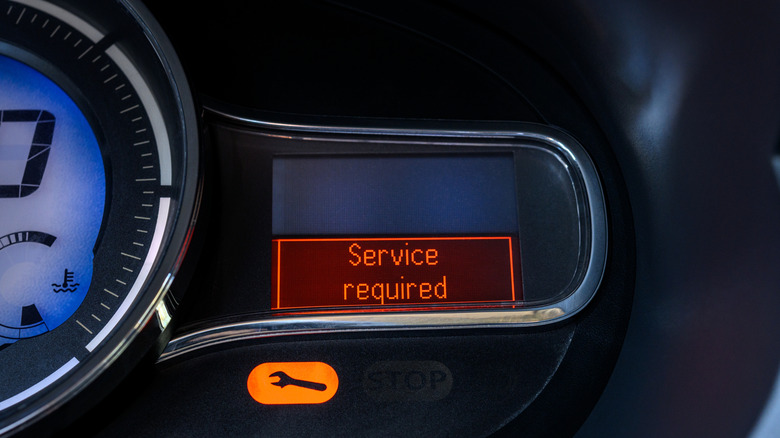
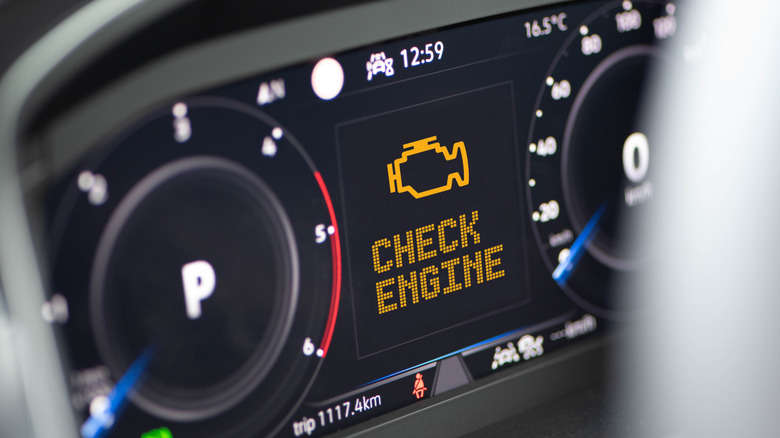
If your vehicle is telling you that maintenance or service is required, it typically means that you need an oil change or other scheduled maintenance, not that there's necessarily something wrong with your car. It's still safe to drive and the alert was likely triggered by your mileage or even the date. The "Check Engine" indicator, on the other hand, lets drivers know that your vehicle's diagnostic systems have detected some kind of problem. It can be a range of issues, but it should not be ignored and will likely require a visit to a mechanic.
Digging deeper into dashboard notifications
While some dashboard warning lights require a more immediate response than others, it's vital to understand what your vehicle is trying to tell you. If you receive a maintenance warning, you've likely hit a certain point on a pre-determined maintenance schedule. These lights often indicate that you need an oil change, a new air or cabin filter, or fluid-level check or refill. It doesn't require an immediate response, but you should schedule an appointment with your service center to have it checked out. Routine maintenance is important to keep your vehicle running safely and reliably, and ignoring the maintenance alert may lead to increased costs or even damage down the road.
The "Check Engine" light is more serious and should never be ignored, and your car may offer other clues as to what is going on. If the light is solid and stays on, Kelley Blue Book advises that the problem is likely to do with the emissions systems or a safety-related system, and it's probably safe to drive your vehicle to get it checked out. A flashing light tells drivers that the problem has to do with a more critical system, which can include the engine, fuel system, and electrical system. If the warning is blinking, you shouldn't drive the vehicle.
Not every "Check Engine" light is going to result in a huge bill from your mechanic, and you may be able to identify the problem at home. Before you make an appointment, check that your gas cap is tightly closed, as a loose cap may trigger a warning. The warning might also be a faulty sensor or a bad spark plug.