

There's No Company Doing AI Better Than Google, And NotebookLM Is All The Proof You Need
OpenAI. Anthropic. Meta. xAI. Microsoft. Google. Apple. If the pattern isn't apparent at first glance, here's the common thread: all these companies are going big on AI. Whether it's by shipping their own Large Language Models (LLMs) or cramming AI into every possible feature, the industry has become obsessed with proving it can keep up. One thing that's apparent in today's world is that we, the consumers, need to adapt.
I realized that the day I first tried OpenAI's ChatGPT. Even its rawest version was enough to push me to start testing AI tools left and right. Ultimately, the gap between what sounds impressive from afar and what's genuinely useful day to day has only become more obvious as time has passed. Safe to say, the company that falls under the latter category is Google. If you don't believe me, try a single Google AI product: NotebookLM.
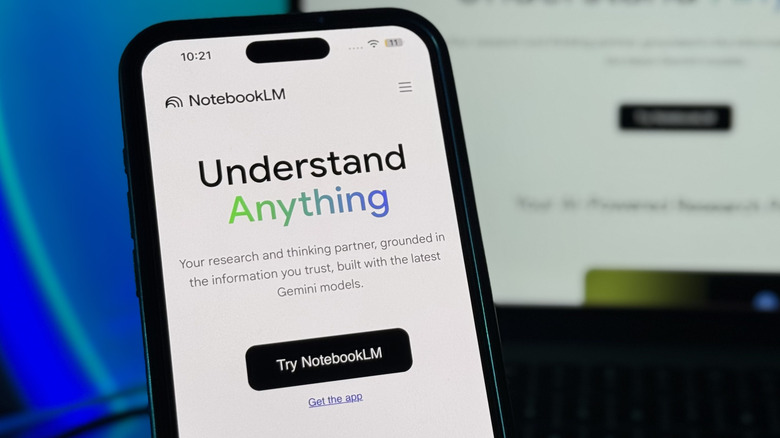
NotebookLM is an AI-powered research assistant launched by Google during I/O 2023. While it initially started as an experimental project within the company's Labs department, it was the first in a growing line of Google AI products that felt purpose-built.
NotebookLM solves a big AI problem
The biggest mistake companies are making is their approach to AI. Instead of building features and tools that users would actually want to use, they seem to be caught up in a specs war that, frankly, means nothing to the average user. Many companies are focused on ensuring AI is everywhere rather than making sure it's useful everywhere.
The truth is, the average user doesn't care whether a feature uses AI as long as it does what they need. It's frustrating when AI gets in the way, which is unfortunately what the majority of companies are getting wrong right now. NotebookLM is the antithesis of that approach.
Its core functionality is ridiculously simple. You upload sources (PDFs, YouTube videos, articles, research papers, images, audio files, etc.) to a notebook. NotebookLM uses AI to read, process, and understand the material you've uploaded. You can then ask it questions, and it provides answers based solely on what you uploaded.
The important bit here is that the AI doesn't make things up. Unlike ChatGPT, Gemini, Claude, and essentially every general AI chatbot, NotebookLM works with only the material you upload to a notebook and nothing else. It doesn't search the web, its training data, or material you might have uploaded to other notebooks. That means the answers you get are always grounded in your sources. Each answer includes citations, allowing you to quickly verify the source.
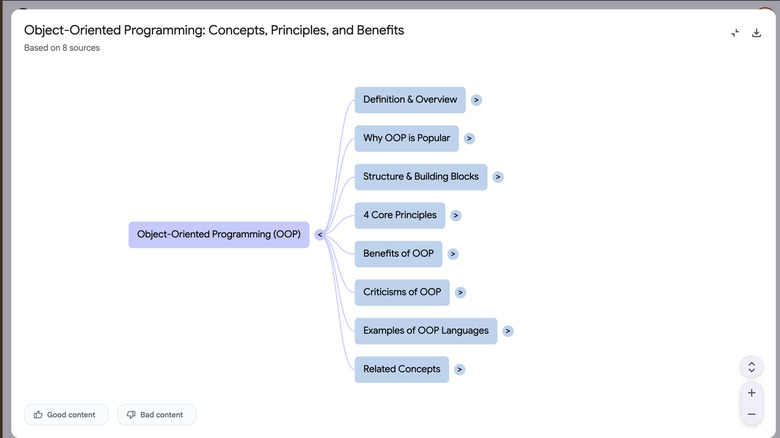
Instead of being just an AI-powered search tool, NotebookLM goes further. For instance, the Audio Overviews podcast feature it went "viral" for turns your uploaded sources into a podcast-style discussion between two hosts. You can generate slide decks, mind maps, infographics, reports, and more — all based entirely on your uploaded material.
Google's other AI experiments prove NotebookLM isn't a one-off
Something we've seen with companies is that they launch a single hit product and then struggle to replicate the magic with anything that follows. Google's been doing the opposite. Ever since NotebookLM's Audio Overviews feature went viral, the company has doubled down on the product itself. Google removed NotebookLM's "experimental status" and graduated the tool from Labs into a full-fledged product a month after the feature launched.
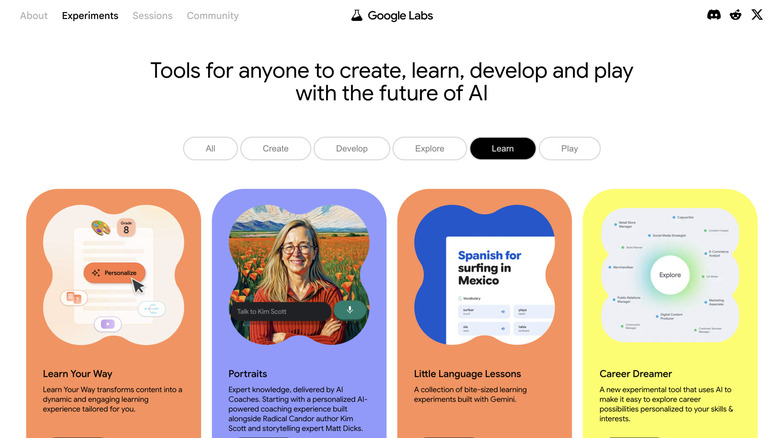
In addition to improving the tool, Google has been continuously testing new AI experiments in the very same Labs department that gave birth to NotebookLM. For instance, some of the experiments you'll find in Labs include:
-
Opal: A no-code tool from Google Labs that lets you build mini apps using plain English.
-
Jules: An autonomous AI coding agent that integrates directly with your existing GitHub repositories. The tool can understand the full context of your project and perform tasks such as fixing bugs, writing tests, and building new features.
-
Learn Your Way: A tool that transforms static textbooks and PDFs into personalized learning experiences. The experiment is powered by LearnLM and can adapt content to a student's grade level and interests.
-
Little Language Lessons: A collection of three bite-sized, AI-powered language learning experiments from Google Labs. The experiments are focused on helping you learn new languages in context and in a way that actually sticks.
Now, the experiments above are just a few of many. Google Labs seems to be dipping its toes into practically every sector. From a full-fledged agentic IDE called Antigravity to a marketing assistant, Pomelli, that helps small businesses create on-brand content without a design team, Google's clearly not limiting itself to one lane. And that's precisely what it's doing right.
Gemini is finally hitting its stride
Something many people don't know about Google's AI journey is that Gemini isn't its first rodeo. Before Gemini, there was Bard, a conversational chatbot that the tech giant launched in March 2023. Like many companies, Bard was discontinued in response to the unexpected popularity of OpenAI's ChatGPT.
Unfortunately, Bard simply felt rushed and half-baked. In fact, during its very first public demo, Bard got a basic factual question wrong, which ended up costing the company $100 billion. This alone made it clear that Bard was simply a panic response rather than a product ready to ship.
In February 2024, Google rebranded Bard to Gemini. Ironically, the fresh name didn't help, and Gemini stumbled almost immediately amid its own controversies. Mere days after the rebrand, Gemini was generating historically inaccurate images and giving bizarre answers that went viral for all the wrong reasons. Ultimately, Google had no choice but to pause Gemini's image generation feature entirely.
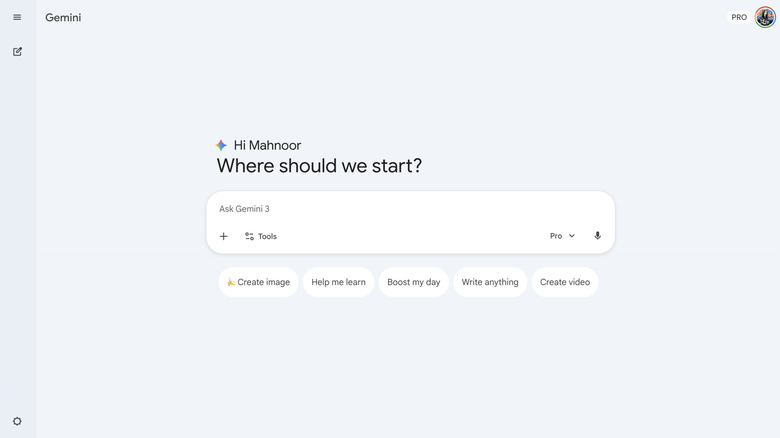
While I could keep talking about the ways Google messed up initially, fast forward to today, and it's a completely different story. Presently, Gemini 3 is one of the most advanced AI models available, and it continues to improve day after day. In my experience, it outperforms ChatGPT in reasoning, coding, and multimodal tasks such as image and video analysis, among other things. Gemini also integrates meaningfully with Google's ecosystem in ways no competitor can truly match.
Google's Nano Banana has also become the world's top-rated image model. Ironic, isn't it? Google went from pausing image generation entirely to becoming the world's best at it. So, while Google's early attempts at AI were messy, the company has proven it can learn from its mistakes. That's why it's winning.