

5 Useful Car Tools You Didn't Know Existed

We may receive a commission on purchases made from links.
If you've ever worked in a garage or done any other at-home DIY projects, you're probably familiar with common tools. Most of us have encountered and used hammers, screwdrivers, wrenches, ratchets, and other basic tools throughout our lives, but that's just a small sample of the things that could fill your tool box. There are a lot of weird tools out there.
When doing automotive work, either in a professional garage or at home, you'll probably use those basic tools on a pretty regular basis, but you'll also run into a collection of lesser-known tools, many of which were designed to solve specific problems a mechanic is likely to encounter.
If you're the sort of person who only works on your car every once in a while to refill fluids, change the oil, or swap out a dead light bulb, you probably don't need most of these tools. However, if you work on cars regularly, these tools could save you more than a few headaches. Best of all, you'll be able to use some of them more broadly on non-automotive projects. Getting the job done requires having the right tool; these are five of our favorite car tools you might not know about.
Funnel holder
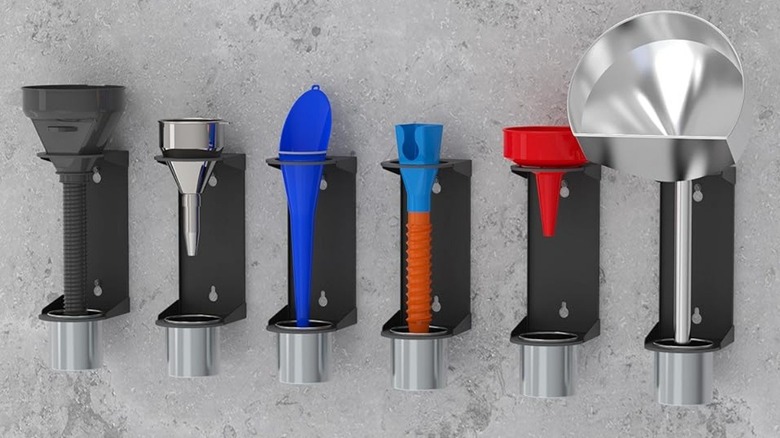
When working on cars, we are often called upon to pour one viscous liquid or another into a tiny compartment. Unless you want to spill oil or antifreeze all over the place, you're probably using a funnel for those jobs. It's a simple gadget that gives you a larger opening to pour into and ensures your oil and other liquids go right where you need them.
The only problem is that viscous liquids grab onto the funnel walls and hang on after you're done pouring. Inevitably, they end up leaking on your workshop floor, getting all over your hands, and generally making a mess. A funnel holder gives you a designated place to put your funnel while the rest of the oil drips out slowly.
There are plenty of funnel holders on the market to choose from, and they all do more or less the same thing. This funnel holder from UnitedPower features a metal funnel holder and a stainless steel catch cup. There are a couple of graduated holes on the back for mounting to the wall with screws. It has an opening that is 2.83 inches in diameter and accommodates funnels from 8 to 18 inches tall. Other funnel holders have slots for multiple funnels, shelves for holding oil, magnetic mounts, and other bells and whistles. There's almost certainly a funnel holder that will fit your DIY needs.
Radiator comb
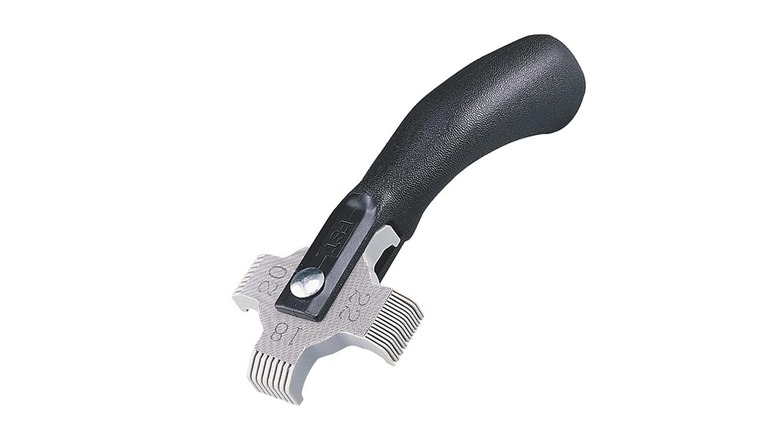
The radiator is an important part of your car's construction. It carries away the heat continually generated by combustion so the engine doesn't overheat and fail. The specifics can differ from vehicle to vehicle, but an automotive cooling system works something like this.
When excess heat is detected by the thermostat, the coolant pump sends coolant from the radiator's outlet tank into the engine. Coolant flows into channels around the combustion chambers and soaks up excess heat. Next, hot coolant flows from the engine through the radiator's inlet tank and into the radiator. As the name suggests, radiators are designed to quickly radiate heat away and keep your engine relatively cool.
Once in the radiator, an array of metal fins helps to dissipate heat by letting outside air pass over them. After the coolant cools down, it circulates back into the engine and the process repeats itself. The key to a functional radiator is maximizing surface area so passing air can carry the heat away; that's why there are so many tiny fins lined up next to one another. If the radiator fins get bent or smooshed together, the surface area decreases and so does your radiator's functionality. Straightening the fins back out can be difficult and tedious unless you have a radiator fin comb. With a few quick swipes, you can straighten out several rows of radiator fins to improve your radiator's ability to transfer heat.
LED headlamp
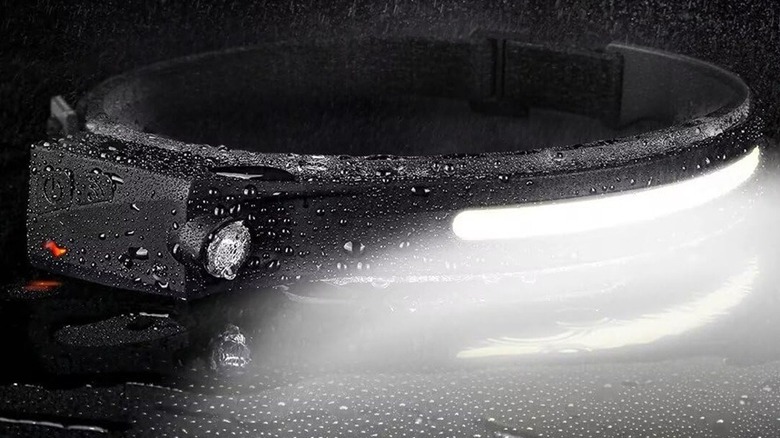
Working on a car often requires you to work in cramped spaces and low-light conditions. Fixing your car can be hard enough without being unable to see. Consequently, a headlamp has long been a well-known and useful tool for professional and amateur mechanics. What you might not know is that headlamps have evolved. These days, you can get a rechargeable LED headlamp that's lightweight, less bulky, and more reliable than its predecessors.
This LED headlamp from Biat has a 230-degree strip of light and a spotlight on the side, providing a better field of view than conventional headlamps and letting you see your workspace without turning your head. It has a motion sensor mode that allows you to turn the light on and off by waving your hand over the motion sensor on the side, a feature that's highly beneficial when your hands are covered in dirt and grime.
There are six different light modes, including wide angle at two different strengths, spotlight at two different strengths, the aforementioned motion sensor mode, and strobe mode for when the job's done and it's time to party. It fits a wide range of heads with an elastic headband and adjustable buckle, and you can get between 2.5 and 8 hours of use out of a single charge of its rechargeable 1,200mAh battery.
Hardware organizer
Working on a car is an exercise in taking something apart and then putting it back together again in precisely the right way. That means that every bolt, nut, and screw you remove needs to be refastened before you're finished. Of course, small pieces of hardware have a way of getting lost in a busy workshop.
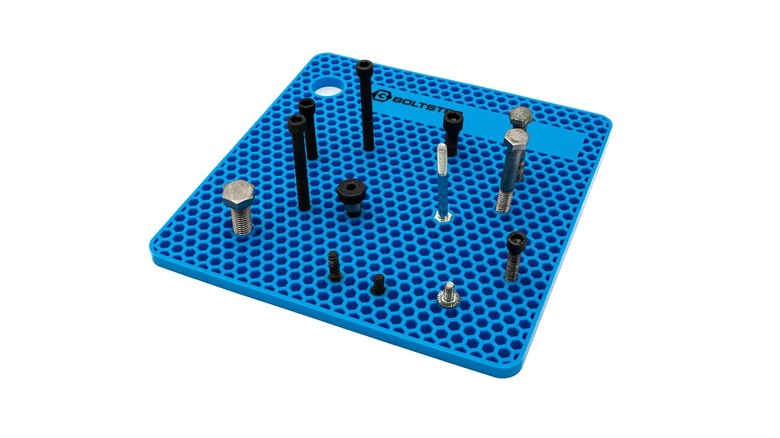
The Boltster hardware organizer seeks to solve that problem with a silicone mat featuring various openings for holding onto hardware and making sure it doesn't disappear. Each mat is ten inches on a side, and the holes fit hardware as small as 7mm and as large as 17mm. Moreover, the silicone construction, which comes in red, blue, or green, holds onto bolts and screws even if you drop the organizer while you're working. Boltster hardware organizers are also chemical- and heat-resistant, so they can stand up to the tough environment of a workshop.
The organizer's honeycomb design features hundreds of holes of the same size, but there are smaller holes along the perimeter for holding onto your tiniest bits and bobs. There's also a single large hole in the top-left corner so you can hang the mat on a hook for storage, and a flat rectangular pad toward the top for labeling. You could, for instance, label one "car" and one "dryer" so you know which pieces of hardware belong to which project.
Oil filter wrench
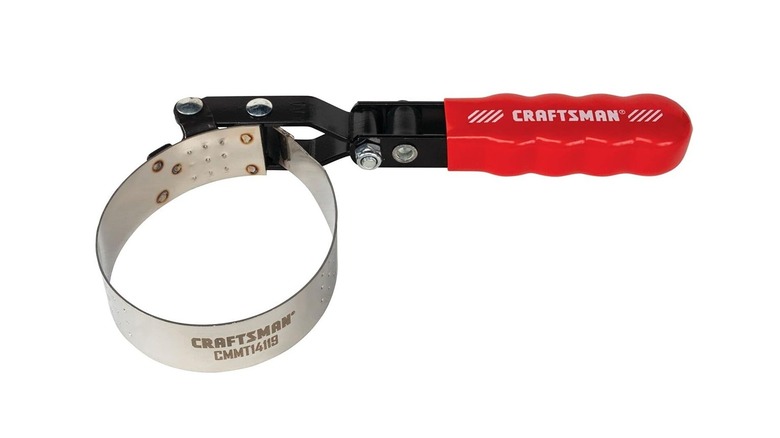
Changing your car's oil, including replacing the filter, is a relatively simple job that you can do at home if you don't mind getting your hands dirty. Ostensibly, you can loosen and remove the oil filter by hand. In practice, it's not always that easy. If the filter wasn't sufficiently lubricated, if it was overtightened, or sometimes for no reason at all, oil filters can fight you when you try to remove them.
If loosening by hand doesn't work, many home mechanics turn to a tool for help. While it's often possible to jam a screwdriver through the filter and use the leverage to remove it, there's a better way. An oil filter wrench is a tool specifically designed for this task, providing you extra leverage for removing stuck filters.
There are multiple kinds of oil filter wrenches to choose from. There are end-cap filter wrenches, which are designed to fit a specific size of filter. There are claw-type wrenches, which grip the oil filter with claws and are more universal. There are chain wrenches, band wrenches, and others. A band oil filter wrench like this one from Craftsman slips around oil filters of several sizes, grabs hold, and helps you loosen them. You can use the wrench to remove a filter, but don't use it to install your new one. And make sure you're turning the correct way. Righty tighty, lefty loosey.