

World-First Supercomputer Discovered This Invisible Flaw In All Jet Engines

Jet engine technology is among some of the most advanced means of propulsion in the skies today. From commercial airlines to military fighter planes, these massive engines can be heard roaring overhead in countries around the world. But while jet engines are powerful, and just keep getting bigger, they all actually share one common problem: small imperfections are negatively affecting performance. It's a major flaw that wasn't actually discovered until late January 2026.
The Frontier, the world's first exascale supercomputer located at Oak Ridge National Laboratory, is responsible for catching the flaw, which became visible during high-resolution simulations. The simulations revealed surface roughness on jet engine turbine blades, which can be found in both turbojet and turbofan engines. That roughness can lead to a loss of fuel efficiency and more heat being generated. Over time, this can shorten the life of the blades and require more maintenance to keep the engine's components from malfunctioning. These imperfections aren't manufacturer defects, and spotting them before would not have been possible, due to the tremendous computing power it took for Frontier to find them.
But identifying the problem is just the first step, as the Frontier's findings are now being used to inform future jet engine design and construction. While it might be impossible to fully remove all surface imperfections, turbines can be engineered to compensate and overcome the flaws. Plus, thanks to the data Frontier gathered, cooling the jet engine's turbine blades will now be more of a focus moving forward.
Frontier's capability beyond jet engines
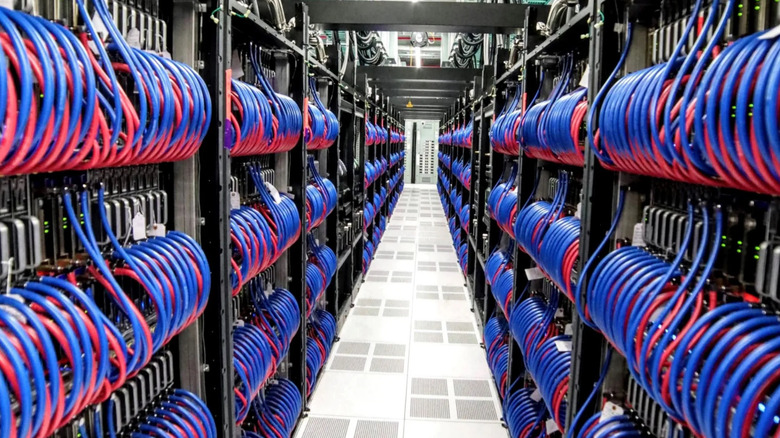
The Frontier supercomputer's findings regarding jet engine flaws are the result of the US Department of Energy's (DOE) Innovative and Novel Computational Impact on Theory and Experiment (INCITE) program. But jet engine research isn't the only work being done through INCITE on Frontier, as 81 other projects were selected by the DOE in 2025. Those projects involve research in various different fields, including cosmic ray transport and drug discovery using quantum-AI.
The Frontier is in high demand due to its ability to perform one quintillion calculations per second. This is an astronomical amount of computational power and makes the Frontier more capable than any of the supercomputers that came before it. It can process so much complex data at one time that it's opening doors in physics, machine learning, and more. But as the Frontier is helping researchers take some tremendous strides forward, it's using a lot of energy in the process.
Despite the Frontier's advanced design, it's consuming anywhere from 8 megawatts to 30 megawatts of electricity. That's enough to power several thousand residential homes. That much energy produces an enormous amount of heat, which is addressed through a complex cooling system. That system pumps around 2,378 to just under 6,000 gallons of water per minute in a closed loop design, to keep everything running smoothly. However, the heat being wasted isn't easily redirected, so in the end, quite a bit of it unfortunately cannot be reused.