

Major Milestone: Sea Trials Kick Off For Supercarrier USS John F Kennedy
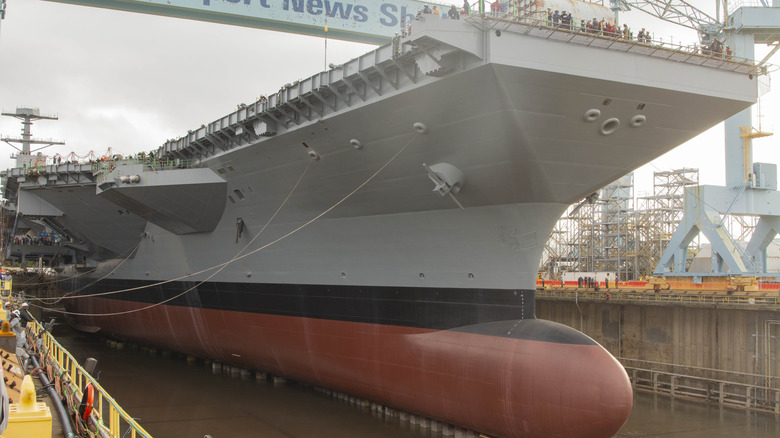
The U.S. naval shipbuilding industry has come under fire in recent times for its inability to attract skilled workers. However, the fact that the USS John F. Kennedy — the second of the Gerald R. Ford class of aircraft carriers — has set sail for sea trials will be welcome news both for the US Navy and the ship's builder, Huntington Ingalls Industries (HII). The ship left the Newport News Shipbuilding Facility on January 28, 2026, to begin its trials.
These sea trials are a set of tests that are undertaken after a ship's construction has been completed, but before the ship has been passed to the final customer. Obviously, in this case, that customer is the US Navy. According to Todd Corillo, a spokesman for HII, "These trials will test important ship systems and components at sea for the first time." These tests represent a major milestone for the much-delayed ship, which was originally expected to be handed over to the Navy first in 2022, then in 2024. After missing this second deadline, the date was moved once more to 2025. It's now expected to be officially commissioned in March 2027.
The $13.2 billion carrier is 1,092 feet long, displaces 100,000 tons, and when it is commissioned will join the USS Gerald R. Ford as the most advanced aircraft carriers in the world. These trials are the first chance to see the USS John F. Kennedy in its natural habitat and for the shipbuilders and navy personnel to iron out the teething problems that inevitably arise in such complex programs.
Why building the USS John F. Kennedy has taken so long
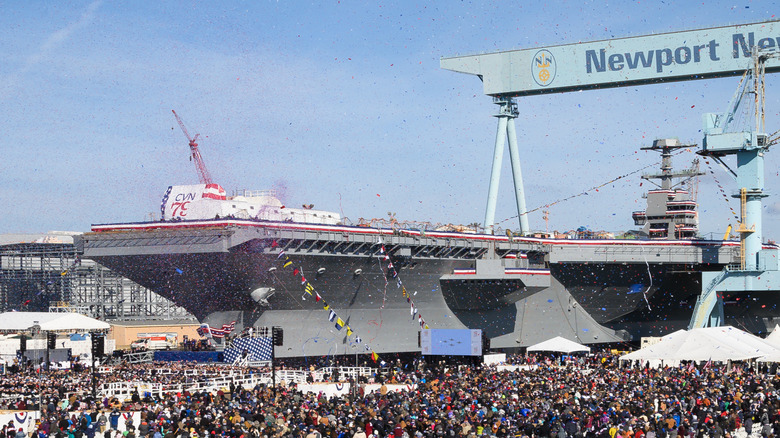
Given that the ship only took to sea in January 2026, it may be surprising to hear that it was actually launched in October 2019 and christened in December of that year. However, the delays that have beset the program can't be pinned down to a single issue. Undoubtedly, the pandemic didn't help, and this was one of the reasons that the initially earmarked commissioning date was moved from 2024 to July 2025.
The sheer complexity of these ships also has to be accounted for. The USS Gerald R. Ford, for example, has a history of persistent problems that have plagued the ship. Even at the time of writing, the $13 billion aircraft carrier is still having essential plumbing issues onboard. This is why there are some notable differences between the the Ford and the USS John F. Kennedy; instigating design changes from the lessons learned had also contributed to the delays.
While it's hoped that the ship will be handed over to the Navy in accordance with the latest schedule, there are no guarantees that this will happen. Already, the March 2027 date is potentially going to be rescheduled to July 2027. It's worth noting that this doesn't mean that the Navy will be able to instantly deploy its newest carrier into active service. This would likely not happen until 2028 at the earliest. For the Navy, this will be more than an inconvenience; carrier decommissions, midlife refueling, and overhauls would leave it short of deployable aircraft carriers.
The scale and complexity behind the Ford class
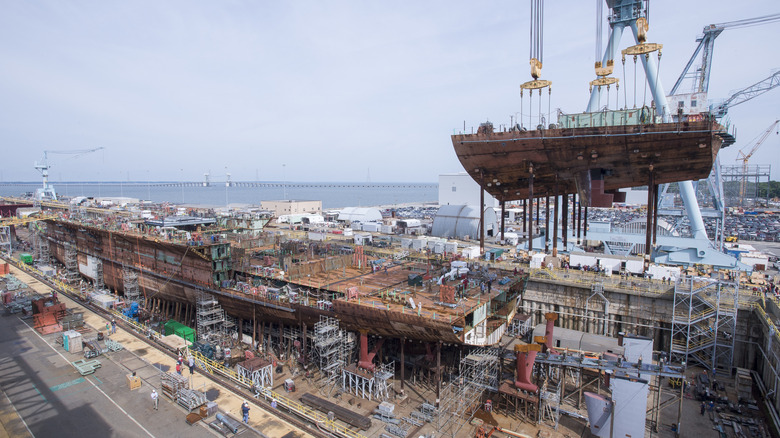
The scale of ships like the USS John F. Kennedy is awesome, and just appreciating their size and complexity goes some way to understanding why such programs are often beset by delays. And it isn't just the proportions of this 100,000-ton behemoth that can be used to justify these delays; it's also suffering from the challenges that go along with being the first version of a ship. While the Kennedy isn't strictly version one (it's closer to version 1.1), the principle remains the same.
The Ford-class ships are the first new class of aircraft carriers to be introduced since the first of the preceding Nimitz-class carriers was launched in 1975 (the last Nimitz-class, the USS George H.W. Bush, was commissioned in 2009). While the later vessels in this class were undoubtedly more advanced than their older sisters, the template for building these ships was well understood; ultimately, 10 Nimitz-class ships were built.
The delays facing the new Ford-class carrier have been linked to manufacturing and installation issues. This is most notably with its weapons elevators — a problem that also delayed the USS Gerald R. Ford, the world's most advanced aircraft carrier. While lessons from this were learned, HII has acknowledged that many improvements came too late to be incorporated into the Kennedy's build. While we still don't know how fitted out the ship was when it took to sea, it's still a promising sign that carrier may very well make its latest deadline.