

China's Advancements In Thermal Battery Tech Could Be A Game Changer

Scientists in China may have found a way to drastically improve the performance of thermal batteries, which would dramatically improve their military applications. Thermal batteries can function effectively in extreme temperatures that traditional batteries cannot, meant to withstand heat up to 660 to 1,020 degrees Fahrenheit. By utilizing molten salt electrolytes, thermal batteries also offer a higher power output that makes them the battery of choice for military equipment, aerospace systems, and emergency power supplies. However, thermal batteries have been struggling to meet the voltage and output demands of newer technologies due to these batteries' cathode performance.
Professor Wang Song and Zhu Yongping from the Institute of Process Engineering of the Chinese Academy of Sciences have been working on improving thermal batteries' cathode performance. Currently, the materials in thermal batteries dissolve during operation due to the high temperature molten they produce. Known as the "shuttle effect," this corrosion causes thermal batteries to last a very short time. The research team in China found that engineering a coating made of covalent organic frameworks (COFs) around carbonyl fluoride (COF2) particles would create tiny, structured paths that transport ion without dissolving any of the thermal battery components. "Our findings provide a mechanistical foundation for designing next-generation high-energy-density thermal batteries through precise interfacial engineering," said Song.
Thermal battery research could improve military applications
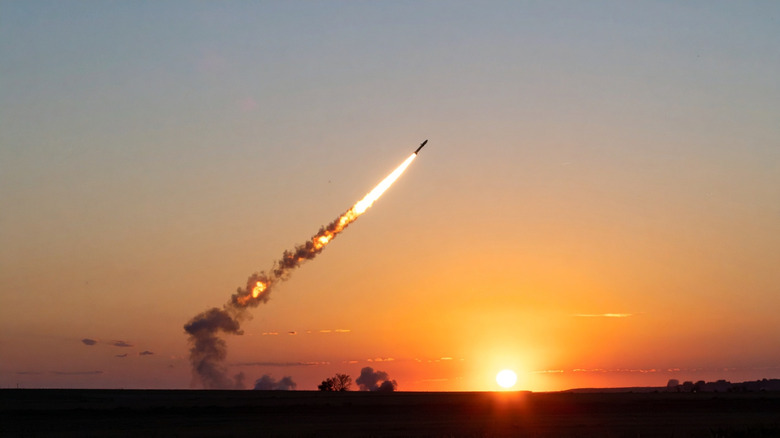
Thermal batteries are most commonly used in military applications, like missile operations. It's expected that the thermal battery military market will be valued at $274.2 million by 2033 — although it could be even higher if China's research improves thermal battery life and output. Due to thermal batteries' high energy and reliability even at extreme temperatures, these batteries are used across a wide range of military equipment, allowing them to remain dormant until activated by a heat source. Inside the military's thermal batteries is an iron powder and potassium perchlorate pallet that will ignite when triggered. The pellet heats up to an extreme temperature, melting the battery's electrolytes. Until then, the batteries can remain dormant for years.
As militaries all over the world look to increase defense and improve technologies, like finally retiring the 70-year-old Air-to-Air Missile the U.S. still uses, thermal batteries are becoming even more desirable. While thermal batteries are used in artillery, spacecraft, and rockets, the largest use increase is expected to be missiles — this is due to their long shelf life and ability to provide immediate energy on demand. If thermal batteries could last even longer, their military use could be expanded — much-needed as countries like China has missiles that can already reach Hawaii and Japan's missiles can dodge defenses and hit targets over 600 miles away.