

Samsung Frame TVs Are Great, But Smart Money Shoppers Buy This Brand Instead
We may receive a commission on purchases made from links.
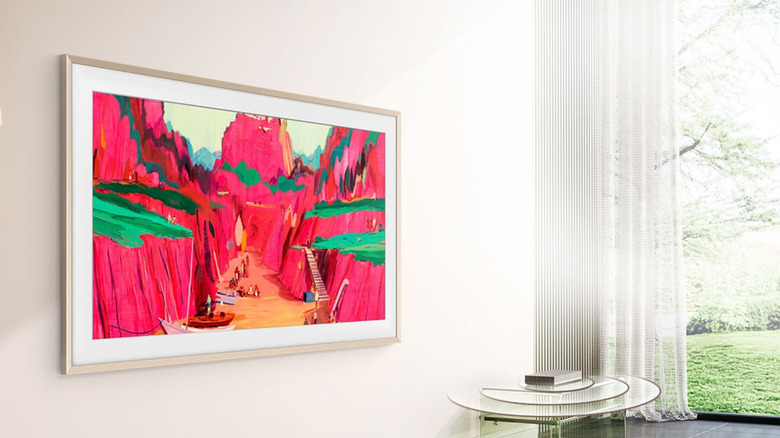
Back in the 20th century, when TVs were bulky cathode-ray-tube affairs, some people hid them in cabinets. You'd walk into their living room, and the sofas were turned to face what was apparently a small cupboard. Samsung's Frame TV is the modern-day equivalent. Introduced in 2017, it was the first television designed to look like a piece of art when not in use. It immediately found its market with people who don't want a big TV hanging around in their otherwise beautifully furnished house looking all "televisiony".
The distinguishing features of The Frame — and other manufacturers' models that followed — are a glare-free matte screen, a choice of artworks, and an ultra-thin build that lies almost flush against the wall. There are surprisingly few competitors for Samsung's crown in the Art TV niche. In fact, there are really only two — TCL NXTVISION and Hisense Canvas. Although there will be a new Art TV on the block come Spring 2026 when Amazon releases its Ember Artline TV. There's also the impressively thin LG OLED Gallery Edition TV, but that's in a whole other bracket — with prices more than double those of The Frame.
While the TCL NXTVISION is a good TV, we think the Hisense Canvas is the best alternative to Samsung's Frame for smart-money shoppers. Like The Frame, it's a 4K QLED TV with a 3,840 x 2,160 resolution and a motion sensor to avoid wasting power. But the Hisense has a major advantage over Samsung's — it's considerably cheaper. It's also cheaper than the TCL NXTVISION. It outperforms The Frame in several areas, making it a smart choice for gamers and budget-minded art lovers. However, there are some trade-offs when it comes to picture quality.
The Hisense Canvas wins on price, art selection, and refresh rate

On Amazon, at the time of writing, the prices of both Hisense Canvas and Samsung Frame TVs have reductions of between 18% and 33%. The Canvas is available in four sizes, so you can choose between 55, 65, 75, and 85 inches, depending on how big you like your pictures, how much wall space you have, and how much you're prepared to spend. The 55-inch model currently costs $690 on Amazon, while the same-sized Frame costs $898. The 65-inch costs $851, the 75-inch is $1,398, and the 85-inch will set you back $1,898, compared to $1,598, $1,998, and $3,298 for the Samsung equivalents. They are all discounted right now, but even the full-price Canvases come out cheaper than reduced-price Frames.
The Hisense model also offers other advantages. While Samsung requires you to subscribe to its art app if you want a wider selection than its 30 or so free pictures, Hisense includes access to artworks in the price of the television. There isn't much information on Hisense's website about what you get — which is surprising when the ability to display art is one of its main selling features. Reviews say that there are around a thousand artworks available.
The Canvas also comes with a "frame", which is really a set of magnetic walnut-effect strips that clip on the edges of the television. It boasts a refresh rate of 144Hz, compared to The Frame's 120Hz, making it a better option for gamers. Another plus is that Canvas uses Google's smart TV operating system software, rather than Samsung's less well-known TizenOS. Plus, if you have any issues with it, you'll be pleased to have Hisense's two-year warranty rather than the 12 months you get with Samsung.
You may prefer The Frame's port handling and picture quality
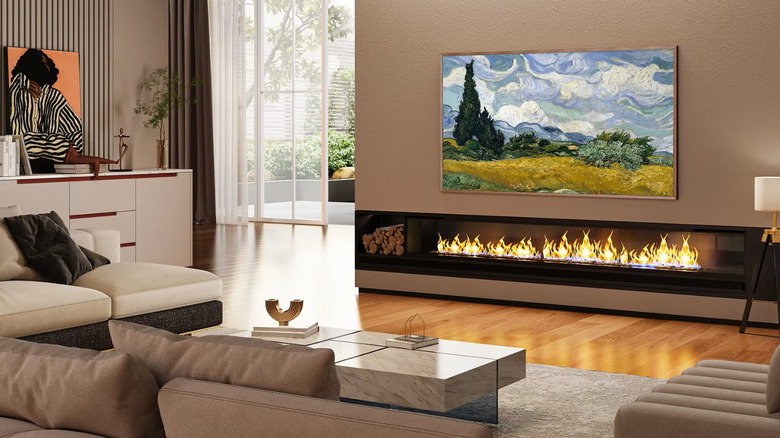
Choosing a Canvas TV over a Frame means you get a lot of benefits for a lot less money. However, there are some things that reviewers think that Samsung's model does better. While Samsung's Frame comes with a separate box that houses all the HDMI and USB ports, Canvas sticks to the traditional method of having all the ports in the back of the TV. This means that if you're connecting devices, like game consoles, you are going to have several unsightly wires ruining the pretense that it's a framed piece of art. You can hide wires by strategically arranging ornaments, buying a cord hider, or drilling a hole in the wall and pushing your cables through. Having all the cable ports in the back means that the Canvas is slightly bulkier than The Frame. It's still thin but doesn't quite match the flat-against-the-wall picture frame appearance of The Frame.
The biggest deciding factor between the two TV brands, though, is picture quality. While Hisense's Canvas gets some positive feedback, many people believe that the picture quality on the Samsung TV is noticeably better. RTINGS said, "The Samsung has better contrast and is brighter in HDR." ZDNet's reviewer remarked of the Hisense Canvas, "The viewing angles are also not ideal, with colors fading quickly if you're not directly facing the center of the TV." What Hi-Fi summed it up by stating, "the Canvas TV's picture quality is a real disappointment".
While the Hisense Canvas certainly wins on price, if you're serious about picture quality, it might be worth a trip to your local bricks-and-mortar retailer. That way, you can check out both TVs side-by-side and see exactly what you're getting for your money.
Methodology

In writing this article, we had to select a viable alternative to Samsung's Frame that would appeal to smart money shoppers. Although many modern TVs are capable of displaying images, we decided to focus on those brands and models which were specifically designed to double-up as framed artworks. The Hisense Canvas was selected as it is cheaper to buy than the TCL NXTVISION.
All specs were taken from Hisense and Samsung's websites. Prices were taken from Amazon.com and were correct at the time of writing, although these are, of course, subject to change. Samsung also includes prices for direct purchases on its website, which were slightly more expensive than those on Amazon. While you can't purchase a Canvas directly from Hisense's website, it provides links to sellers, including Amazon, Walmart, and Best Buy. Again, Amazon had the cheapest prices for Canvas models.
To understand users' experiences, we consulted Reddit threads and Amazon reviews. We also read many professional reviews, including those on RTINGS.com, ZDNet, What Hi-Fi, CNN, Business Insider, and digital art seller, ArtForFrame.com. If you're planning to buy a new television, it's going to cost a lot of money — regardless of what model or screen size you go for — so we recommend conducting your own research as well, particularly as everybody's requirements are going to be different.